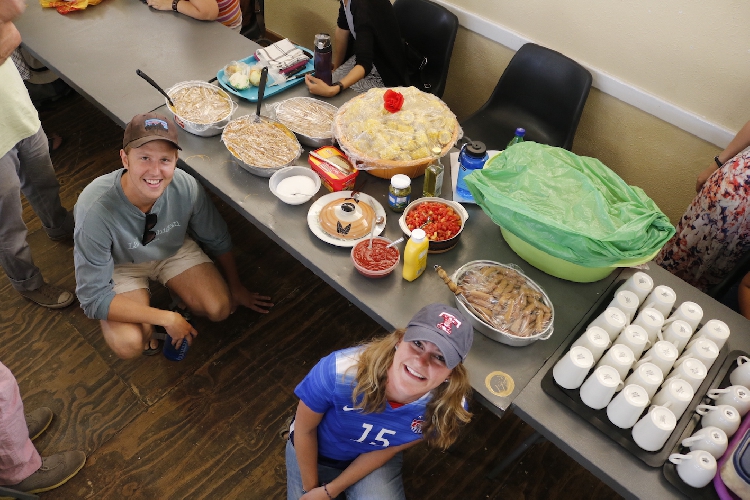
SHE clutches her bracelet and caresses the ring on her right hand.
She was given the jewellery by her grandfather and friends before leaving Oregon state in the United States of America two months ago.
Grace Mehlhaff (22), is one of the 50 Peace Corps volunteers who will help in Namibia’s health and education sectors for the next two years.
Armed with an education degree, she left her home for the very first time in her life after having been posted to Namibia, where she will teach mathematics and science at Tsumeb.
Excited, scared and nervous – these are the feelings that Mehlhaff experienced when she was introduced to her host family in Okahandja.
The host family was a temporary measure while she and others were undergoing training on how to integrate better into Namibian society.
Mehlhaff decided to be a Peace Corp volunteer while still in high school.
She said although she felt bad about leaving her family and friends behind, having no boyfriend made it easier.
“I love diversity, languages. It’s amazing how people coexist and are so friendly here,” she noted.
Her training included learning any local language of her choice or that of her host family, or the popular language spoken in the area where she might be deployed.
While living with the Van Wyk family, Mehlhaff has learned to eat various traditional dishes, and how to speak a bit of Damara/Nama.
“I have come to love fatcakes, biltong, tripe and pap. I have also learnt how to cook, and I will definitely cook pap when I go back,” she stated.
The Namibian spoke to another volunteer, Victoria Allworth, who will be teaching health sciences at Luderitz in southern Namibia.
Coming from Seattle, a rainy metropolitan city in the US, the 22-year-old had been a vegetarian for more than a decade, but changed that when she decided to come to Namibia.
“I read about Namibia, and I knew that meat is a big deal here. I appreciate how Namibians eat the whole animal, and the culture behind cooking,” she noted.
The vibrant Allworth said she is looking forward to teaching in Luderitz, and is glad that it is at the coastal area as this would help her feel closer to home.
“While still in high school, one of my teachers told me it would do me good to get perspective, so here I am. I have come to love how people are so friendly, and greet each other on the street. This does not happen back home,” said Allworth.
When asked about leaving her family and boyfriend behind, Allworth said she realised that being a Peace Corps volunteer is a selfless thing to do.
Her host mother, Amy Springbok, said Allworth has been very open and active around her house, visiting her relatives across the road and playing with the children.
Speaking to The Namibian, acting training manager for Peace Corps Namibia, Joseph Maruti, said volunteers were expected to be posted to different towns across the country by yesterday.
He said the volunteers are between the ages of 22 and 62, and are required to have qualifications in whatever field they would be serving in.
“We just give them training so that they know how things operate in Namibia since this country is different, and things operate differently,” added Maruti.
He said being a volunteer helps one buy experience, share expertise, gain perspective and creates room for cross-cultural exchanges. There is no pay for such volunteers, except for a small stipend for their upkeep.
The Peace Corps programme is a volunteer programme run by the United States government, through which volunteers provide technical assistance through capacity building. Additionally, volunteers lead youth clubs and raise awareness about HIV prevention, maternal and child survival, AIDS care and treatment strategies and the rights of people with disabilities.
Since 1990, more than 1 500 volunteers have served in Namibia.
Currently, there are 33 Peace Corps volunteers serving in the health sector, 39 in education and 35 in community economic development, while 53 are currently going through training before deployment.
In an age of information overload, Sunrise is The Namibian’s morning briefing, delivered at 6h00 from Monday to Friday. It offers a curated rundown of the most important stories from the past 24 hours – occasionally with a light, witty touch. It’s an essential way to stay informed. Subscribe and join our newsletter community.

The Namibian uses AI tools to assist with improved quality, accuracy and efficiency, while maintaining editorial oversight and journalistic integrity.
Stay informed with The Namibian – your source for credible journalism. Get in-depth reporting and opinions for
only N$85 a month. Invest in journalism, invest in democracy –
Subscribe Now!