






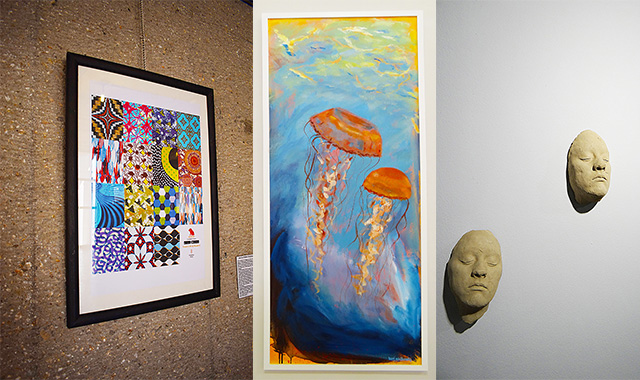
The Namibian visual art year tends to end the same way. The College of the Arts presents ‘Artsplash’ at the Katutura Community Arts Centre while the University of Namibia’s graduate exhibition adorns the walls of the Franco-Namibian Cultural Centre and the National Art Gallery of Namibia.
The same is so for 2018. A year that began with Masiyaleti’s Mbewe’s multi-disciplinary and inclusive exploration of future blackness in ‘The Afrofuturist Village’ a few weeks before Hildegard Titus’ contemporary consideration of Namibia’s born-frees raised issues of identity and legacy amidst a growing tide of -isms at the Goethe-Institut.
Kickstarting the visual art year with slickly produced and analytical offerings, Mbewe and Titus joined this year’s wave of blossoming conceptual photographers such as Sam Matengu, who brought us an edgy ultra-violet ‘Black Light Portrait Party’ before co-founding the fledgling Namibia Arts Fair.
With conceptual photographers growing wings, so, intermittently, did other visual artists.
The NJE Collective investigating ‘Trauma and Identity’ at the Cape Town Art Fair and Gallery One11. Photographer and multimedia artist Nicola Brandt whose written dissertation ‘Emerging Landscapes’ exploring “recent histories in contemporary southern African lens-based practices” is upcoming with Bloomsbury Publishing. Erik Schnack and Madryn Cosburn, who reflected on the “paradoxical relationship between technological advancement and humankind” in ‘Wired”s family of upcycled cyborgs.
A selection of the NAGN’s ‘Booth’ artists deftly disrupting the white cube as well as Marita van Rooyen, who partnered with Ju/’Hoansi San and #Aonin Topnaar communities to assist in showcasing and preserving their knowledge of plant-based traditional medicine in cyanotypes in ‘The Elders Called it Medicine’.
A year in which Pieter Basson let light flow in ‘Divine Intervention’, Indonesian artist Feeza Jazri presented beautiful ‘Splashes of Memory’ and sculptor Tafadzwa Gatsi honoured single mothers in ‘Nurture’, the exhibition arena was as busy as ever with events like Art Battle, a series of competitive live painting events, electrifying the scene before the Franco-Namibian Cultural Centre’s Wakpon revelation showcased the potential of augmented reality in the appreciation of African art.
Regularly scheduled and retrospective in ‘Tulipamwe Now and Then’, 2018 also offered Helga Kohl’s ‘Perspectives’, Chris Johnston’s ‘Favosrites’ at the Omba Gallery, Lok Kandjengo’s ‘Mastermind’, Lynette Diergaardt’s ‘Mind to Hand’, Alex Bracht’s ‘A World Unwell’, ‘Annie Olivier’s ‘Dusk Till Dawn’, Lara Diez’s ‘Pressed’ at The Project Room, Julia Hango’s ‘Manifestations of the Self’ and Alpheus Mvula’s ‘Heads of Cattle’ amongst the year’s memorable solos.
Succeeding in the confluence of concept and consciousness, Isabel Katjavivi’s reflection on the Herero-Nama genocide in ‘They Tried to Bury Us’ was particularly pertinent with Ngavee Kambezunda presenting promising sculptural work on theme before co-creators Shomwatala Shivute and Nelago Shilongoh closed the year with the interrogative, post-colonial and patriarchy defying ‘Ma Ndili’.
Instructive in Heritage Week’s myriad art demonstrations, bringing art to the public in Cota’s uplifting ‘Project Week’ and reverent in a multi-disciplinary celebration of John Muafangejo after the Omba Arts Trust’s honouring of late !Kung and Ju/’hoansi artists at the Art-i-San gallery, the local visual art scene was certainly up and at it with Snobia Kaputu taking up the reins as the new CEO of the NAGN and the Namibia Arts Association opening their new gallery and headquarters on Macadam Street.
As for feature film, it was largely a year teasing the cinema incoming in the next one.
With the filming of Michael Pulse and Desiree Kahikopo’s ‘The White Line’, promotion of Oshoveli Shipoh’s ‘Hairareb’ as well as a year-long social media campaign chronicling the making of Tim Huebschle’s ‘Land of the Brave’, 2018 previewed 2019 with all the savvy one would expect of the social media age.
Featuring the premiere of Lavinia Kapewasha and Jenny Kandenge’s Namibian millennial web series ‘Untitled’, Namib Mills’ sitcom ‘The Polanas’ as well Luis Munana’s ‘Waka Waka Moo’ finding a home on NBC, Namibia’s budding television industry also seemed astir.
In terms of garnering attention abroad, Tim Huebschle’s ‘Another Sunny Day’ was perhaps the most well-travelled. With the documentary about a man with albinism’s unique perspective on sunlight featured at 15 festivals around the world, Namibian narratives reached far and wide with the director’s ‘Oom Land’ one of the top 10 films in this year’s Discovery Channel South Africa’s ‘Don’t Stop Wondering’ competition.
Also making waves in South Africa after her Namibia Film Commission funded stint at the National Film and Video Foundation’s (SA) Youth Film-maker Project, local film-maker Mikiros Garoes premiered ‘Chommies’ at the Durban International Film Festival (DIFF) while Kahikopo joined some of the continent’s most promising film-makers at Talents Durban, a five-day DIFF intensive.
Developing talent here at home, initiatives such as KinoNamia invited film-makers to make short films in 48 hours while the NFC launched the N!xau Toma Film Fund, named for ‘The God’s Must Be Crazy”s N!xau Toma to fund African feature films with Namibian co-producers.
Also hosting a six-day film-makers’ alternative funding workshop with Los Angeles’ Rodney Charles and Yasmin Rams, the NFC evidenced a renewed focus on development with the Women in Film luncheon and the Namibia Film Commission expo highlighted by SA’s Nomzamo Mbatha speaking on new ways of financing film and television narratives.
A year which saw radio presenter Sally Jason, film-maker Esther Beukes and multimedia and communications agency director Ashivudhi Nghidipohamba selected as Namibia’s Multichoice Talent Factory stars, writer-director Perivi Katjavivi direct an episode of Thishiwe Ziqubu’s acclaimed ‘Emoyeni’ and Jana Bruckner’s ‘The Girl from Wereldend’ find producers in Stage Five Film’s Dylan Voogt and Germany’s Die Gesellschaft DGS, there is little doubt that while 2018 was scant on new Namibian film premieres, our makers have been hard at work.
Including writer-director Philippe Talavera who premiered ‘Kukuri’, a film about child marriages, this year before walking the red carpet at the Africa Magic Viewers Choice Awards as a best film (southern Africa) nominee for ‘Salute.’
A fertile visual art year including a Japanese Film Festival, local screenings of conservation/wildlife documentaries such as ‘The Vanishing Kings’, ‘The Poachers Pipelines’ and a call for auditions for Florian Schott and Girley Jazama’s ‘Baxu and the Giants’, 2018, particularly in the film industry, was a time of work and ends with a showcase of 33 local films, delightfully curated as ‘Namflix’, on One Africa TV from 15 to 28 December.