


Windhoek, 27 October 2025
Good morning,
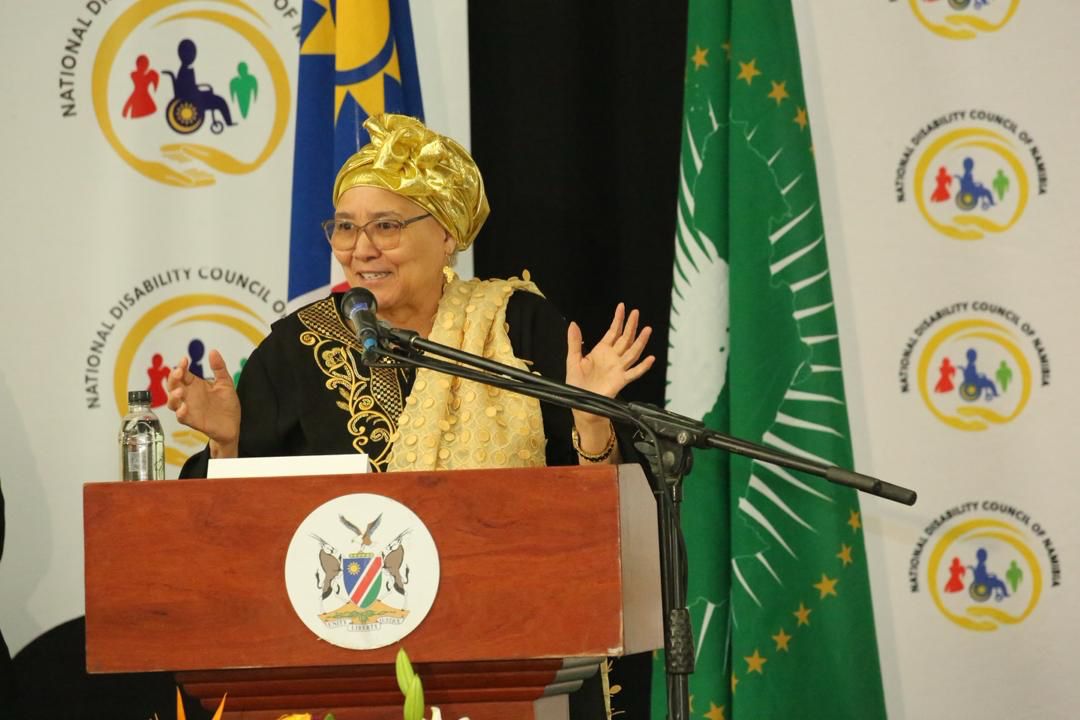
It is a great honour and privilege that I stand before you today at this memorable occasion – the official launch of the Revised National Policy on Disability 2025-2035 and its Costed Implementation Plan.
Today’s gathering is a moment of renewal, reflection, and reaffirmation. It is a moment when Namibia once again commits itself to the full inclusion, participation, and empowerment of persons with disabilities as equal citizens of our country.
When the first National Policy on Disability was adopted in 1997, it provided a foundation for coordinated action and awareness. It was a milestone at the time, the first of its kind in post-independent Namibia. However, as years passed, we recognised that society had progressed, the world had advanced, and our understanding of issues of disability had deepened.
The adoption of the United Nations Convention on the Rights of Persons with Disabilities in 2007 and Namibia’s ratification thereof signalled a global shift from considering disability as a welfare issue to understanding it as a human rights and development issue.
Therefore, this evolution called for an updated, modern, inclusive, and rights-based policy framework that reflects the real experiences of Namibians with disabilities throughout our country.
The Revised National Policy on Disability that we are launching today replaces the 1997 policy and firmly anchors Namibia’s commitment to the principles of equality, dignity, and non-discrimination. It is built on the understanding that disability is not a limitation of the person, but rather a reflection of the barriers created by society – barriers in the physical environment, communication, education, employment, and sometimes, in our attitudes.
By embracing a rights-based approach, this policy ensures that persons with disabilities are no longer viewed as recipients of charity, but as active citizens, leaders, and contributors to the cause of our national development. This is not only a matter of social justice; it is a matter of economic and moral necessity. We will not successfully achieve the developmental objectives of Vision 2030, the Sustainable Development Goals, or the National Development Plan 6 if, as a country, we leave behind a segment of our people.
It is on this basis that the Swapo Party Election Manifesto’s implementation plan declares that our government’s agenda must be aimed towards improving the lives of all our citizens through economic emancipation and social inclusion. Therefore, persons with disabilities, through this revised policy, are worthy of inclusion in the developmental agenda of our government.
The revision of the 1997 policy was not merely a formality. It was a national dialogue involving persons with disabilities, their representative organisations, policymakers, service providers, and development partners. The process revealed key challenges that persons with disabilities continue to face, for example limited access to education and employment, inadequate healthcare services, inaccessible infrastructure, and underrepresentation at decision-making levels.
This revised policy therefore aims to close these gaps by creating a framework that guarantees equal access, participation, and protection from discrimination in every aspect of life. It speaks directly to our constitutional values and to Namibia’s commitment to human dignity, equality before the law, and freedom from discrimination.
The Costed Implementation Plan – Turning Words into Action
A policy is only as strong as its implementation. The Costed Implementation Plan that accompanies this revised policy is therefore a powerful tool – a roadmap that transforms commitments into measurable actions. It clearly defines what needs to be done, by whom, when, and with what resources. It allocates responsibilities across government ministries, regional councils, and local authorities, aligning budgets and timelines to ensure accountability.
Through this plan, Namibia is saying: we are serious about results. We are moving from policy statements to policy delivery, from promises to performance. Therefore, this revised plan identifies priority areas such as:
- Access to inclusive education at all levels
- Employment and economic empowerment opportunities
- Accessible healthcare and rehabilitation
- Infrastructure and transport accessibility
- Inclusive disaster risk management
- Empowerment of organisations of persons with disabilities and caretakers
- Representation in decision-making
- Strengthening the capacity of the disability sector itself
Each of these policy objectives is costed, monitored, and evaluated as practical strategies to ensure that the rights of persons with disabilities are not aspirational, but actionable. Thus, I call on the government and the private sector to reconsider funding for disability-related programmes, and for each office, ministry, and agency to implement disability-centric budgeting to ensure the realisation of these policy objectives.
The launching of this revised policy today is not the end of the process, but the beginning of a new era of partnership and accountability. Government cannot walk this path alone. The implementation of this policy will require the active participation of every sector, ministry, regional and local authority, the private sector, academia, civil society, and persons with disabilities themselves. I therefore call upon all of us to work together to integrate disability inclusion into our strategic plans, budgets, and programmes.
The principle of ‘Nothing About Us Without Us’ must guide our actions. Persons with disabilities should not be consulted as an afterthought, but should be involved from planning to implementation, from monitoring to evaluation.
As a government, our appreciation goes to the National Disability Council of Namibia for leading this important process with dedication and vision. Its tireless advocacy and technical input, as well as the contributions of organisations of persons with disabilities, have shaped this policy. Our gratitude also goes to the United Nations systems in Namibia, our development partners, and civil society organisations that provided technical and financial support to this process.
As we move forward, let us remember that disability inclusion is not a favour – it is a fundamental part of human development. When we make our schools accessible, we educate every child. When we make our workplaces inclusive, we grow our economy. When we make our towns barrier-free, we build a Namibia for all. Every ramp, every sign language interpreter, every accessible document, and every inclusive policy is a step toward realising the Namibia we all want to see – a Namibia where every citizen, regardless of ability, can live with dignity and contribute meaningfully to national development.
As we launch this revised policy and its implementation plan, let us do so with commitment and conviction. Let us turn our promises into action, our aspirations into outcomes, and our inclusion into transformation. Let this policy serve as a reminder that progress is not measured by how far the strong have advanced, but by how far the marginalised have been empowered to move forward with them. Together, let us build a Namibia that leaves no one behind – a Namibia that sees ability in disability, strength in diversity, and unity in inclusion.
Having said that, it is now my honour to officially launch the Revised National Policy on Disability and its Costed Implementation Plan.
I thank you.
In an age of information overload, Sunrise is The Namibian’s morning briefing, delivered at 6h00 from Monday to Friday. It offers a curated rundown of the most important stories from the past 24 hours – occasionally with a light, witty touch. It’s an essential way to stay informed. Subscribe and join our newsletter community.

The Namibian uses AI tools to assist with improved quality, accuracy and efficiency, while maintaining editorial oversight and journalistic integrity.
Stay informed with The Namibian – your source for credible journalism. Get in-depth reporting and opinions for
only N$85 a month. Invest in journalism, invest in democracy –
Subscribe Now!