


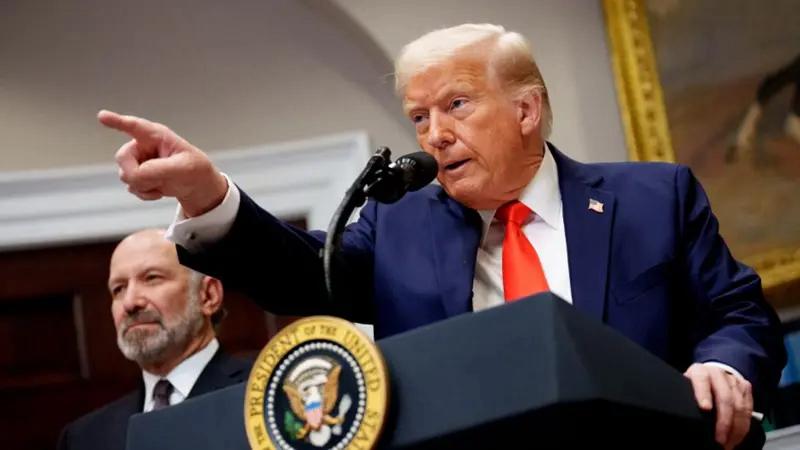
President Donald Trump has announced a 90-day pause for countries hit by higher US tariffs but a trade war with China has escalated.
In a dramatic change of policy, just hours after levies against roughly 60 of America’s trading partners kicked in, Trump said he was authorising a universal “lowered reciprocal tariff of 10%” as negotiations continued.
At the same time he increased tariffs on goods from China to 125%, accusing Beijing of a “lack of respect” after it retaliated by saying it would impose tariffs of 84% on US imports.
This comes a week after Trump announced import taxes on all goods entering the US, in the biggest upheaval of international trade in decades.
His plan set a baseline tariff of 10% on all imports – which remains in place – but also higher rates on partners the White House described as the “worst offenders” for what the president considers to be unfair trade practices.
This included the 27-member European Union, Vietnam, South Africa and many more – all of which were due to be on the receiving end of US tariffs ranging from 11% to more than 100%.
Major market turmoil followed Trump’s announcement last week, with sell-offs sparking trillions in losses across the world, many Americans fearing price rises and some analysts predicting increased odds of recession.
On Wednesday, before Trump said he would suspend the higher tariffs on goods from countries other than China, the US government saw interest rates on its debt spike to 4.5% – the highest level since February.
Hours later, when the change was announced, US shares rocketed with the S&P 500 soaring 7% in afternoon trading. It later closed the day’s trading up 9.5%, while the Dow Jones surged by 7.8%.
Announcing the latest iteration of his plan on Truth Social, Trump said he was authorising a 90-day pause on tariffs for the countries that had not retaliated against his levies.
The additional tariff on Beijing, he said, would be effective immediately.
“At some point, hopefully in the near future, China will realise that the days of ripping off the US, and other countries, is no longer sustainable or acceptable,” he wrote.
US treasury secretary Scott Bessent insists the change of policy had not been influenced by the global falls, but senior Democrat Chuck Schumer says the decision showed Trump was “reeling and retreating”.
Speaking outside the White House, Trump later said the amendments to his tariffs policy had “had to be done” because people were “getting yippy”.
“I did a 90-day pause for the people that didn’t retaliate because I told them ‘if you retaliate, we’re going to double it’ – and that’s what I did with China,” he said, adding that he thought, “It’s all going to work out amazing.”
He also said he thought Chinese president Xi Jinping was “going to want to get to a deal”.
In the UK, which was not affected by the changes as it was already on the list of countries receiving the baseline 10% tariff, a No 10 spokeswoman said a “trade war is in nobody’s interests”.
A source also says the developments in Washington showed “cool and calm can pay off”.
The ongoing stand-off between China and the US – the world’s two biggest economies – began when Trump announced new tariffs last week.
China was hit with an additional 34% tariff, on top of a 20% levy the president had put in place earlier this year. However, Beijing was quick to retaliate with a 34% tariff on US imports to China.
In response, Trump threatened an additional 50%, bringing the total to 104% on Tuesday, if Beijing did not back down. China did not change course and said it would “fight to the end” if the US “insists on provoking a tariff war or trade war”.
Just hours after the 104% tariffs from the US kicked in earlier, Beijing announced it would raise its own tariffs on American goods from 34% to 84% from Thursday.
China’s foreign ministry spokesman Lin Jian said on Wednesday the US “continues to impose tariffs on China in an abusive manner”.
He said China opposes such “bullying practices” and the US must show “an attitude of equality, mutual respect, and reciprocity” if it hopes to resolve issues through negotiation.
The deteriorating relationship between the two nations could see their goods trade fall as much as 80% – a $466 billion drop, according to World Trade Organisation (WTO) forecasts.
“Our assessments, informed by the latest developments, highlight the substantial risks associated with further escalation,” WTO head Ngozi Okonjo-Iweala says.
Away from China, Trump’s latest plans have not affected other recently-announced tariffs already in play.
These include the 25% import taxes on cars and car parts coming into the US, which came into effect on 2 April, and a further 25% tariff on all steel and aluminium imports.
Earlier on Wednesday, the European Union approved a first set of retaliatory tariffs against the US, due to take effect on 15 April. The bloc, on Trump’s “worst offender” trading partner list, had been due to receive customised tariffs of 20%.
But because the EU’s retaliatory tariffs had not yet gone into effect, the White House included it on the list of countries to be capped at 10%.
Meanwhile, the so-called baseline rate never applied to Canada and Mexico – key trading partners of the US – and a White House official has said neither is in line to receive the 10% baseline tariff now.
– BBC
In an age of information overload, Sunrise is The Namibian’s morning briefing, delivered at 6h00 from Monday to Friday. It offers a curated rundown of the most important stories from the past 24 hours – occasionally with a light, witty touch. It’s an essential way to stay informed. Subscribe and join our newsletter community.

The Namibian uses AI tools to assist with improved quality, accuracy and efficiency, while maintaining editorial oversight and journalistic integrity.
Stay informed with The Namibian – your source for credible journalism. Get in-depth reporting and opinions for
only N$85 a month. Invest in journalism, invest in democracy –
Subscribe Now!