



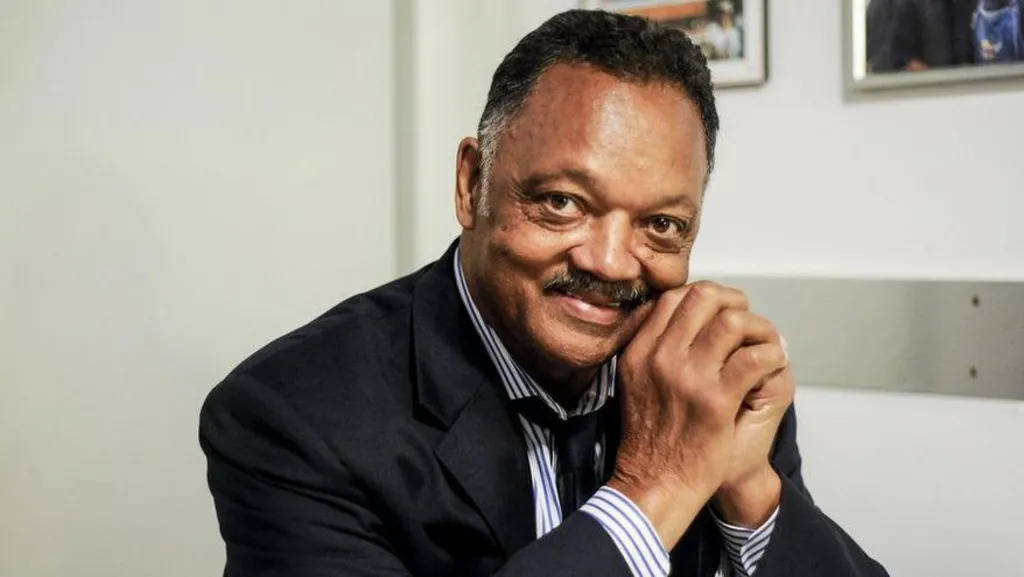
Veteran United States (US) civil rights activist reverend Jesse Jackson died on Tuesday, his family said in a statement. He was 84.
“His unwavering belief in justice, equality, and love uplifted millions, and we ask you honour his memory by continuing the fight for the values he lived by,” Jackson’s family said.
As a close associate of Martin Luther King Jr in the 1960s, a dynamic Black orator and a successful mediator in international disputes, the longtime Baptist minister expanded the space for African Americans on the national stage for more than six decades.
Jackson was present for many consequential moments in the long battle for racial justice in the US.
He was with King Jr in Memphis in 1968 when the civil rights leader was slain; openly wept in the crowd as Barack Obama celebrated his 2008 presidential election; and stood with George Floyd’s family in 2021 after a court convicted an ex-police officer of the unarmed Black man’s murder.
“My constituency is the desperate, the damned, the disinherited, the disrespected, and the despised,” Jackson told the 1984 Democratic National Convention.
He rose to prominence in the 1960s as a leader in King Jr’s Southern Christian Leadership Conference.
He launched two social justice and activism organisations: Operation Push in 1971, and the National Rainbow Coalition a dozen years later. The two groups merged in 1996.
It was Jackson’s presidential runs – and one 1988 speech – that caught many Americans’ attention and ensured that African American issues became fundamental to the Democratic Party platform.
His debut White House campaign supported a massive jobs expansion, ending the nation’s “war on drugs” and its mandatory minimum sentences for drug users, and improving equality for women and minorities.
Jackson finished third in the 1984 Democratic primaries – behind former vice president Walter Mondale and runner-up Gary Hart – making him the most successful Black presidential candidate until Obama.
Mondale was trounced by Ronald Reagan in that year’s general election.
Four years later, Jackson was back on the convention stage after coming in second to nominee Michael Dukakis, urging Americans to find “common ground.”
“That’s the challenge of our party tonight. Left wing, right wing… It takes two wings to fly,” he said, in a cadence reminiscent of King Jr’s.
Jackson attacked what he called the “reverse Robin Hood” of a Reagan presidency that bestowed riches on the wealthy while leaving poor Americans struggling.
“It gets dark sometimes, but the morning comes. Don’t you surrender,” he said as the crowd roared.
While his electric speech raised Jackson’s profile, the nation’s gradual tilt to the right deprived him of major political influence in later years.
And though his accomplishments were pioneering, his work was also tarnished by controversy.
In 1984, he described New York as “Hymietown,” using a pejorative term for Jews.
One of Jackson’s sons, former US congressman Jesse Jackson Jr, served prison time after pleading guilty in 2013 to taking some US$750 000 (about N$11.9 million today) in campaign money for his personal use.
Jackson’s personal story began with hardship.
He was born Jesse Burns on 8 October 1941 in Greenville, South Carolina, to an unwed teen mother and a former professional boxer.
He later adopted the last name of his stepfather, Charles Jackson.
“I was not born with a silver spoon in my mouth. I had a shovel programmed for my hands,” he once said.
He excelled in his segregated high school and earned a football scholarship to the University of Illinois, but later transferred to the predominantly Black Agricultural and Technical College of North Carolina, where he received a degree in sociology.
In 1960, he participated in his first sit-in in Greenville, and then joined the Selma-to-Montgomery civil rights marches in 1965, where he caught King Jr’s attention.
Jackson later emerged as a mediator and envoy on several notable international fronts.
He became a prominent advocate for ending apartheid in South Africa, and in the 1990s served as presidential special envoy for Africa for Bill Clinton.
Missions to free US prisoners took him to Syria, Iraq and Serbia.
But he ruffled some feathers in 2005 when he met in Venezuela with Hugo Chavez, and then spoke at the strongman’s funeral in 2013.
Jackson announced in 2017 that he was battling Parkinson’s disease, and he began curtailing his public engagements.
But he stood with Floyd’s family at their April 2021 press conference when a Minneapolis jury convicted Floyd’s killer.
The verdict brought “relief, but not a time for celebration,” Jackson told the Australian Broadcasting Corporation.
“It’s a long struggle for racial equality in this country.”
– AFP via IOL NEWS
In an age of information overload, Sunrise is The Namibian’s morning briefing, delivered at 6h00 from Monday to Friday. It offers a curated rundown of the most important stories from the past 24 hours – occasionally with a light, witty touch. It’s an essential way to stay informed. Subscribe and join our newsletter community.

The Namibian uses AI tools to assist with improved quality, accuracy and efficiency, while maintaining editorial oversight and journalistic integrity.
Stay informed with The Namibian – your source for credible journalism. Get in-depth reporting and opinions for
only N$85 a month. Invest in journalism, invest in democracy –
Subscribe Now!