


“OTSHEE Tshetweeta? Omagongo. Otshee tshetweeta? Omagongo”. So goes the song, which when translated, simply means, “what brought us here?”, and the women respond “Omagongo (marula brew)”.
The scene was one of a joyous occasion at the Uukwaluudhi Traditional Authority’s palace at the Onalushwa village near Tsandi in the Omusati region. This festival lasted from Friday to Saturday, uniting the eight Aawambo communities of northern Namibia through the consumption of omagongo, a beverage brewed from marula fruit.
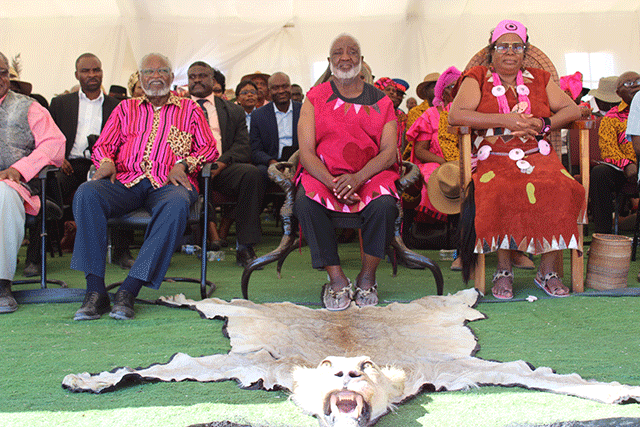
Colourful, traditional outfits were the order of the day. Most were proudly clad in shirts and skirts made out of their respective traditional designs. The men added traditional hats to match their outfits. Those from the Zambezi region were donning skirts and dresses bearing the face of Mafwe chief George Mamili the 7th. Some draped the cloth bearing the chief’s face and the elephant, a symbol of power and endurance for the Mafwe people, around their shoulders and on their heads.
The festival was attended by a large number of national leaders, representatives of traditional authorities from across the country, and thousands of local community members. This year’s festival is held under the theme “Promoting development through intangible cultural heritage”.
Founding President Sam Nujoma is the guest of honour.
Although the event was scheduled to start at 09h00. By 11h15, however, the king of Uukwaluudhi, Josia Shikongo Taapopi, arrived with his wife, Nandjala Taapopi. The people were unbothered by the time delay. The dances capture united Namibian tribes. Former President Hifikepunye Pohamba was also there. There was the cheerfulness of a festival in the air. One sensed it in the singing and the dances. It was the Omagongo Cultural Festival.
The respected elders sat in a tent. The king had his own special seat next to where his wife and other notable people were seated. He was ushered into the tent. Ululations, songs and chants continued as he took his seat. A lion skin is laid in front of him. People entering or leaving the tent bow to the king as they came and went, in a sign of respect.
The unified marula festival was the brainchild of Nujoma, who initiated it to help Namibians keep up with culture, and to celebrate their cultural heritage. It was first held in 2001. It is hosted on a rotational basis by the eight traditional authorities of Aawambo.
Last year, the festival was held at Uukwambi, and will move to Ongandjera next year. The marula festival is the first Namibian festival to be recognised by Unesco.
It is an example on how intangible cultural heritage can unite communities, preserve traditions and enrich people’s lives, said Unesco country representative, Jean-Pierre Ilboudo.
“It showed us that culture is not only about dancing and singing. Culture is lifestyle. It is immersing in the daily life of local people,” Ilboudo said as he addressed the people.
The Tjekushwama Cultural Group put on a show. The aim was to educate those in attendance about the marula beverage’s brewing process. In preparation for the festival, men carved wooden cups and tools from animal horns to pierce the fruit. Women made the baskets and clay pots used for processing omagongo. The omagongo season is normally during the rainy season of mid-January to mid-March.
On this Saturday, it was all a showcase. The fruits turned yellow as they ripen. The women use a sharp object fashioned from animal horns to squeeze the juice out, which was then stored for up to three days in traditional clay pots to ferment before consumption.
On the day, this group of Namibians celebrated a piece of their heritage, their identity and a way of life, embracing all cultures, while eagerly waiting to consume the marula brew.
In Uukwaluudhi, women are not allowed to drink omagongo, even though they prepare it. Only the men consume the brew openly, and the women have to steal some to get a taste.
National Council chairperson Margaret Mensah-Williams, who was also in attendance, said: “I am a Namibian. Culture is the backbone. It does not matter the background. Inherently, we are all from somewhere. That makes us who we are. We are diverse. Together, we can unite through culture and become one Namibia.”
Elizabeth Nambahu, from Ongandjera, said she learned how Mafwe people greet their chief, and expressed happiness at the presence of various ethnic groups at the festival.
Nambahu wants children to attend such events as she feels the youth are losing out on valuable aspects of their cultures. “Older people are growing old and phasing out. The youth need to keep bearing the torch,” she added.
Prime Minister Saara Kuugongelwa-Amadhila said colonialism made Africans disrespect and hate their own cultures, so much so that “most people believe if they do not speak their mother tongues or do not eat traditional food, then they are advanced”.
“It is important for us as parents to teach our children their forefathers’ norms and traditions; to make sure they are proud and to take it forward,” she said.
As the day wears on and the people sweated in the sun, the king and his prominent guests departed for lunch, while the entertainment continued. There are plans for the festival to grow even bigger next year, as it is passed on to the Ongandjera Traditional Authority.
In an age of information overload, Sunrise is The Namibian’s morning briefing, delivered at 6h00 from Monday to Friday. It offers a curated rundown of the most important stories from the past 24 hours – occasionally with a light, witty touch. It’s an essential way to stay informed. Subscribe and join our newsletter community.

The Namibian uses AI tools to assist with improved quality, accuracy and efficiency, while maintaining editorial oversight and journalistic integrity.
Stay informed with The Namibian – your source for credible journalism. Get in-depth reporting and opinions for
only N$85 a month. Invest in journalism, invest in democracy –
Subscribe Now!