



For many people, the last time they actually felt comfortable being fully nude was when they were born. The older we get, the more self-conscious and shy we become, save for a few Namibian indigenous groups like the Himba, and parts of the San Community.
Nudity makes sense historically in Namibia because let’s face it, more times than not, Namibia’s weather is extremely hot and wearing layers of clothes doesn’t make that much sense except in the few short months when winter decides to grace us with its chilly presence.
When Christianity descended upon Namibia, so did more layers of clothes, as those who brought us the church and the Bible thought that modesty was needed. Fast forward a few hundred years or so, and most of us are pretty bashful about nudity, beyond being in the shower, and even then some gawk at our reflections in the mirror and pick what see apart.
“I could lose a few kilos!”
“Ugh! So much cellulite… Is that a new stretch mark?”
With our extra layers of clothes has come an extra layer of body and self-image criticism, and being far removed from our minimal clothing beginnings, even the idea of looking at nude art work sends us into a frenzy and makes us dub it pornography.
Unless you are Julia Hango, of course. Widely known as JuliArt, the 23-year-old photographer and performance artist is anything but shy of the human body.
In November 2015, she built a giant replica of a vagina as the entrance to her exhibition titled ‘The Womb Of It All’ at Jojo’s Music and Art Café. Visitors had to walk through it to get into the exhibition – giving new meaning to the term rebirth.
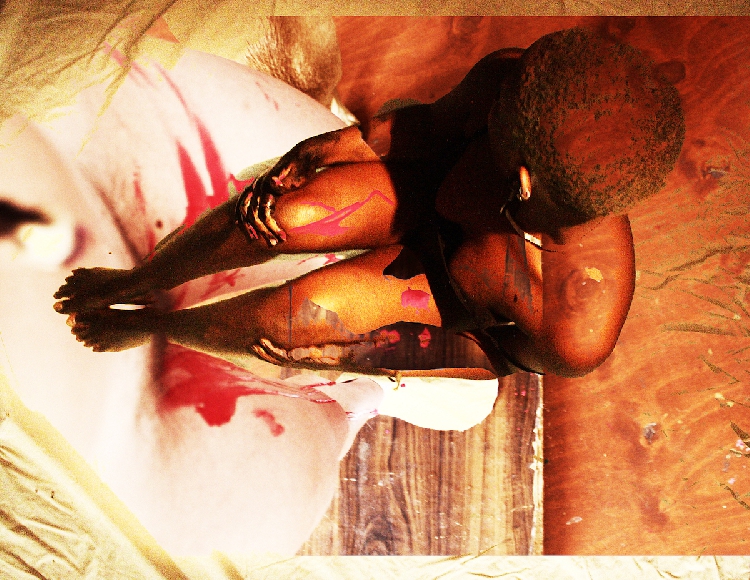
This year, she had held an exhibition at the Franco-Namibian Cultural Centre’s Restaurant la bonne table titled ‘Naked Spaces’, a photography series that documents the spaces in which Namibian people feel most comfortable being naked.
The artist defines nudity as “freedom, expression, freedom of expression, freedom to just be and then express and letting go”.
Branching out from her usual subjects of friends and family, Julia decided to photograph people she hasn’t met before.
“It was really important for me to create a safe platform for people in my community and around the country to volunteer themselves to this social experiment,” she said.
“I am on a magical journey of self-realisation and expression, and I have narrowed it all down to being naked. Nude photography and visual stimulation.”
“Visual art are my main muses as I perform with every creation of series, projects and showcases to finding my truth.”
For a country that is somewhat conservative, the idea of nude photography would no doubt ruffle some feathers or turn people red with embarrassment, but the artist sees her work as a catalyst of conversation as she challenges people to be comfortable in their own skin.
“To me, self-love and embracing your body encompasses self-worth, self-belief, self-esteem, self-happiness and more,” she said.
But that does not come without its challenges and triumphs.
Online backlash is something that she has become familiar with, having had her Facebook profiles removed no less than 11 times.
“Once someone went through all my photos and reported over 20 images that resulted in me being banned and my account being deleted. Facebook asks you to send them your US issued ID, which of course I didn’t have. The first five times it happened, I had this feeling of being unwanted, but soon after that, it became pretty normal and I have gotten better at choosing who I let into my space for how long and recognising what their intentions are.”
Figuring out people’s intentions with her work isn’t solely confined to the online world, but something she has become adept at even at her exhibitions.
People coming to her exhibition in the hopes of being able to pick out how many people or models they can recognise speaks volumes about many people’s approach to nude photography. It also points to how Julia’s work should be welcomed as a fire starter in the national dialogue about nudity.
At previous exhibitions, she’s had some of her work removed due to people complaining about the nudity and another venue only put up her work after 18h00, so as not to upset some of their clientele.
Speaking to the curators Helen Harris, Ndeenda Shivute and Isabel Katjivivi from the National Gallery of Namibia on the concept of censorship in art spaces, they explain that galleries are spaces that allow an interface between artists and society. A space to provoke conversation, sometimes even at the expense of people’s comfort.
“We don’t educate people about facts but we encourage thought, discussion and debate.”
They shared an example from earlier this year when a ministry returned a nude sculpture to the gallery due to outcries from some members of the public. The piece wasn’t even up for a full week, but now has been returned to the gallery and joins other sculptures that decorate the exterior of the gallery.
With many different mediums and genres of photography to choose from, one might get curious about why Julia chooses nude photography.
“I am a nudist, I am naked 99% of my life inside. Outside, I do me. I also just love everyone’s naked body and I want to show the world just how beautiful everybody is.”
Julia cites activists, revolutionaries and provocateurs as a main outlet for her inspiration, because she too is exactly all of those things embodied.
In an age of information overload, Sunrise is The Namibian’s morning briefing, delivered at 6h00 from Monday to Friday. It offers a curated rundown of the most important stories from the past 24 hours – occasionally with a light, witty touch. It’s an essential way to stay informed. Subscribe and join our newsletter community.

The Namibian uses AI tools to assist with improved quality, accuracy and efficiency, while maintaining editorial oversight and journalistic integrity.
Stay informed with The Namibian – your source for credible journalism. Get in-depth reporting and opinions for
only N$85 a month. Invest in journalism, invest in democracy –
Subscribe Now!