


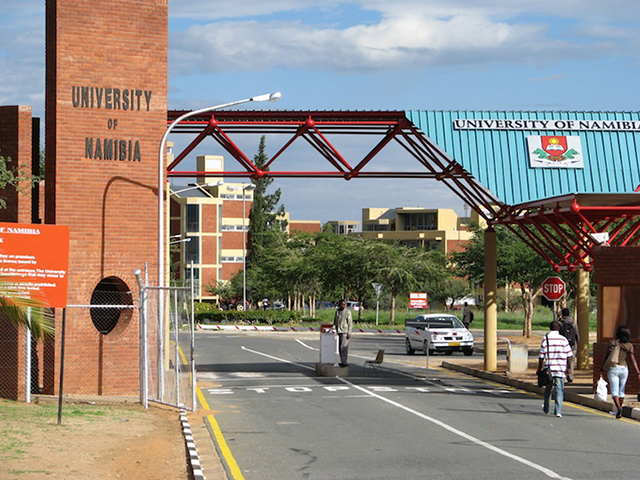
OKERI NGUTJINAZO and CHARLOTTE NAMBADJATHE University of Namibia says students will be required to write face-to-face examinations after months of not being on campus but this was met with indignation by the students.
Universities resorted to online learning after the country went on lockdown in March.
In a circular sent out on Wednesday, the institution stated that based on feedback from staff and students, and analysis of the first semester results and quality assurance considerations, assessment in all modules will revert to the original the senate approved. This implies that there will be no more 100% continuous assessment, except for those modules originally approved.
The circular further stated that the continuous assessment (CA) portion of the final mark will consist of online assessments as per the guidelines, as well as practical assessments where applicable.
All modules with a senate approved examination component will be written in the traditional set-up (face-to-face) for all final year modules and all modules in professional programmes regulated by a professional body. All modules that require students to write mathematical, chemical and statistical formulas as part of their answers will also be written exams.
“Examinations for all other modules will take place online using the translational model,” the circular read.
All CA marks will be announced on 30 October with students needing a mark of at least 40% to pass. Exams will then be written between 5 and 27 November, and supplementary exams will be written from 7 to 14 December.
This decision was not met well by the students. A group of students started a petition pleading with the university to reconsider its decision.
The petition has a target of 5 000 signatures and had already reached more than 3 000 signatures by yesterday late afternoon.
The Namibian could not establish who initiated the petition.
“Face to face examinations create stress… students require basic day-to-day interactions with colleagues and lecturers in order to grasp more than the limit we have experienced during the pandemic. Most work has been self-taught. Online classes should equivocate to online examinations,” the students said.
Unam’s spokesperson, John Haufiku, said they are aware of the ongoing petition but are yet to formally receive it. He, however, said they will wait to get it and give it due consideration and analysis.
“Whatever valid arguments students bring forward will be acknowledged and interact with. The data analysis from the first semester assessments indicates that there are challenges with certain qualifications for both staff and students,” he said. He added that the rationale for this decision is informed by sound insights from their data, and it’s not all students who will write face-to-face exams. This is only relevant for modules in the STEM fields of mathematical, chemical, and statistical formulas as well as modules regulated by a professional council and all final year modules.
All other students will use online exams, he said.
Haufiku further noted that the university is not a democracy, and it is not ruled by popular opinion, but by superior ideology that is supported by facts.
“So far, the facts clearly state that it is better to have some students do face-to-face and online assessments in the form of examinations and not only the continuous assessment as we tried during the first semester,” he sid.
President of the Student Union of Namibia Simon Amunime said they are in solidarity with the student leadership of Unam and the affected students, especially those in their final year.
“As the biggest academic institution in the country, Unam has a responsibility to consult students and make decisions inclusive of every registered student,” he said.
Amunime called on the management to have a uniform and standard modality in conducting the end year examination. He added that the same method of utilising the e-learning platforms amidst the Covid-19 pandemic must apply to all students.
Namibia National Student Organisation’s (Nanso) secretary for education, Malcom Kambanzera, said their obligation is to ensure that the students’ interests are placed on the highest pillar even if it means to take an unpopular stance.
Kambanzera added that the organisation welcomes Unam examination procedures. He added that the pandemic has forced the university to balance between assuring the working market that its graduates are of the same quality that was produced and ensuring the health and safety of students.
In an age of information overload, Sunrise is The Namibian’s morning briefing, delivered at 6h00 from Monday to Friday. It offers a curated rundown of the most important stories from the past 24 hours – occasionally with a light, witty touch. It’s an essential way to stay informed. Subscribe and join our newsletter community.

The Namibian uses AI tools to assist with improved quality, accuracy and efficiency, while maintaining editorial oversight and journalistic integrity.
Stay informed with The Namibian – your source for credible journalism. Get in-depth reporting and opinions for
only N$85 a month. Invest in journalism, invest in democracy –
Subscribe Now!