Windhoek’s erratic theatre scene isn’t precisely the place for revivals but Ndayola Ulenga’s ‘KoKo’ recently returned to the stage for its second season.
Premiering at Windhoek’s Theatre School last year after its initial conception during the Otjomuise Live Arts Festival in 2022, the one-woman theatre performance was staged at the new Goethe-Institut Namibia as a farewell, a fundraiser and a first.
The iteration presented to Friday night’s audience, many of them returning, is titled ‘Koko: Patulula’.
It’s the first play to be staged at the institute’s new building and Ulenga’s last performance before the actress begins her masters studies in the United Kingdom.
For those following Ulenga’s award-winning trajectory, ‘Koko: Patulula’s’ first act is familiar.
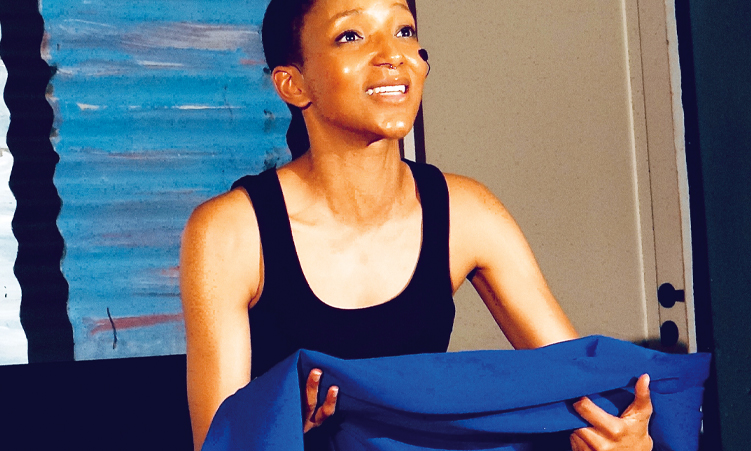
Ulenga takes the sparse stage with just a few strips of blue cloth and elements of a corrugated iron shack connoting her mother’s childhood Donkerhoek home.
Behind her, a map sets the scene of her father’s experiences as a member of the People’s Liberation Army of Namibia.
For Ulenga, this is more than enough to transport the audience to apartheid-era Namibia, through pivotal moments of the liberation struggle and to the present day where the actress makes a spirited plea for Namibians to continue witnessing, sharing and archiving Namibian stories.
Starring and written by Ulenga (NU Theatrics), directed by Dark Crown Productions’ Lavinia Kapewasha and featuring the proficient Chris Eiseb on percussion, ‘KoKo: Patulula’ digs deeper into the stories of Ulenga’s parents’ formative years.
Spellbinding in her embodied storytelling, movement, music and soaring original songs, the actress deftly weaves between maternal narratives humorously recounting the rules of township football to the tragedy that befalls the neighbourhood football star.
From her paternal history, Ulenga reimagines her father’s shooting and capture in combat against the apartheid regime.
While ‘KoKo’ previously ended here, ‘KoKo: Patulula’ introduces a second act.
In it, Ulenga highlights Robben Island not only as a site of unjust detainment of some of the Namibian liberation struggle’s most notorious actors but as a place of “intellectual renewal”.
The knowledge, alliances and organisation established at Robben Island are what sow the seeds of Namibia’s labour movement and the Namibia National Students’ Organisation, both of which push back against the injustices of apartheid.
Telling stories of post-Robben Island conscientisation, workers’ resistance at Lüderitz and at a Windhoek bread shop, as well as naming heroes such as Richard Pakleppa and Anton Lubowski, who used their white privilege for good, ‘KoKo: Patulula’ conjures a space of education, remembrance and memorial radiating from various gunshots.
The one that killed the family’s football star, another that preceded her father’s detainment on Robben Island and more that rang out at Ponhofi Secondary School in 1987, triggering a significant period of uprising and arrest.
To speak of all this, Ulenga uses her body, her superb singing voice and a humble blue cloth that is a backpack, a rifle and a dead brother. Wonderfully written, energetic and engaging to the last, ‘KoKo’ returns triumphantly on the eve of a new professional chapter for Ulenga and as a request to us all.
“Namibians are not a people if we do not tell our stories. Who are we, if we don’t remember? Did we just come to this planet to disappear?” says Ulenga as her father looks on proudly from the audience.
“Tell your stories so that they can live beyond you, beyond me, beyond us. Let them live into eternity.”
– martha@namibian.com.na; Martha Mukaiwa on Instagram; marthamukaiwa.com