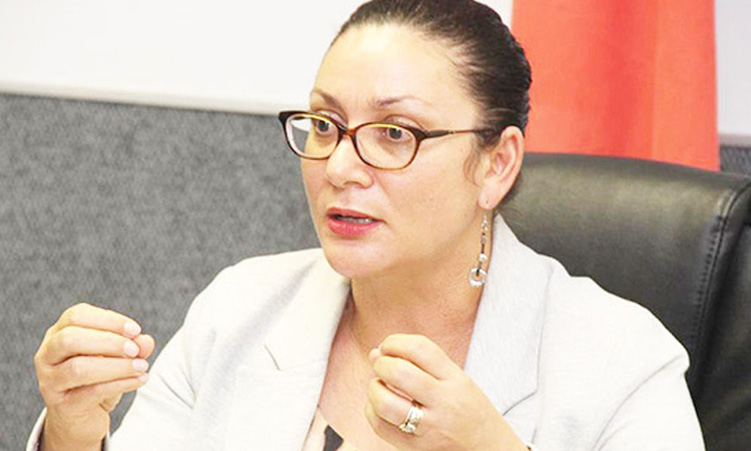
Tuli Mekondjo and Helena Uamembe’s stories begin on either side of a war. The first’s parents joined Swapo in exile in Angola and the second is the daughter of a former Angolan member of the South African Defence Force’s 32 Battalion.
Meeting at the Cape Town Art Fair last year, the artists discovered a mirror. A reflection of war, exile, mothers who passed away too soon and the residual scars. In ‘The Borders of Memory’, an online exhibition hosted by Guns & Rain, the artists touch mirrored hands.
The Namibian struggle for independence and what South Africans call the Border War are considered through the lens of the exiled, and prevailing narratives about 32 Battalion told primarily by white male soldiers are looked upon from the homes the Angolan soldiers left behind.
There are borders around these memories.
In Tuli Mekondjo’s mixed media resin and mahangu works featuring burnt holes recalling refugee camps, fierce women fighters and children of the war, the borders of memory are constructed by the victims and perpetrators who guard these recollections.
“Memories are permanently etched in the minds of victims of torture constantly haunted by the horrors they encountered within the torture dungeons.”
She believes these borders of memory are constructed amid untreated trauma-induced dissociative amnesia.
“Witnesses stood still while gazing at a lifeless body of a Plan fighter mounted on a Casspir being paraded in broad daylight. Eyewitnesses survived Cassinga and had to bury people they knew in mass graves. They all lay awakened under the blanket of night, still in dialogue with memory.”
Born in the Kwanza-Sul Swapo refugee camp in Angola and having spent her formative years in Nyango refugee camp in Zambia, Tuli Mekondjo shares her investigations into her identity and feelings of displacement with Uambembe, who uses army green canvas, the 32 Battalion’s buffalo insignia and decorative fabric to distil her own history of the war.
“32 Battalion was/is seen as a military unit, a machine and within that there were/are people,” says Uambembe, whose work features Angolan soldiers shaped from floral fabrics.
“Those people have attached themselves to the narrative of the military, so they lose their own personal narrative. I want to remember the homes they forgot. Homes they were forced to flee in Angola. In remembering, I wish to bring healing, in myself and in others.”
Uambembe and Tuli Mekondjo each consider domesticity as central to their rendering of this time, and use embroidery as a reference to women.
“As children, growing up in a hostile war environment, we vividly remember the warmth of our mothers. In the Nyango camp, where I grew up, children were raised by all the mothers,” says Tuli Mekondjo.
“They did everything they could to create a certain feeling of “normalcy” within a tented or mud home structure.”
While women were nurturers and keepers of fragile normality, Tuli Mekondjo, who beautifully reimagines photographic images from national and personal archives, also recalls Namibia’s women fighters in a work titled ‘Spiritual Embodiment of Meme Nekaya’.
“Meme Nekaya was a female Plan soldier who was photographed in uniform and carrying her rifle in one of the Swapo refugee camps in Angola in 1978,” says Tuli Mekondjo.
“To me, she is the embodiment of strength and unwavering determination of young women like my mother, who risked their lives by crossing the border into Angola. These young women fought a war, birthed children and raised them under the most intense circumstances. Through her ‘eyes’, Meme Nekaya allows us to see the role women played in wartime. Their roles as soldiers who also fought on the frontlines are often not acknowledged.”
Sharing a history of war and the desire to look beyond dominant narratives’ erasure of black soldiers and the significance of women, the artists created ‘The Borders of Memory’ to excavate both the personal and the historical as they endeavour to heal from inherited trauma.
“It’s apparent that Helena’s parents and my parents were on opposing sides during the war, but our work weaves a tapestry of commonality,” says Tuli Mekondjo.
“We have both been scarred by a war and we are still feeling its residue. We both came into being within restrictive boundaries or confinements, then displacement before embarking on an internal journey, in search of ‘home’…”
‘The Borders of Memory’ will be on display at gunsandrain.com until 6 May.
– martha@namibian.com.na; Martha Mukaiwa on Twitter, Facebook and Instagram; marthamukaiwa.com
In an age of information overload, Sunrise is The Namibian’s morning briefing, delivered at 6h00 from Monday to Friday. It offers a curated rundown of the most important stories from the past 24 hours – occasionally with a light, witty touch. It’s an essential way to stay informed. Subscribe and join our newsletter community.

The Namibian uses AI tools to assist with improved quality, accuracy and efficiency, while maintaining editorial oversight and journalistic integrity.
Stay informed with The Namibian – your source for credible journalism. Get in-depth reporting and opinions for
only N$85 a month. Invest in journalism, invest in democracy –
Subscribe Now!