



Government’s resettlement programme has been under fire for years now because of how be-neficiaries use the land. At Tsaobis things are handled differently.
SUCCESS stories about resettlement farms that aim to benefit previously landless Namibians are very rare, but Tsaobis Nature Park is an exception.
The former Tsaobis Leopard Nature Park is halfway between Windhoek and Swakopmund, about 60km south of Karibib. It has a long history stretching back to 1938, and was owned by a few individuals before the government bought it in 2005 for resettlement purposes.
The 16 000-hectare ‘geological wonder’ is now in the hands of Adari Nature Conservation Management Services, chaired by Ditto !Gonteb.
Initially, Tsaobis was developed into a safe haven for leopards, and then evolved into a sheep and goat farm as well as a fruit and vegetable farm that uses innovative irrigation systems.
The last owner made it a leisure facility with bungalows, campsites, a swimming pool as well as game drives for tourists to enjoy peace and tranquility. Wildlife and geology research groups also frequented the park, which is famous for its exposed rock formations.
In 2005, Polla Swart sold the farm to government, and Adari’s proposal to continue with the layout and services proved a good idea, allowing the group to succeed as a beneficiary.
Tsaobis seems to have succeeded in not falling into the trap where farms are converted into subsistence farming by inexperienced beneficiaries, and then there is no production, land is depleted and infrastructure vandalised.
This has been possible with Adari’s continued efforts to maintain and develop the place by continuing with the former ventures and investing funds from their own pockets.
But the going was and still is not easy, according to !Gonteb.
There was a transition period of about three years from the time government bought the farm to when it was handed over to Adari.
“People from the surrounding areas came and destroyed most of the infrastructure, stealing what they could. When we came here, we basically had to start building up from scratch,” explained !Gonteb.
It cost Adari roughly N$2 million to get the park facilities back into business condition, and although they struggle to break even, visitor numbers are increasing again.
“We stay hopeful. We do benefit ourselves, but also the people around here and the rest of Namibia by offering them this pristine breakaway at very affordable prices, compared to surrounding competitors,” said !Gonteb. He admits that there was still a lot of potential which needs to be developed, and that more investments were required.
The lease agreement between government and Adari has apparently not been signed yet, which also hampers progress in that the lack of such an agreement can count against attempts to get loans.
“We are waiting for government to come forward. One of our biggest needs is game fencing for about 2 500 hectares. Once we have this, we can expand the perks for visitors, which in turn will increase revenue that can be ploughed back for further development.
“We were told that the Ministry of Environment and Tourism could give us game, but before we can have the money to erect this fence, we first need the agreement to be concluded,” !Gonteb explained.
Tsaobis, however, is showing progress, and even received the applause of former minister of lands and resettlement Alpheus !Naruseb, who said coming to the park resulted in his stress levels dropping after experiencing disappointments at some resettlement farms around the country.
A night at Tsaobis proved truly refreshing with the peace and quiet of a pristine nature environment, acceptable facilities and hospitality.
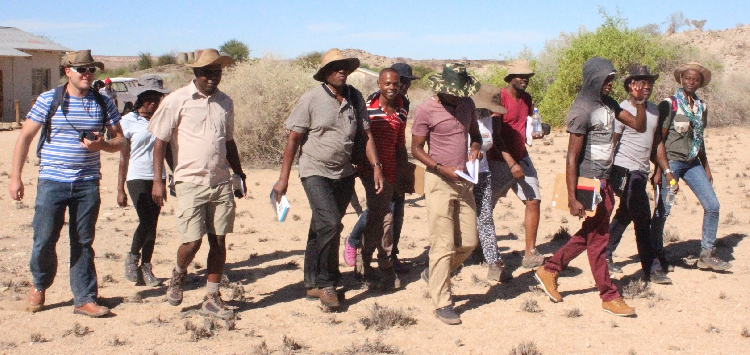
Tsaobis still offers bungalows, camping sites, has a swimming pool, game drives and even a restaurant. There is wireless connection available and a restaurant which offers breakfast, lunch and dinner. Unam students and other wildlife research groups are still returning.
“Our success is that we stuck to the plan we proposed, and that is to keep the business activities alive here, develop them and make them available to Namibians. This is a home away from home, and we have had many good reports – even from foreigners,” beamed Ouseb.
“Many thought this would be just another resettlement farm, and many groups came here who wanted to go into partnership with us, but we knew their agenda was only to make themselves rich, and that locals would not be able to enjoy this facility.
“We, however, stuck to our initial game plan.”]