



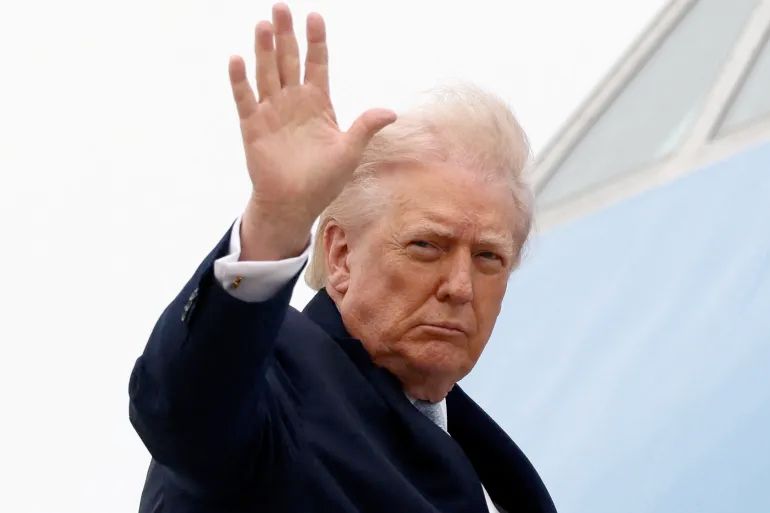
President Donald Trump says the United States (US) and Iran want to make a deal, and the two sides have “major points of agreement” after he ordered the United States military to postpone strikes on Iranian power plants and energy infrastructure for five days.
“I am pleased to report that the United States of America, and the country of Iran, have had, over the last two days, very good and productive conversations regarding a complete and total resolution of our hostilities in the Middle East,” Trump posted on Monday in capital letters on his Truth Social platform.
“I have instructed the Department of War to postpone any and all military strikes against Iranian power plants and energy infrastructure for a five-day period, subject to the success of the ongoing meetings and discussions.”
Speaking to reporters at a Florida airport, Trump said Iran wanted “to make a deal”, and US envoys have been holding talks with a “respected” Iranian leader, but not “supreme leader” Mojtaba Khamenei. He asserted that Iran must give up its enriched uranium stockpile for a deal.
The US president said the Strait of Hormuz would be opened very soon if there’s a deal.
“If a deal happens, it’s a great start for Iran and the region,” he said, adding that he could not guarantee a deal with Tehran. The US president claimed that the Iranians called him for talks and not the other way round.
Earlier, Trump told Fox Business Network that Tehran wants to make a deal “badly” and it could happen within five days. He said his envoys, Steve Witkoff and Jared Kushner, were engaged in talks most recently on Sunday night.
The latest announcement will be seen as a big relief in the region, which has been bearing the brunt of Iranian attacks, and across the world as the war on Iran has caused a global energy crisis and sent oil prices soaring.
ULTIMATUM
In an effort to lower energy prices, Trump on Saturday gave Tehran 48 hours to reopen the Strait of Hormuz to all vessels, warning that otherwise the US would “obliterate” Iran’s power plants. Trump’s ultimatum was aimed at ending Tehran’s chokehold on the Strait of Hormuz, through which a fifth of global oil and liquefied natural gas supplies pass.
Wall Street stocks mostly rose early on Monday after Trump said Washington and Tehran had held “very good” talks. Oil prices – which have spiked since 28 February, the day the US and Israel launched their war on Iran – dropped sharply on Monday.
Al Jazeera’s Osama Bin Javaid says that with his announcement, Trump may have opened a potential off-ramp on the war on Iran.
“This is the breaking news that everybody in the region and beyond has been waiting for, . . . that Donald Trump, who declared this war unilaterally without legal backing, can end it unilaterally without any preconditions,” he says.
Reporting from Washington, DC, Al Jazeera’s Alan Fisher agrees that it seems Trump might be looking for an off-ramp.
“He has set a five-day deadline. We will see where the talks go at that point. But remember, Donald Trump’s deadlines tend to be elastic. They have been in the past, and it could well be, come Friday, that there won’t be a resolution to this question.”
Analyst Mohamad Elmasry of the Doha Institute for Graduate Studies says Trump’s announcement may be “his way of sort of giving himself a dignified exit”.
“But the question that people need to ask is what the Iranians are going to do and what the Israelis are going to do and to what extent they might be willing to continue the war effort against Iran without US backing, if that’s what ends up happening here.”
Reporting from Tehran, Al Jazeera’s Mohamed Vall says the Iranians will possibly climb down despite three weeks of war.
“The likelihood that they will refuse this offer from Trump is remote,” he says.
“The Iranians do not want to continue this war. They say it was imposed on them and the region. They have said that if there are guarantees and further negotiations take place, and if there is no repeat of the same type of aggression or any kind of aggression against Iran in the future, and if there is a willingness to find a lasting deal, then I am sure the Iranians will not say no.”
MIDDLE EASTERN ‘INITIATIVE’
Iran has not commented yet. But its ministry of foreign affairs in a statement carried by the semi-official Mehr news agency says Trump’s move is aimed at reducing energy prices and providing time to implement his military plans.
It says there are “initiatives” by countries in the region to reduce tensions, but their concerns should be referred to Washington, “the party that started this war”.
Tehran denied there was a dialogue between Tehran and Washington.
Iran has said that if Trump carries out his threat to “obliterate” Iran’s power plants, it would completely shut down the strait in retaliation. Tehran also pledged to attack energy facilities in Israel and Gulf countries.
Iran’s de facto blockade of the Strait of Hormuz has caused a spike in global oil prices and a shortage of cooking gas in Asian countries.
Fatih Birol, the head of the International Energy Agency, on Monday warned that the situation in the Middle East is “very severe” and is worse than the two energy crises of the 1970s and the fallout of the Ukraine war put together.
On Monday, the Islamic Revolutionary Guard Corps responded that if Washington went ahead with Trump’s threat, Iran would target power plants in all regions that supply electricity to US bases “as well as the economic, industrial and energy infrastructures in which Americans have shares”.
In addition, the defence council warned that any attack on Iran’s southern coast or islands would prompt the laying of sea mines that would sever Gulf shipping routes, according to state media.
Al Jazeera’s Bin Javaid, citing conversations with diplomats, says even during the Eid holiday, “multiple countries at different levels have been holding conversations with embassies or directly with the White House”.
“People have told us they have been telling Trump that this process of escalation does not bode well for Iran or for Israel,” he says.
“There are multiple factors to take into account. One is the threat Trump issued about hitting power plants and energy infrastructure and Iran’s response in a tit-for-tat escalation.”
In an age of information overload, Sunrise is The Namibian’s morning briefing, delivered at 6h00 from Monday to Friday. It offers a curated rundown of the most important stories from the past 24 hours – occasionally with a light, witty touch. It’s an essential way to stay informed. Subscribe and join our newsletter community.

The Namibian uses AI tools to assist with improved quality, accuracy and efficiency, while maintaining editorial oversight and journalistic integrity.
Stay informed with The Namibian – your source for credible journalism. Get in-depth reporting and opinions for
only N$85 a month. Invest in journalism, invest in democracy –
Subscribe Now!