



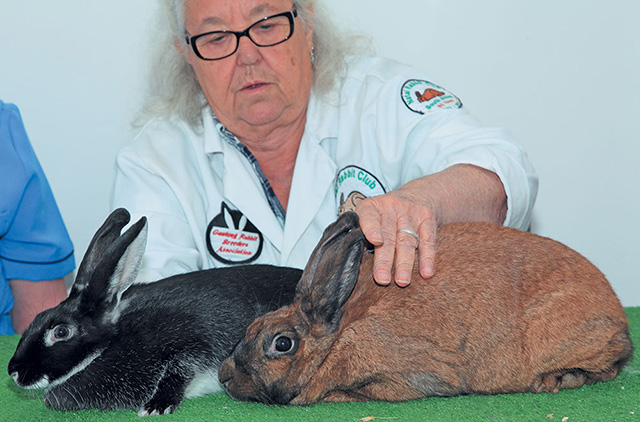
• GLENNEIS KRIELWHILE rabbit farming can be fairly lucrative, it is not a get-rich-quick scheme. Glenneis Kriel spoke to Karoline Steenekamp about the dos and don’ts when starting a rabbit enterprise.
One could say Steenekamp was born into the industry, as her mother, who was a rabbit judge, breeder and author of the book Rabbit Breeding in South Africa, gave birth to her in between judging rabbits at the Rand Easter Show.
“After her contractions started, my mother quickly finished her judging before leaving for hospital. She returned to the show the very next day, with me in her arms,” Karoline says.
Karoline went on to become an internationally acclaimed rabbit judge and one of only four judges in South Africa. She also boasts considerable production experience, having farmed in various locations, including Johannesburg and Cape Town.
THE BASIC RULES
While it requires plenty of dedication and hard work, rabbit farming has the potential to generate good primary and additional income streams, as well as uplift rural communities.
There is, however, no blanket recipe for success, as production protocols differ according to the breed of rabbit chosen, the type of housing used, the production aim, and the climatic conditions.
Nonetheless, the following principles are non-negotiable:
• Firstly, establish a ready market right at the start. This applies regardless of whether the end product is meat, wool, pelts or manure.
• Secondly, find a mentor. An aspiring rabbit farmer should learn the whys and wherefores from an experienced farmer before building cages or buying stock, so that you understand how to feed and care for the animals. “Find a mentor you can turn to if you face a problem,” says Karoline. An easy way to find a mentor is by joining a rabbit club.
• Thirdly, forget about free-range production. Rabbits have to be kept in housing or cages, as they love to burrow. When kept outside, they are sure to escape before too long. They are also safer in cages, away from predators such as rats, birds of prey, dogs and snakes, as well as pests such as mites (which can cause mange) and fleas. Rabbits are surprisingly territorial, explains Karoline. “They do search out their own space within a communal burrow, even though they might share communal feed and toilet areas, and they are therefore quite content to live in single cages within sight and smell of other rabbits.”
• Fourthly, choose the right- sized cages. Overcrowding causes stress and poses health risks, as it drives up ammonia levels, which might cause respiratory and other problems. The actual stocking density depends on the type of housing and the breed produced, but a fair cage size for most breeds is about 600mm (l) x 500mm (w) x 450mm (h). The height is important, as rabbits need to stretch after eating to get rid of pockets of sour air that form in their intestines during eating and resting.
“If they don’t stretch, the gas gets trapped, causing digestion problems. Ideally, when the rabbit stretches, its ears shouldn’t touch the top of the cage,” Karoline says.
Fifthly, like all livestock farmers, you have to be a good stockman. This means honing your ability to quickly identify problems and spot sick animals before things spiral out of control.
A farmer should be quick to identify a sick animal by merely looking at its posture or picking up a sour smell. Signs of ill health might be a dull eye, hunched-up body, breathing difficulties or a runny tummy,” says Karoline.
For this reason, she prefers cages to be visible.
“Avoid multi-tiered cages that are above or below eye level. A commercial farmer might be able to manage a three-tier system if there’s enough airflow in the rabbitry, but I prefer two as it allows me to see what’s happening in the cages.”
Sound hygiene is another tool for preventing diseases.
“Rabbits that are kept under dirty conditions or receive contaminated feed, tend to develop coccidiosis, which can explode into an epidemic if not treated quickly,” cautions Karoline.
“The best way to prevent this disease is to keep the rabbits, cages, water and feed clean. Sulphur drugs are the best treatment when the disease breaks out.”
Commercial premixed lucerne-based pellets are available on the market. Karoline advises against using pellets containing antibiotics.
“Some companies put coccidiostats in their feed to prevent coccidiosis, but this might result in the animals not responding to medication should they require it later.”
In community projects, vegetable surpluses and scraps can be used as feed instead of pellets, provided that a sufficient quantity is available and that high-quality hay is provided as well.
Karoline estimates that a rabbit on premixed feed might reach slaughter age at 10 to 14 weeks, whereas rabbits on hay and garden excess might do so only at 20 to 30 weeks.
The coat of rabbits on hay and vegetables will, however, be significantly better than that of rabbits on premixed rations, as the older animal will have a more mature pelt at slaughter.
(email Karoline Steenekamp at karoline@telkomsa.net.)
In an age of information overload, Sunrise is The Namibian’s morning briefing, delivered at 6h00 from Monday to Friday. It offers a curated rundown of the most important stories from the past 24 hours – occasionally with a light, witty touch. It’s an essential way to stay informed. Subscribe and join our newsletter community.

The Namibian uses AI tools to assist with improved quality, accuracy and efficiency, while maintaining editorial oversight and journalistic integrity.
Stay informed with The Namibian – your source for credible journalism. Get in-depth reporting and opinions for
only N$85 a month. Invest in journalism, invest in democracy –
Subscribe Now!