



RUTH KAMWIFINDING one’s way to Mount View High School located in Windhoek’s Okahandja Park is no easy task. This is because the school, formerly known as Tobias Hainyeko Project School secondary, is hidden on premise it shares with two other schools.
These are Aupa Frans Indongo Primary School and Green Leaves Primary School.
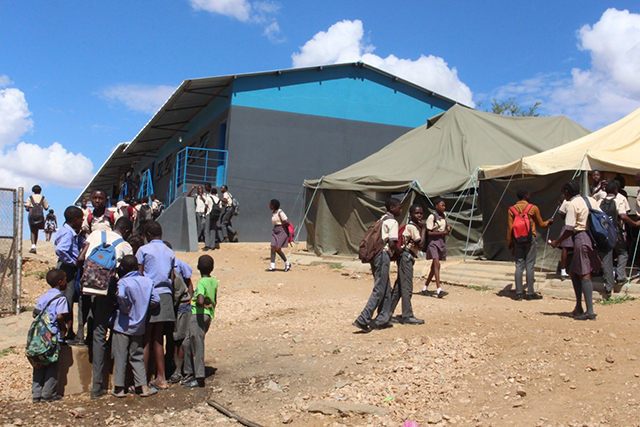
The set-up here is confusing. This, we establish after having used the Aupa Frans Indongo Primary School main gate to access Mount View High School. There are no visible school names, just a couple of brown classroom blocks which are set aside from an unmissable royal blue structure.
About four tents–which we learn were supplied by the Khomas Regional Council– are situated close to the blue structure and can be seen from a fence which seems to demarcate Aupa Frans Indongo Primary School from Green Leaves Primary School and Mount View High School.
We head to the blue building, and here we are introduced to a geography teacher who identifies himself as Brian Munguni, before she agrees to a brief interview we then conduct in an unused computer lab.
He has been directed to speak to The Namibian by the school principal [who was not at the school when we arrived] and explains that there is a lack of classrooms.
Munguni reveals that the blue building is the only block of classrooms which belongs to the secondary school.
Through an open door, we observe some pupils from a group clad in two different school uniforms removing cloths from their sport branded backpacks. They then use the cloths to wipe the dust off their black leather uppers.
After the cleaning interval, the pupils wander off in different directions.
“You got to see the tents which are in good condition because last year we were using tents that were torn. They are just in the storeroom,” says Munguni who has been teaching at the school since its inception in 2015.
He explains that the spring season brings strong winds which cause the tents to collapse during the weekend.
Consequently, pupils have to sacrifice the first period of their class time on a Monday to put up the tents.
Grades 8 and 9 use two Green Leaves Primary School classroom blocks which have eight classrooms in total.
The school often relies on goodwill and recently received a donation of 25 computers from the Turkish Cooperation and Coordination Agency.
However, computers lay idle as the computer lab remains unused due to there being no teacher qualified to teach information and communications technology.
Furthermore, all the high school pupils also have to negotiate the sharing of toilets with primary school pupils.
It must be considered that more than 1 000 pupils share the toilets.
According to Munguni, the school emerged in position 14 out of 34 schools in the Khomas region for Grade 10 results and moved up three places to position 11 in 2018.
This is even though the school only has 16 teachers, no departmental heads, cleaners, nor a secretary.
After the interview with Munguni, we tour the school.
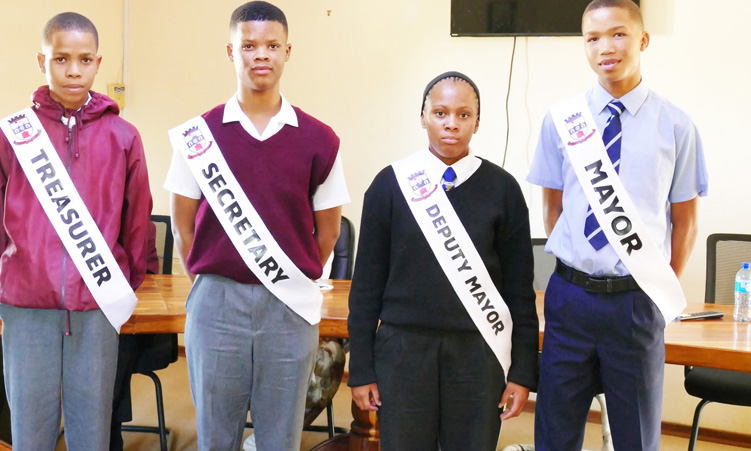
A containerised classroom donated some weeks ago, during a project initiated by Miss Windhoek High 2018, Reschelle Beukes, who is the Windhoek junior mayor, can be spotted between the blue structure and the tents.
We meet a Grade 11 pupil, Annatolia Uupindi, who started school at Mount View High School in 2016. Uupindi mentions that Aupa Frans Indongo Primary School previously permitted her school to use its school hall but has since taken a U-turn.
She says the tent classrooms absorb heat throughout the day and become very hot by noon, adding that her school has had to resort to using the Nathaniel Maxuilili Centre which is some kilometres away, for examination purposes.
Uupindi who sports a neatly tied-up afro, also insists that having to share toilets with Grade 1 pupils [from Green Leaves Primary School] is inappropriate.
“We need more classes and textbooks for Grade 10 and 11 for the new curriculum,” Uupindi adds, explaining that only 20 textbooks were availa-ble by the Khomas Regional Council, in line with the new curriculum.
According to her, the textbooks are expected to be shared by 60 Grade 11 pupils. Another Grade 11 pupil, Mike Muchiagami, grinning, with his left leg crossed behind the right one, says that learning in tent classrooms is not a pleasant experience.
“Ma’am, the boys’ uniforms even get dirty when putting up tents on Monday mornings,” he complains while adjusting his sling bag.
We later meet a Grade 10 and 12 geography and development studies teacher, Rauna Shaningwa, who complains about the heat absorbed by the tent classrooms.
The teacher who sits at the back of one of the opened tent classrooms looks weary and chews on ice while speaking to this reporter. She says that pupils’ concentration levels would have deteriorated by 10h00 and that some would want to stand outside the tent while others want to open the sides of the tent.
In an age of information overload, Sunrise is The Namibian’s morning briefing, delivered at 6h00 from Monday to Friday. It offers a curated rundown of the most important stories from the past 24 hours – occasionally with a light, witty touch. It’s an essential way to stay informed. Subscribe and join our newsletter community.

The Namibian uses AI tools to assist with improved quality, accuracy and efficiency, while maintaining editorial oversight and journalistic integrity.
Stay informed with The Namibian – your source for credible journalism. Get in-depth reporting and opinions for
only N$85 a month. Invest in journalism, invest in democracy –
Subscribe Now!