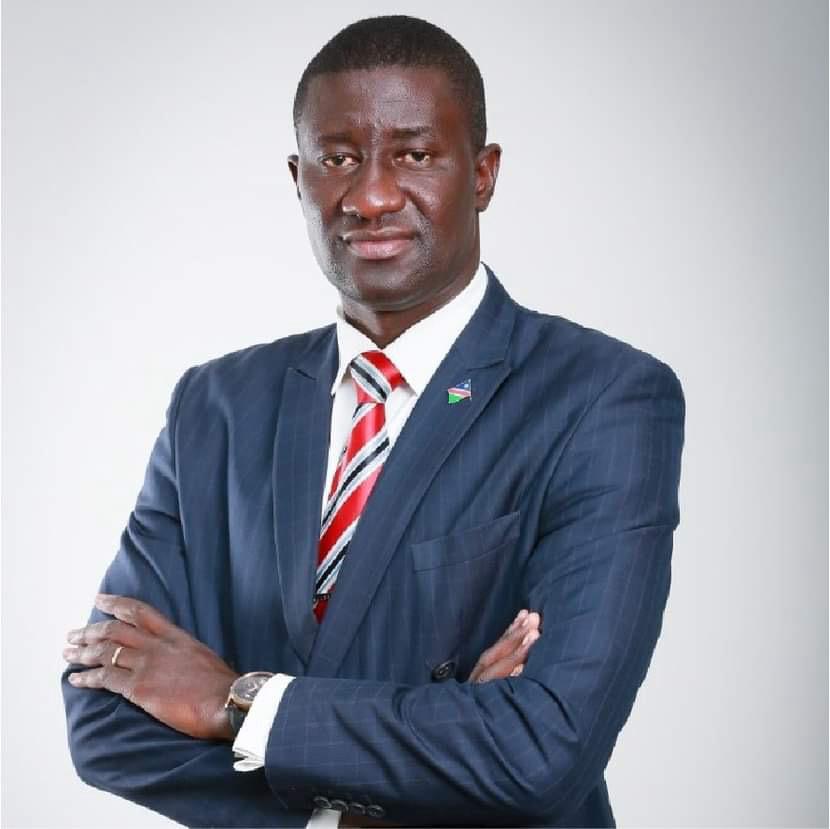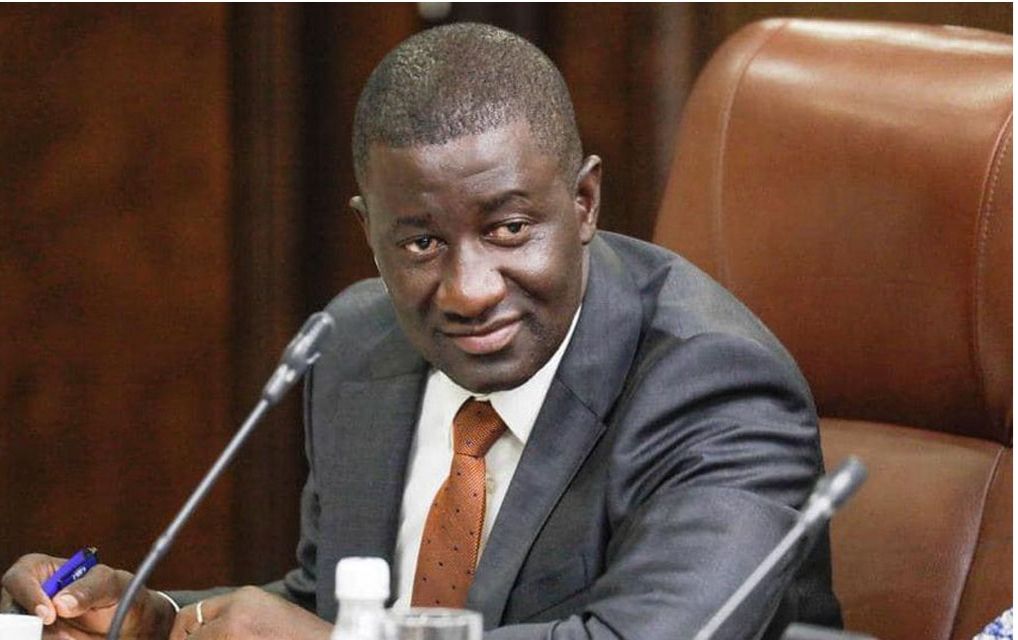



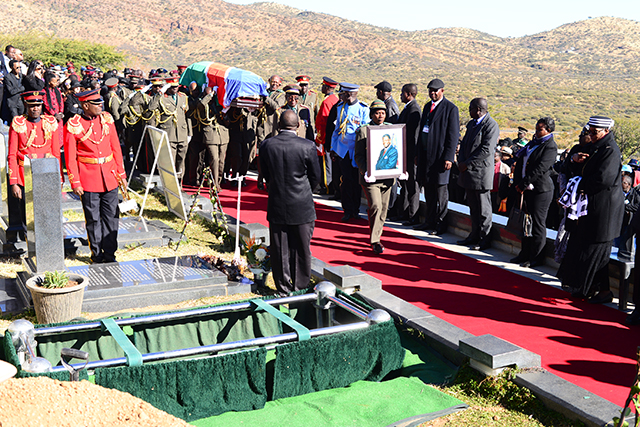
• ANDRÉ DU PISANIAFTER Theo-Ben was sought by the final truth that has no complement: death, much was said and written about a life of many achievements – some of it moving, enlightening; much of it repetitive and shallow.
Theo-Ben’s life was history, biography, mind and mindful.
Born at Usakos in the embrace of the towering and spiritual Erongo Mountains along the Khan River with its life-giving water snaking around the town, his childhood was conventional. He himself saw life in apartheid Usakos and the then South West Africa, as an expression of a history, a reality, that had to be broken and could and should be transcended.
Here, and at the Augustinium College at Okahandja, he and others lived the life of the mind, debating the subjects of power, justice, emancipation, liberty, unity and ultimate independence for Namibia.
When Theo-Ben left the country of his birth to spend 27 years in exile, the subjects of power, justice, emancipation, liberty, unity and nationhood were understood from different perspectives: liberalism, socialism, communism, nationalism and pan-Africanism.
It would be unfair to limit his intellectual biography to that of nationalism only. Yes, he was a nationalist and pan-Africanist, but one who understood the limitations and possibilities for renewal of the nationalist creed, and of the moral failures and duties of politicians and intellectuals in politics.
While it is widely acknowledged that his contributions were formative and seminal to the diplomacy in exile of Swapo and for the foreign policy and international relations of the new republic, his ideas came from different intellectual traditions.
At the time when Theo-Ben was a student at Temple University in the United States, where he read politics and international relations, realism was the dominant paradigm for analysing the world. The emphasis was on national power and its constitutive parts, national interest, the balance-of-power for ensuring stability in an anarchic world and alliance-building.
The realist lens accorded a central place to nation states and to diplomacy as the substance and the means of state-centric international relations, respectively.
The rise of black power that found an expression in the ghetto riots and civil disobedience in the United States in a post-Second World War world with its bipolar Cold War logic and its celebration of global capitalism, exemplified by the earlier ‘New Deal’ of Roosevelt, found distinct outlets in Theo-Ben’s critical mind.
So, too, the first wave of decolonisation in Africa ushered in by the independence of Ghana in 1957 under the charismatic and intellectual Kwame Nkrumah. It was also the time of the Algerian War of Independence, the Hungarian Revolution, the Suez Crisis, the Cuban Revolution, Mao’s ‘Great Leap Forward’ in China and the destructiveness of the Vietnam War.
In southern Africa it was the beginning of armed struggle in many arenas, inclusive of Namibia. Theo-Ben lived through all of this and at the United Nations (UN) he analysed and reported on what all this meant to Swapo and Africa. Collectively these key world events, led to the ideas and ideology of Non-Alignment (especially since the 1955 Bandung Conference) and the recasting of diplomatic, political and military alliances.
Theo-Ben, Hage Geingob, Hidipo Hamutenya and Sam Nujoma were at the heart of reconfiguring and cementing relations with many socialist countries, while at the same time maintaining relations with Western states, India, North Africa and West Africa, among others.
The 1970s brought both new opportunities and challenges to Swapo, nationally, regionally and internationally. It also saw the long recession and crises in global capitalism, notably around the energy crisis of the early-mid 1970s and for Swapo and Namibia, the military coup in Portugal, the difficult birth of Angola and Mozambique.
Teo-Ben cut his diplomatic teeth in a context of crisis, uncertainty and transition as Neo-Liberal and Neo-Realist approaches to international relations emphasised the primacy of non-state actors, such as liberation movements and multinational corporations and of trade and wider economic relations as central to an emerging world.
Again, Theo-Ben read these trends with commendable insight and we witnessed the deepening of relations between Swapo, inter-governmental organisations such as the World Council of Churches and above all with multilateral bodies such as the then Organisation of African Unity (OAU), the Commonwealth and the United Nations (UN).
The fulcrum of the 1970s propelled Theo-Ben and Swapo forward as the party pursued a triadic approach to liberation: internal and international mobilisation, bilateral and multilateral diplomacy and armed struggle. These events united biography and history, as Theo-Ben became central to the diplomacy of Swapo and emerged as a skillful negotiator and peace-maker.
When the United Nations (UN) Peace Plan for Namibia took shape in the 1970s and 1980s, Theo-Ben contributed actively to the framing of UN Security Council 435 (1978) and the topography of the subsequent UN Peace Plan for Namibia.
Amidst an ongoing crisis in what is now called, neo-liberal capitalism, the 1980s brought a different harvest to Theo-Ben and to Swapo. China turned neo-liberal under Deng Xiaoping and rose to become an industrial and later a global economy. While the Iranian revolution of 1987-1988 and the Soviet-Afghan war were paralleled by diplomatic breakthroughs on Namibia and Angola, largely because of the unpopular construct of linkage, geo-political and military changes in Angola, new forms of resistance inside South Africa, deepened by oil sanctions and growing diplomatic isolation of that country.
It was in the turbulent 1980s that saw the independence of Zimbabwe, culminating in the end of the Cold War, the unravelling of the former Soviet Union, the rise of Thatcher and Reagan in the United Kingdom and the USA, respectively, that Theo-Ben Gurirab’s preoccupations and achievements for peace and justice and the life of his mind and mindful life, served Namibia and the former liberation movement, Swapo, particularly well.
It is thus no coincidence that the new state’s foreign policy and international relations brought together various ideas and strands from realism (with its emphasis on the near-sacrosanct nature of sovereignty and national interest); liberalism with its emphasis on human rights, its belief in international law – peace though law ; neo-realism with its concerns for economic and trade relations and for multilateralism; non-alignment based on older forms of solidarity that have all-but been eroded by neo-liberal capitalism and idealism – a philosophy on a grand scale – that combines small and big problems and challenges into systematic accounts of human achievement.
Theo-Ben was accorded global recognition when he chaired the UN General Assembly from 1999-2000 that led to the UN millennium development goals (MDGs) and the recognition of the role of women in peace-making and building.
This was a fitting tribute to a person who lived more than one truth – a mental library of considerable diversity and polish and a person who was simultaneously a Namibian and a citizen of the world; a nationalist and a cosmopolitan. He cared deeply for both.
As I celebrate his life, the life of a mind and of a life well lived, I believe, Theo-Ben lived by more than one truth – the truth of clarity and erudition, the truth of love, the truth of the politician, the truth of a father, the truth of principled loyalty. There is no way however, one can reduce any of these forms of truth to a single truth, for truth and morality require many forms of seeking and thinking.
*André du Pisani is emeritus professor at the University of Namibia (Unam) and one who learnt much of enduring value from Theo-Ben Gurirab.
In an age of information overload, Sunrise is The Namibian’s morning briefing, delivered at 6h00 from Monday to Friday. It offers a curated rundown of the most important stories from the past 24 hours – occasionally with a light, witty touch. It’s an essential way to stay informed. Subscribe and join our newsletter community.

The Namibian uses AI tools to assist with improved quality, accuracy and efficiency, while maintaining editorial oversight and journalistic integrity.
Stay informed with The Namibian – your source for credible journalism. Get in-depth reporting and opinions for
only N$85 a month. Invest in journalism, invest in democracy –
Subscribe Now!