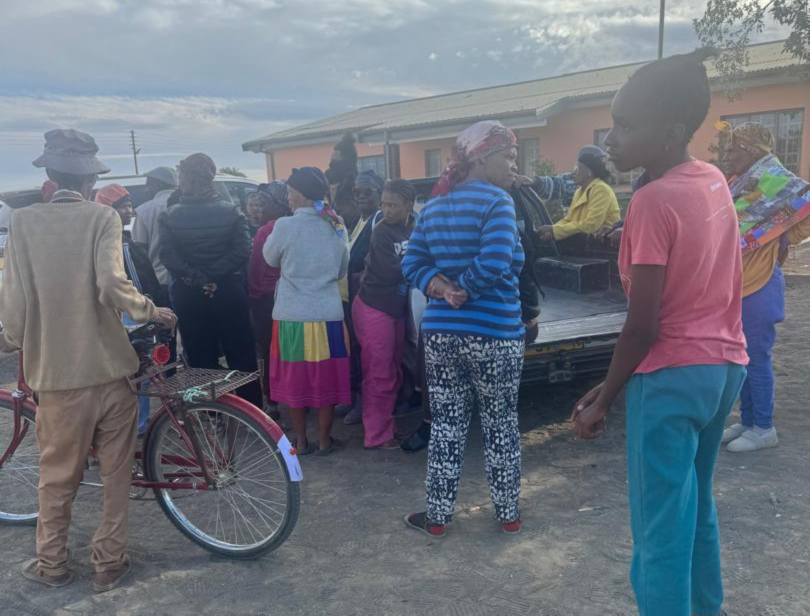









Here Has Been considerable debate about the new speed humps on the Western Bypass.
Other speed humps are planned between Prosperita and the Windhoek Country Club Resort.
The speed humps, which are aimed at increasing pedestrian safety, have already been blamed for several car crashes. There are also complaints that they cause traffic jams.
Near Osona, just outside Okahandja, pedestrian traffic is controlled with walls lining the highway.
Some suggest that pedestrian bridges would be a better option for the Western Bypass.
What does the law say?
The relevant laws are the Road Traffic and Transport Act 22 of 1999, the Road Traffic and Transport Regulations, 2001, and the Roads Ordinance 17 of 1972 (which will eventually be replaced by the Roads Act 4 of 2025, which has been passed by parliament but has not yet been brought into force).
Is the Western Bypass a freeway?
Maybe. In April 2017, the Windhoek Express reported that Roads Authority chief executive Conrad Lutombi, announced that the recently completed section of the dual carriageway between Windhoek and Okahandja had been renamed the ‘A1’ in accordance with relevant standards.
He said one of these standards required that all freeways should be classified as ‘A’ with road signs that are blue rather than green.
Another report in the Windhoek Express in 2024, titled ‘Freeway Officially Inaugurated’, states that the Windhoek-Okahandja highway has been reclassified and upgraded from a B1 to an A1 road in accordance with road classification standards, and was officially inaugurated by then-president Nangolo Mbumba.
Other press reports about this event also refer to the Windhoek-Okahandja ‘freeway’.
WHAT IS A FREEWAY?
According to the Roads Ordinance 17 of 1972, “freeway” means a trunk road that is declared to be a freeway in terms of the ordinance.
The procedure for declaring a road as a freeway is that the executive committee (which would now mean the relevant post-independence authority) must declare the road is a freeway and then make this declaration known by publication in the Government Gazette.
A search of Government Gazettes turned up no such publication. (Caveat: Although several search mechanisms were used to locate the expected notice, it is possible it could have been missed.)
It is not clear what weight the declaration would have if the accompanying requirement to publish it was not carried out.
It could be that the declaration is a separate action that is not invalidated by failure to give notice of it, or it could be that the declaration is not effective without the publication requirement.
Only the Namibian courts can say how the statute should be interpreted on this point.
The Roads and Traffic Act takes a slightly different approach.
It says “freeway” means a public road or a section of a public road which is designated as a freeway by an appropriate road traffic sign – but it is not clear from the law what constitutes an appropriate sign.
And what if it is a freeway in terms of the law?
The Roads and Traffic Regulations have special provisions related to freeways.
Subregulation 358(2) says a person may not be on a freeway on foot except in areas reserved for the stopping or parking of vehicles by an appropriate road traffic sign, or when the situation is beyond their control (such as when a car breaks down).
This rule does not apply to traffic officers or people engaged in construction or maintenance work, rendering essential public services or carrying out civil protection duties.
INTERNATIONAL STANDARDS
No international standards on road classifications that would be binding on Namibia have been located.
However, a freeway is typically described as a high-speed, divided highway designed for long-distance travel, featuring restricted access with entrance and exit ramps rather than intersections.
A freeway generally refers to a road without traffic lights, stop signs, speed humps or roundabouts.
And what if the Western Bypass is not in fact a freeway?
Even if the Western Bypass is not officially a freeway, there are still duties that apply to pedestrians under the Roads and Traffic Regulations (regulation 351).
A pedestrian may not cross a public road without taking care that the roadway is sufficiently free from oncoming traffic to permit him or her to cross the road safely.
A pedestrian crossing a public road may not linger on the road but must proceed with “due despatch”.
No pedestrian on a public road may conduct himself or herself in a manner likely to constitute a source of danger to himself or herself or to traffic on the road.
WHAT’S THE UPSHOT?
It would be helpful if the Roads Authority would clarify the status of the Western Bypass.
It is sometimes referred to as a “highway” or “a dual carriageway”, but these terms are not legally relevant in the same way as the classification “freeway”.
Where exactly does the “freeway” between Windhoek and Okahandja start, and where exactly does the ‘Hage Geingob Freeway’ from Windhoek to Hosea Kutaka International Airport start?
If the Western Bypass is a freeway, then it appears that pedestrians must be re-routed, such as over a pedestrian bridge, for the safety of everyone on foot or in vehicles.
*Dianne Hubbard is a legal consultant with many years of experience in public interest law and a passion for trying to make legal issues clear and accessible.