


Jesse Jackson, a key figure during the United States (US) civil rights movement of the 1960s, was known for being the first African-American to make the jump from activism to major-party presidential politics.
A protege of Martin Luther King Jr, Jackson built a career around working to politically organise and improve the lives of African-Americans, and became a national force during his two White House campaigns.
While other African Americans sought the US presidency, Jackson was the first to find significant success at the ballot box – which would pave the way for those who came after, including Barack Obama and Kamala Harris.
Over the course of his career, Jackson built a movement to bring America’s increasingly diverse population together, with a message that centred on poor and working-class Americans.
“No one else in the Democratic Party was talking about a multiracial, multi-ethnic democracy,” Vermont senator Bernie Sanders said at an event in Chicago in August 2024 that celebrated Jackson.
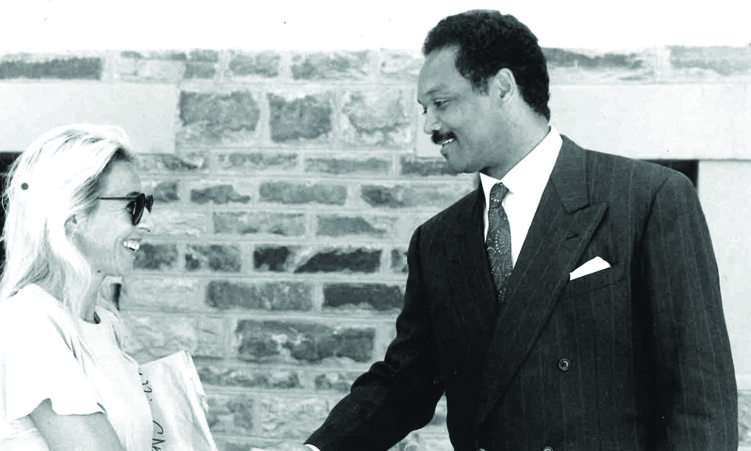
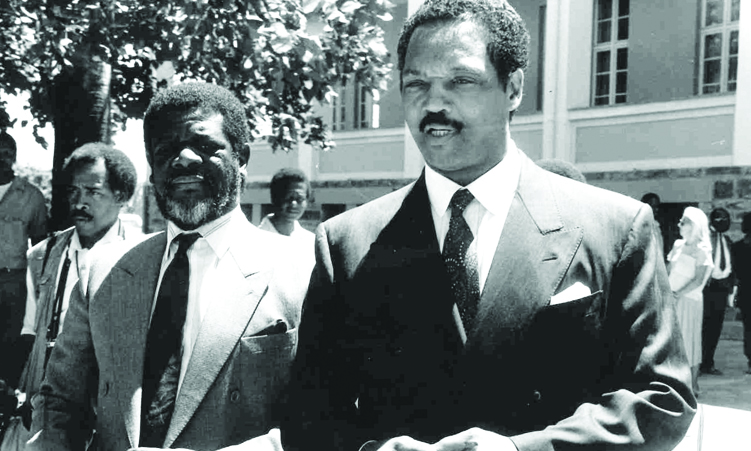
FIGHT FOR FREEDOM … The Namibian’s founder Gwen Lister meets veteran civil rights activist Jesse Jackson.
“This movement wasn’t just about bringing us together, but about bringing us together around a progressive agenda.”
KEEPING HOPE ALIVE
A gifted orator, Jackson articulated the frustrations of those who felt like second-class citizens in the world’s most prosperous democracy.
His speech to the 1988 Democratic National Convention, which ended with the refrain “keep hope alive”, would be echoed decades later in the “hope and change” slogan of Obama’s successful 2008 presidential campaign.
After his historic run of presidential campaigns, Jackson went on to position himself as an elder statesman within the Democratic Party.
However, Jackson’s later years would be punctuated by scandal, including revelations of marital infidelity and financial impropriety involving his son and political heir, Jesse Jackson Jr, who served as a congressman from Illinois.
In 2017, the elder Jackson was diagnosed with Parkinson’s disease and largely withdrew from public life.
That diagnosis was subsequently changed to one of progressive supranuclear palsy, a degenerative brain disease with similar symptoms.
ROOTS
Jackson was born Jesse Louis Burns on 8 October 1941 in Greenville, South Carolina, the son of Helen Burns (16).
Unmarried, she was expelled from her local Baptist Church after she became pregnant — the result of an affair with a married neighbour, Noah Robinson (33).
When Jackson was two, his mother married Charles Jackson, who went on to adopt his new stepson.
Jesse Jackson remained in touch with Robinson, and regarded both men as his fathers.
Charles Jackson was a religious man, and his son was brought up in the church – a traditional focus for black political resistance since the time of American slavery.
Growing up in South Carolina, Jackson, like all black Americans, was segregated from his white neighbours.
He was forced to attend separate schools and allowed only in designated areas in public places, like buses or restaurants.
KING’S PROTEGE
In high school, Jackson did well being elected as class president and excelling in nearly every kind of team sport.
A football scholarship to the University of Illinois helped Jackson pursue his ambitions and escape his poor surroundings.
But he soon transferred from the predominantly white institution to a historically black college in North Carolina.
He said he left Illinois because his white coaches wouldn’t let him play quarterback in American football, although that account is disputed.
Records show the team already had a black quarterback and Jackson was on academic probation.
As a student in North Carolina A&T, Jackson gradually became involved with the civil rights movement.
In 1960, he was arrested with seven other students after a silent demonstration in a whites-only public library, which led to the desegregation of the library.
Four years later, Jackson graduated and moved to Chicago, where he trained to become a religious leader and was noticed by King, the country’s most famous civil rights leader.
Through the Southern Christian Leadership Conference, which King founded in 1957 to promote non-violent action to seek social and economic justice, he established Operation Breadbasket.
The operation encouraged black men and women to frequent businesses that gave them basic courtesy and job opportunities, and to boycott those that did not.
Still in his 20s, Jackson was first asked to run the Chicago arm of the operation and, before long, to take on the national leadership.
PIVOTAL MOMENT
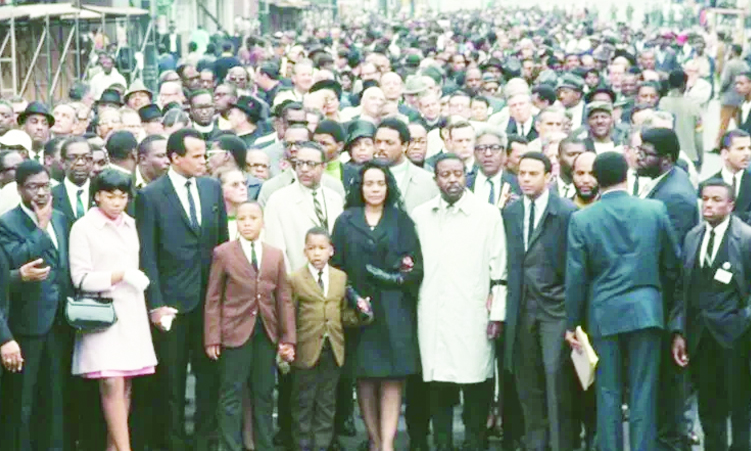
In 1968, Jackson’s life changed dramatically. He was with his mentor at the Lorraine Motel in Memphis, Tennessee, when King was assassinated.
Moments before the fatal shot, King was leaning over a railing in playful conversation with Jackson, who was standing in the parking lot below.
Jackson told reporters that he cradled King’s head as he died – although other witnesses did not confirm that account.
The next day, Jackson controversially appeared on television with his clothes still stained with King’s blood, assuming the mantle of civil rights leadership.
“We were determined we would not let one bullet kill the movement,” he later said.
Jackson, like King had done in the years before his death, began speaking about America’s problems as rooted in class inequality as much as racism. The principal schism, he said, was between the haves and the have-nots.
“When we change the race problem into a class fight,” he told the New York Times, “then we are going to have a new ball game.”
Three years later, arguments over leadership led Operation Breadbasket to fracture and Jackson to form Operation Push (People United to Serve Humanity) – a new, wide-ranging civil rights group.
In the years that followed, Jackson became one of the most influential political figures in America.
His Push organisation championed inner-city education and affirmative action programmes that saw businesses employing black workers.
PRESIDENTIAL RUNS
But he remained a controversial figure, with allegations that he had once made antisemitic remarks, and – as an ordained minister and the result of an unwanted pregnancy – he opposed abortion.
The issue was convulsing US politics after the landmark Supreme Court decision Roe v Wade.
Democrats, who traditionally aligned with the civil rights movement, mostly supported keeping abortion legal.
“Human beings cannot give or create life by themselves, it is really a gift from God,” Jackson wrote in 1977.
“Therefore, one does not have the right to take away that which he does not have the ability to give.”
He suggested that Moses and Jesus would not have been born, had abortion been a possibility in biblical times.
In 1983, Jackson travelled to Syria to plead for the release of a captured American pilot, Lt Robert Goodman. His mission was successful, and greatly boosted his national profile.
With black youth unemployment running at around 50%, Jackson then announced a run for president.
His decision caused heartache for some of his natural supporters, including King’s widow, Coretta, who feared he would fail to win the Democratic Party’s nomination and damage the chances of other progressive candidates.
During the campaign, Jackson spoke about the “rainbow coalition”, a broad group of voters from a variety of races and beliefs who were traditionally disadvantaged and who, Jackson said, had been hurt by the policies of then-president Ronald Reagan, a Republican.
“Our flag is red, white, and blue, but our nation is a rainbow — red, yellow, brown, black, and white — and we’re all precious in God’s sight,” he said in a speech at the 1984 Democratic National Convention, where he called for the party to unify.
Jackson copyrighted the term and later founded a political group with the same name.
The move irritated some members of the Black Panther organisation, which in the 1960s had used the term to describe an alliance between activists groups in Chicago.
While Jackson ultimately lost the Democratic nomination, his campaign had become a political and cultural phenomenon.
In October 1984, he hosted Saturday Night Live – a popular weekly network television comedy programme.
His presidential bid also had a profound effect on Democrats. By winning more than three million votes and coming third during the primaries, he showed that a black candidate could rally nationwide support and possibly take the White House.
At the same time, by running on a liberal platform, he brought many of the issues important to the party’s left wing to the fore and gave them traction, such as universal healthcare and paying reparations to the descendants of slaves.
Jackson was on record as a supporter of a Palestinian state, and had called Israel’s prime minister “a terrorist”.
He had also pledged never to use nuclear weapons first and to slash defence spending if he became president – positions that seemed impossible at the height of the Cold War.
He tried for the White House again four years later and continued to campaign on a liberal agenda of higher taxes, increased public spending and universal, state-funded healthcare.
Once more, he made an impressive showing, taking an early lead over Michael Dukakis, the eventual nominee, but once more, he lost, this time after winning just under seven million votes and 1 023 delegates to the Democratic National Convention. – BBC
- Read the rest of this article at www.bbc.com
In an age of information overload, Sunrise is The Namibian’s morning briefing, delivered at 6h00 from Monday to Friday. It offers a curated rundown of the most important stories from the past 24 hours – occasionally with a light, witty touch. It’s an essential way to stay informed. Subscribe and join our newsletter community.

The Namibian uses AI tools to assist with improved quality, accuracy and efficiency, while maintaining editorial oversight and journalistic integrity.
Stay informed with The Namibian – your source for credible journalism. Get in-depth reporting and opinions for
only N$85 a month. Invest in journalism, invest in democracy –
Subscribe Now!