



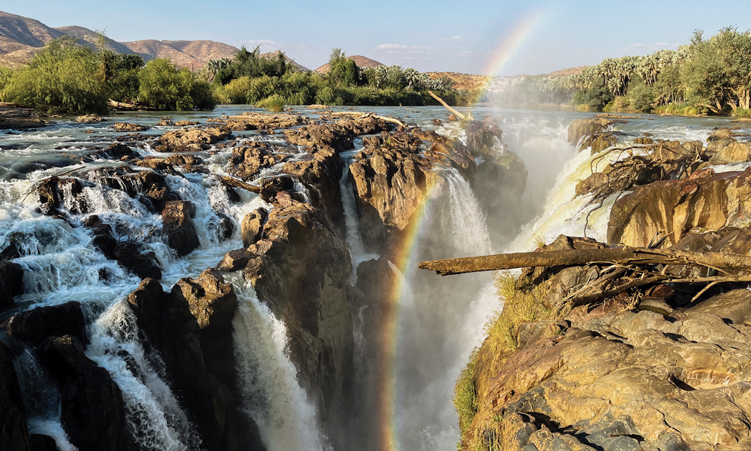
You don’t stumble across Epupa Falls by accident. You choose it. You chase it. You earn it. It’s the kind of place that tests your patience with long gravel roads and heat that hangs like a curtain, only to reward you with something far richer than a view.
Somewhere far in northern Namibia, where the Kunene River slices through desert and rock, there’s a rhythm that starts to pull you in long before you hear the water fall. Epupa loosely translates “to flow,” and nothing here is still. Not the river, not the wind in the palms, not the pulse in your chest when you first stand at the edge of those falls and feel the thunder roll beneath your feet.
The road to Epupa Falls isn’t a road – it’s a reckoning. The kind that strips away signal, stress and certainty.
It teaches you how to travel slowly again, to read the colour of the soil like it’s telling a story: sand that turns from bleached beige to crimson red, bushes that bristle to life the closer you draw to the water’s edge. Along the way, goats and cattle graze unbothered, guided by young Ovahimba herders. Everything here is simple but alive: stubbornly alive and as the Kunene River emerges through the trees like a silver thread, it’s clear that you’ve arrived somewhere sacred.
Omarunga Epupa-Falls Camp rests just 200 metres upstream from the crashing energy of the falls, where the river splits into a dozen channels and leaps over boulders with wild, deliberate beauty. Omarunga means “palm trees” in Otjiherero, and there couldn’t be a more fitting name. Towering makalanis stand like watchmen above the thatched camp. This place doesn’t announce itself: it settles into you. The camp is built with respect, not ego. You can tell by the way it hugs the riverbank and the quiet presence of the staff who seem to know you’ve come to rest, not to perform.
What makes Omarunga more than just a place to visit, is the fact that you witness a way of life. The Ovahimba people are among the last semi-nomadic tribes in Africa, and a guided visit to their village isn’t a tourist show, it’s an exchange. A sharing. You learn how they build with mud and cattle dung, how they adorn their hair with red ochre and butterfat, and why fire: okuruuo – is never allowed to die. You see children running barefoot, women sitting under the shade of trees and you remember what unhurried living feels like. It’s humbling. It’s grounding. It’s Namibia in its most unapologetic form.
And then, there’s the river. A living, shifting thing. From dawn until the stars appear, the Kunene is your soundtrack. You wake to it, eat beside it, and fall asleep with it still in your ears. Some days, it’s a soft murmur. Others, it roars.
For those who need more than stillness, there’s river rafting, fun, fast, and chaotic. There are guided walks for bird lovers (this region is rich with kingfishers and fish eagles), sundowner drives to high hilltops where the land rolls out beneath you in every direction, and those golden moments where you just sit by the bar, gin and tonic in hand, letting the river mist cool your skin.
The camp itself offers all the comfort you didn’t expect to find this far out: 14 en-suite rooms, a pool and bar with an incredible view of the river. If you’re more the feet-in-the-dust kind of traveller, the shaded campsites are perfect. Equipped with braai facilities, hot showers and ablutions that even cater to wheelchairs. You’ll find no unnecessary luxury here, but everything you need to feel human again. Meals are hearty, honest and always served with a view, breakfasts with birdsong, three-course dinners as the falls echo in the dark.
This is Brand Namibia: real, raw, unfiltered. It’s the Namibia that teaches you patience and presence, that invites you into ancient rhythms and makes you feel small in the best possible way. Gondwana Collection’s role here is not to lead, but to support: to build with purpose. The camp is a quiet agent of empowerment for the Ovahimba community, supporting local artisans, providing employment, and helping sustain a delicate ecosystem.
In a time where travel has become checklist-driven and photo-ops are prioritised over experience, Omarunga reminds you that the real story lies not in the perfect shot of a waterfall, but in the gentle smile of a child waving at you as you pass, the hum of palms in the evening cool, and the way you carry this place with you long after you’ve gone. If you’re a traveller at heart, not just a tourist, this is where you come to feel Namibia. Where you let it change you. Where you finally understand what it means to flow.


In an age of information overload, Sunrise is The Namibian’s morning briefing, delivered at 6h00 from Monday to Friday. It offers a curated rundown of the most important stories from the past 24 hours – occasionally with a light, witty touch. It’s an essential way to stay informed. Subscribe and join our newsletter community.

The Namibian uses AI tools to assist with improved quality, accuracy and efficiency, while maintaining editorial oversight and journalistic integrity.
Stay informed with The Namibian – your source for credible journalism. Get in-depth reporting and opinions for
only N$85 a month. Invest in journalism, invest in democracy –
Subscribe Now!