


The power stone? What stone? I am a 24-year-old Ovakwanyama woman and have never heard of ‘the stone’. I’ve heard of Mandume ya Ndemufayo, the last Kwanyama king. I’ve heard of how the Kwanyama got their name.
Each story I was told the central idea was that it had a lot to do with our unwavering love of meat.
I’ve heard stories of barren queens who sold their enemies to the Portuguese as slaves, and I’ve heard of narcissistic kings who were set alight in their huts by their servants because they were fed up by their never-ending demands, but until I saw an event invitation on my Facebook, I had never heard of our power stone.
Passed down from generation to generation, the stone is said to have travelled with the Kwanyama when we first migrated to Namibia.
Kept in a sacred hut that only the king, his traditional healer and her husband were allowed to enter and see, the power stone was placed at the centre of the kingdom and was believed to have a direct correlation with the wellbeing of the kingdom.
If the stone was found to not be in the upright position, it could have disastrous consequences for the kingdom.
As a way to ward off misfortune, an ox had to be slaughtered and its fresh blood smeared across the stone so that the kingdom would remain safe. And generation after generation it did, up until the era of Mandume ya Ndemufayo, which saw the end to a certain way of life for the Kwanyama.
After trying to ward off the Portuguese from selling hard liquor to his people which was creating alcohol dependency and complacency, he found himself wedged between the Portuguese and South Africans and with a new border dividing his kingdom which left half of the Kwanyama in Namibia and the other half in Angola.
Mandume’s reign slowly started to come under threat, and one fateful morning, as the sun was rising, South African forces attacked him in a fierce battle where he lost many men, and also lost his life.
It has been disputed whether he was killed by South African forces or committed suicide as a final defiance against his enemy to not give them the pleasure to kill him.
And after the death of Mandume, the fate of the Kwanyama people drastically changed and they disbanded. Many were forcibly recruited into the gruelling labour system which sent men and women marching south to work on building roads and cities. Without a king, and with many headmen seen as puppets for the colonial system, the Kwanyama kingdom fell.
The stone was kept a secret over time and was smuggled to Angola, brought back and then sent to Finland for ‘safekeeping’ after the war ended, only to be returned again to the Kwanyama people a good while after independence.
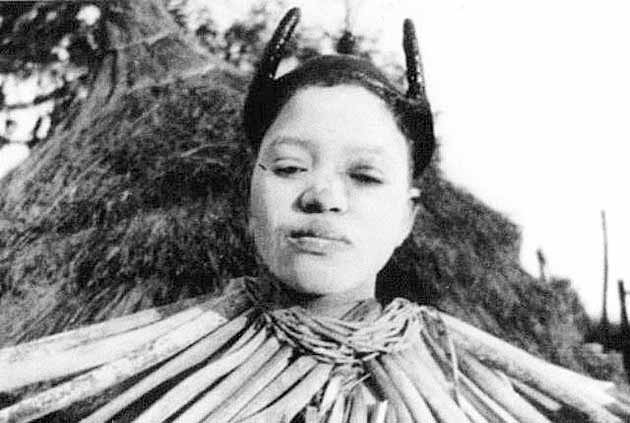
The film ‘The Power Stone’ used a montage of archival images, footage and recreation of integral Kwanyama customs and celebrations like Efundula. To illustrate the demise of King Mandume, the film juxtaposed images of photographs of Mandume being beheaded by South African forces with lino-cuts by the late renowned Namibian artist, John Muafengejo.
The film is narrated by local Kwanyama storyteller Nathanael Shinana and features various video interviews.
AfricaAvenir partnered up with the FNCC to show the film that was initially released in 1999 to a young Namibian audience who, in most cases, had not seen the film before.
The film screening was also used as a precursor to the 10th session of the Intergovernmental Committee on Intangible Culture Heritage in the hopes of creating a dialogue about culture in Namibia.
And once the film ended and the floor was open to questions and comments, it was quite evident it did.
With questions such as ‘were the directors Kwanyama? Because their pronunciation was off’, ‘did the stone lose it significance culturally when it was taken to Finland?’, ‘do our artefacts and heritage belong in museums?’, ‘why are other people telling our stories?’ rising up about the film, the questions and comments went on and on.
The discussion delved into the local film and art industry and what local artists are doing to ensure our stories are told accurately and don’t get lost in translation through subtitles and text. This in turn opened up the dialogue about access and funding for local artists to be able to make films and be able to distribute them to Namibians.
Then came the topic of what culture means. Where would the Kwanyama be if ‘the white man’ never came? And to nicely round off what was turning to a heated and invigorating discussion that would have gone on for hours if there was nobody to chair the discussion, Jacques Mushaandja added “culture is not static, it is ever evolving”.
And over 15 years after the film’s initial release, one can see that the dialogues, criticisms and self-awareness of what culture means to Namibians is ever evolving too.
In an age of information overload, Sunrise is The Namibian’s morning briefing, delivered at 6h00 from Monday to Friday. It offers a curated rundown of the most important stories from the past 24 hours – occasionally with a light, witty touch. It’s an essential way to stay informed. Subscribe and join our newsletter community.

The Namibian uses AI tools to assist with improved quality, accuracy and efficiency, while maintaining editorial oversight and journalistic integrity.
Stay informed with The Namibian – your source for credible journalism. Get in-depth reporting and opinions for
only N$85 a month. Invest in journalism, invest in democracy –
Subscribe Now!