



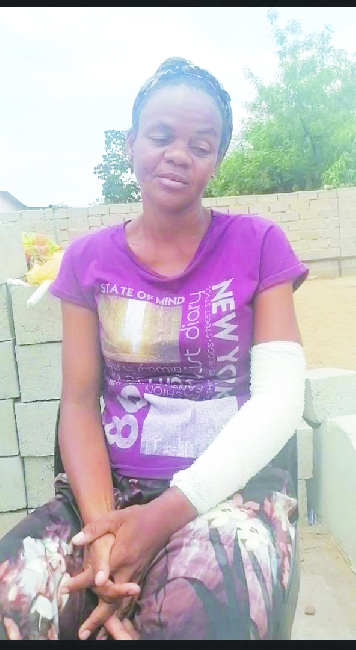
• ELIZABETH MWENGO THERESIA Mimi Mangalians, a 37-year-old woman living with epilepsy, says the condition has caused her immense pain and loneliness.
Mangalians lives alone in a shack given to her by her aunt who raised her after her mother passed away. None of her siblings stay close to Rundu’s Safari location, where she lives.
She does not have electricity and uses a gas stove for cooking. When the gas runs out, she also sometimes cooks using firewood, and she is forced to fetch water from her neighbours, as she has no water facilities.
Her illness started after she finished her Grade 10 exams, which she passed with 30 points.
“The first time it started I was just sitting and I felt a strong wind. When I woke up, I was at the hospital and was even told it was the third time I had fainted.”
Mangalians says her condition does not see her shaking or foaming at the mouth, but just falling.
“It is normal for one to have an episode without foaming because those that pass foam have a lot of saliva mixed with air in their lungs, but if you don’t have saliva pools, there will be no foam coming out of the mouth,” says neurologist Dr Percy Kumire.
Mangalians suffered deep burns from an epileptic incident two years ago, when she fell while she was cooking on the fire. She was burned on her arm and leg, and she says the wounds still haven’t healed properly.
She also recently burned her arm on the gas stove.
“I really don’t know how it happened because all I can remember is that there was a pot on the gas stove but still I burned my arm,” she says.
Kumire says it is not advisable for those living with epilepsy to live alone.
“They need attention, someone that will have a close eye on them because when they have an episode they do not have control, anything can happen to them, some even die due to that.
“There are some that have 90-second episodes while others may have a series of episodes in one day.
Kumire says some people are born with epilepsy, while others develop it after incidents like car accidents.
Mangalians says she often falls when walking to the shops to buy food because there is no one to help her buy groceries.
She gets some help from the Tobias family, who provide her with the little that they can, as well as community members who help her with food or pay her to do their laundry.
“She lives in the forth street from our house, we visit at times or she comes to our house and spends the day with us. Mimi doesn’t only need food or financial help but also attention. She needs love, we do not have it all but we try to help were we can,” says Yolanda Tobias.
“I call upon all my fellow Namibians, especially people at Rundu, to come forth and help her out, I and my family and few other people have been trying to help her out with some things but we fail here and there.
“It would be good if we can all come together and pay her a visit, and watch over her to make her feel that she is not alone,” says Tobias.
Mangalians says she does not wish anyone to go through her pain, and all she can do is pray and believe that all will be fine one day. At times she would like to visit her family, but she always worries that she will be a burden to them.
In an age of information overload, Sunrise is The Namibian’s morning briefing, delivered at 6h00 from Monday to Friday. It offers a curated rundown of the most important stories from the past 24 hours – occasionally with a light, witty touch. It’s an essential way to stay informed. Subscribe and join our newsletter community.

The Namibian uses AI tools to assist with improved quality, accuracy and efficiency, while maintaining editorial oversight and journalistic integrity.
Stay informed with The Namibian – your source for credible journalism. Get in-depth reporting and opinions for
only N$85 a month. Invest in journalism, invest in democracy –
Subscribe Now!