



A YEAR or two after independence, back in Namibia after my studies overseas, I drove into the legendary Kaokoland for the first time, alone in my trusted Land Rover, a carefree and adventurous youngster discovering his own country.
On my way to Epupa, I camped along the Huab River and spoke to the people living there. I’d seen tracks of elephant and was told of small groups in the area, but they were extremely wary and ran at the first sign of man. Wildlife was generally scarce and skittish. At a farmstead along the Huab, I was told of a lion that had recently been shot. I was confounded and exhilarated by all this, having been unaware that there were still any lions roaming free outside parks in north-western Namibia. The fabled lions of the Skeleton Coast, made famous through National Geographic features by Des and Jen Bartlett, had not been seen for about two decades. By 1995, according to the estimates of Philip Stander, the lion population west of Etosha National Park had been reduced to around 25 animals.
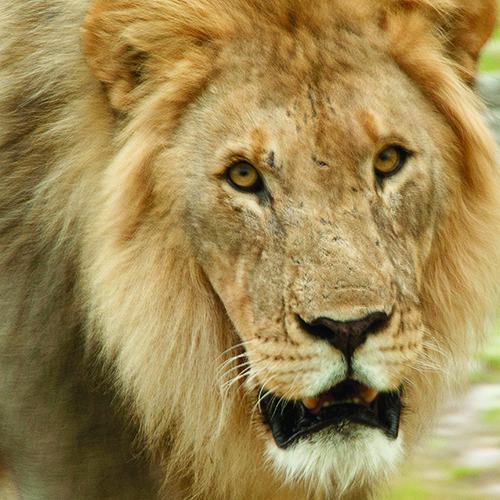
Today, the ‘desert lions’ of the north-west have rebounded and are amongst the most famous and well-studied lions in the world. They number around 150 and roam from the Ugab to the Kunene, and from Terrace Bay to Kamanjab, through some of the most spectacular – and most marginal – lion habitat imaginable. They are truly iconic.
No wonder, then, that they have become a significant tourist attraction; that they have featured in countless documentaries and youtube videos, and have built up a huge following in the virtual world of social media and the internet.
The work of Stander has been instrumental, in helping to increase lion numbers, in amassing fascinating data on their ecology, and in popularising them around the globe as individuals with names and family histories. In the process, Stander, barefoot and bearded, has become almost as mythical as the lions themselves.
Yet Stander’s work is not the only reason for the return of lions to much of the north-west, from where they had been eradicated by the communal farmers that lived here and survived on livestock herding in these same marginal lands. In the 1990s, far-sighted legislation enabled communal farmers to diversify their livelihoods by forming conservancies that generate returns from tourism, trophy hunting and other natural resource uses. This gave wildlife a direct value and has led to widespread game recoveries – including large predators. Today, lions and elephants, as well as giraffe and an abundance of plains game, are regularly encountered in the conservancies of the north-west (as well as in some conservancies of the north-east).
The recent shooting of the famous Terrace Male near the settlement of Tomakas in the Puros Conservancy – not as a hunting trophy, but presumably by a local farmer unwilling to be continually faced with the danger that lions pose – has again caused not just national but global outcry. It has motivated public calls to save the ‘last of the desert lions’. This creates the impression that the population is in severe decline, when it has in fact increased from 25 to 150 over the last two decades. If we are still saving the last of these lions, then how many do we want, exactly, to be roaming across farmland, outside national parks? And do we only want them in the north-west, where they are at their most photogenic? Or also in more suitable habitat, perhaps around Otjiwarongo or Gobabis? Do we want to open the fence separating Namibia from Botswana and the Kgalagadi Transfrontier Park and allow lions to roam across our Kalahari to Gochas and Aranos?
How many lions do we want, and where do we want them? Preferably not in our own backyard? Preferably not where our own children play or walk to school? Our perception of lions – and leopards and elephants and other dangerous wildlife – is relative to our unprotected proximity to and interaction with them. People who have never faced a wild lion on foot, unprotected, out there, who have never stood over the mangled remains of a cow or sheep or horse killed by any of our large predators, are perhaps no longer able to really, practically understand that a lion is a large, efficient and very dangerous predator, not necessarily averse to eating people.
The main reason why free-roaming lions exhibit respect for people outside cars and national parks is because they are regularly shot at and chased away by the locals who do not want to be close to them. Habituating lions to cars and people significantly elevates their danger for those who need to live with them. And, realistically, it is not possible for livestock farmers to live permanently with lions without there being conflicts. Lions are predators and livestock is prey. It is a very simple equation for conflict. The conflict can be mitigated, but it can never be eliminated completely. And farmers have a right to defend themselves and their property. So what gives us, as urban-based preservationists, the right to dictate to these farmers whether or not they should be living with lions?
The human population in the north-west continues to increase substantially. There are now over 52,000 people living in rural areas of the Erongo-Kunene Community Conservation area . The area covers around 74,000 square kilometres – that’s just over three times the size of Etosha National Park, where the largest lion population in Namibia is well-protected (sizable lion populations also occur in the national parks and adjoining conservancies of the Kavango and Zambezi Regions). While an estimated 300 to 400 lions live in Etosha, the human population there is confined to the tourism camps; there are no people or livestock living with the lions – only meandering tourists, safe in their vehicles.
The recovery of the lion population in the north-west is a major Namibian conservation success story, and is largely a result of a greater tolerance towards predators by the resident communities. A hundred and fifty is a substantial number of lions for these communal farming areas. Notably, an average lion requires about eight kilogrammes of meat a day, which means these lions are consuming around 1,200 kilos of meat per day or the equivalent to approximately ten gemsbok or three cows eaten every day of the year! Expecting ever-increasing numbers of lions here – where they must coexist with people and their livestock – is unrealistic. As shown by Stander’s work, the lions use most of the area, at least as temporary range. Where would more lions disperse to, and what new conflicts would they cause?
The ever-increasing public concern about our environment and its charismatic species is very positive. The sentiments expressed on internet blogs and in social media are a clear indication that people really care. It is commendable that people want to save the last wildlife. Yet, we need to be careful that we are not misled by the downward trends of wildlife elsewhere, or by international calls to save ‘the last’ of so many species – when these are not relevant to Namibia. It is easy to overlook that Namibia is different to most other countries in Africa, or around the world. We actually have healthy and increasing populations of most species. And most of the substantial wildlife recoveries have taken place outside of state protected areas. We need to be careful about what our conservation goals actually are. We need to make sure that they are guided not just by public opinion and sentiment, but also by scientific knowledge of the situation on the ground. And we need to ask ourselves what effects they will have and in whose interests they are being carried out.
In an age of information overload, Sunrise is The Namibian’s morning briefing, delivered at 6h00 from Monday to Friday. It offers a curated rundown of the most important stories from the past 24 hours – occasionally with a light, witty touch. It’s an essential way to stay informed. Subscribe and join our newsletter community.

The Namibian uses AI tools to assist with improved quality, accuracy and efficiency, while maintaining editorial oversight and journalistic integrity.
Stay informed with The Namibian – your source for credible journalism. Get in-depth reporting and opinions for
only N$85 a month. Invest in journalism, invest in democracy –
Subscribe Now!