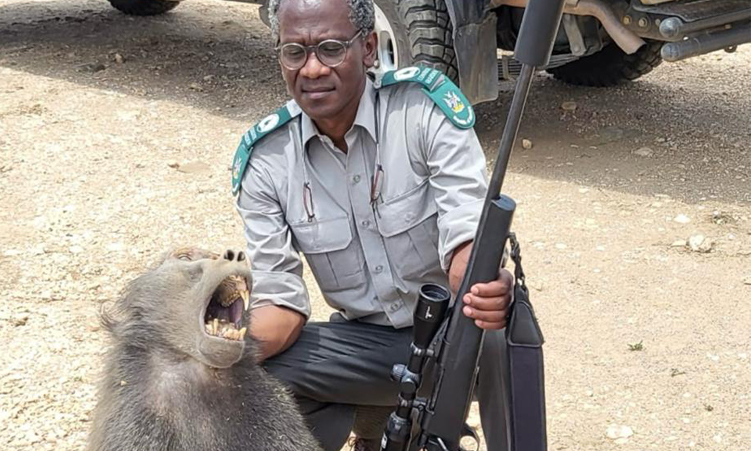
He ruled over the dustbins of Windhoek’s Kleine Kuppe suburb for a year.
He invaded some residents’ yards and ate from their lemon trees with no mercy, leaving a trail of destruction in his wake.
Many of his kind followed him from the nearby rocky mountains, down to the homes of the humans.
They moved in groups. Sometimes four to five baboons at a time, with him as ‘ring leader’.
There, he ruled the kitchens of the humans with terror and rummaged their trash while nibbling on food waste.
He jumped on their rooftops… bang, bang, bang. “What is that sound?” one resident asks as she rubs her eyes, awakened from her afternoon nap.
“The king has returned,” one part of her brain already knows.
Then one day, a frustrated neighbour, Dolla Kavari, calls an official from the Ministry of Environment, Forestry and Tourism after yet another intrusion.
The warden pulls the trigger, aiming at the ‘ringleader’.
One bullet in the leg is enough to bring him down. ‘The king’ is now dead.
Kavari says she was terrified of the baboons constantly entering her house from the balcony, opening her kitchen pantry and helping themselves to her groceries.
“They especially loved taking spaghetti and macaroni, shoving them under their armpits, eating and coming back for more to feed their young ones,” she says.
Kavari didn’t feel safe, especially not with a toddler in the house.
Another resident, Peter Mawoyo, remembers waking up to the horrific sight of one of the baboons in his kitchen.
“It was eating my rice, spaghetti and peanut butter,” says Mawoyo.
He says when their eyes met, the animal charged at him.
“I ran and locked myself in my room. I waited five to 10 minutes and then it left,” he says. Other times, he would come home from work to find his kitchen in a mess and all his food gone.
“I knew it was them. They entered from the window,” he says.
Another resident who spoke on condition of anonymity believes if the ‘king’, as some called him, was really dead, then this reign of terror has truly come to an end.
“He was just a baboon, but he terrorised our neighbourhood. I think he was the leader of the pack. He was their king,” she says. She believes residents can now be at peace.
Chief control warden in the ministry of environment’s directorate of wildlife and National Parks Management Penda Shimali, confirms that he was called by a resident to take down ‘the king’ a few weeks ago. “We don’t just shoot, we take down the leading male as he is the root cause of the problem. Once the leader is dead, the other baboons often stay away,” he says. Shimali warns that the absence of the baboons without their leader only lasts three two four months, however.
“After that, a new leader of the group will emerge, and the terrorising will begin again,” he says.
*Read Shimali’s full explanation on The Namibian’s Facebook page later today.