


Communities, government leaders and development partners came together on 23 March in the Kavango East region to commemorate the International Day of Forests under the theme ‘Forests and Economies’, highlighting the role forests play in supporting livelihoods, culture and sustainable economic development.
The celebration, hosted under the Dryland Sustainable Landscapes Impact Programme (DSL IP), brought together stakeholders, schools, local producer groups and cultural institutions.
The DSL-IP Namibia Child Project is run by the Ministry of Environment and Tourism and the Ministry of Agriculture, Fisheries, Water and Land Reform, with support from the United Nations Food and Agricultural Organisation and the Global Environment Facility.
The event emphasised the importance of sustainable forest management while showcasing practical community-led initiatives.
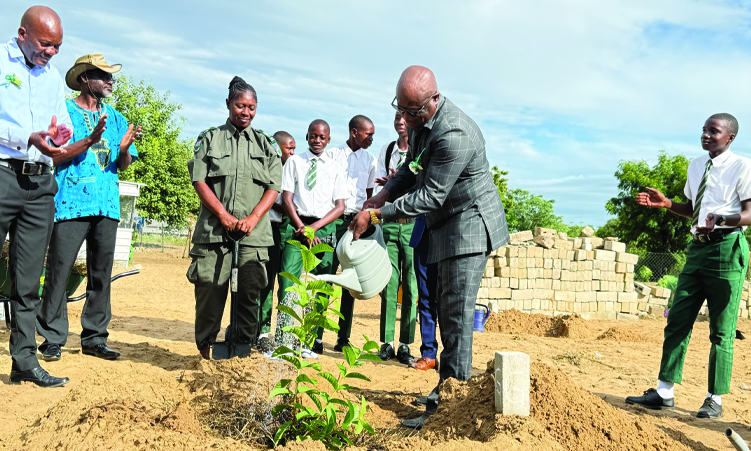
A symbolic tree-planting ceremony at Kamunoko Secondary School marked the beginning of the day’s activities.
The event was led by Kavango East governor Julius Hambyuka alongside representatives from the ministries, the Dryland programme and the school community.
The event underscored the importance of trees in sustaining life, improving environmental health and combating climate change.
By actively involving students, the initiative reinforced the role of young people as future custodians of natural resources and positioned schools as important platforms for environmental awareness and action.
Participants took part in an indigenous walk from the Rundu forestry office to the Kavango museum.
The walk provided an opportunity to observe indigenous tree species in their natural environment while promoting community engagement in forest conservation.
It also highlighted the importance of preserving indigenous knowledge systems.
At the museum, the governor emphasised the link between forests and economic development in the region. The address highlighted how forest resources contribute to livelihoods through sustainable harvesting and value addition.
Local producer groups, particularly wood carvers, depend on forest materials to create marketable products that generate income and support household economies.
“It is a collective responsibility of all of us to act responsibly today, else we risk losing not only our forests but also the economic opportunities and livelihoods they give us. Therefore, I call upon all stakeholders, government institutions, traditional authorities, civil society organisations, development partners and community members to work together,” stated Hambyuka.
The Dryland programme project also gave an overview of some of the notable interventions within the region.
“The project is supporting a range of practical interventions aimed at restoring degraded landscapes while strengthening community livelihoods.
These efforts include the establishment of a tree nursery at Ndiyona, where indigenous species are raised to support restoration and ongoing initiatives.
In addition, a borehole has been drilled at Muduva Nyangana Conservancy and Community Forest to support a community-based nursery and horticulture activities, improving water access and enabling year-round production,” said the programme’s regional project implementation officer Erikka Mokanya.
Local woodcraft producer groups contributed to the celebration by donating handcrafted items to dignitaries and stakeholders, symbolising appreciation for continued support towards conservation and local enterprise development.
An indigenous tree information-sharing session, organised by the Kavango museum in collaboration with the Dryland programme project and traditional authorities, provided a platform for learning and exchange.
Participants gained insights into the ecological, cultural and economic importance of indigenous tree species, including their traditional and medicinal uses.
The session strengthened appreciation for indigenous knowledge systems and emphasised their role in supporting sustainable land management and community well-being.
The celebration reinforced the critical link between forest conservation and livelihoods.
By bringing together communities, leaders and development partners, the event demonstrated that sustainable forest management is not only an environmental priority but also a pathway to economic resilience and improved well-being.
As Namibia continues to advance its restoration and conservation efforts, initiatives such as these highlight the importance of collective action in safeguarding forest ecosystems for present and future generations.
– DSL-IP Namibia Child Project
In an age of information overload, Sunrise is The Namibian’s morning briefing, delivered at 6h00 from Monday to Friday. It offers a curated rundown of the most important stories from the past 24 hours – occasionally with a light, witty touch. It’s an essential way to stay informed. Subscribe and join our newsletter community.

The Namibian uses AI tools to assist with improved quality, accuracy and efficiency, while maintaining editorial oversight and journalistic integrity.
Stay informed with The Namibian – your source for credible journalism. Get in-depth reporting and opinions for
only N$85 a month. Invest in journalism, invest in democracy –
Subscribe Now!