



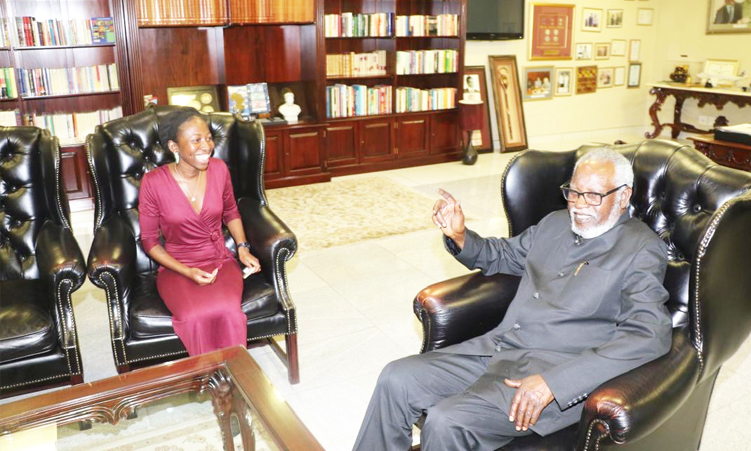
“What are those things on your face?” the old man asks me as we sit down for an exclusive interview in his office on Schweringsburg Street.
It is a warm morning. Founding president Sam Nujoma squints his eyes and studies my face before asking the question. He looks disgusted.
In the next minute or so, I would be escorted out of his office by one of his assistants.
The interview ends before it can start.
A CONSERVATIVE MAN
While Namibia mourns the death of its founding president, I find myself returning to the memory of a man often described as humorous, yet intimidating.
His stern temperament casting a long shadow. This is not a tribute, nor is it a condemnation. It is simply an account of an encounter that reinforced much of what I already knew about the kind of person Nujoma was: rigid, strict and conservative.
To some, what happened might seem trivial. A laughable clash between a stubborn, uncompromising elder set in his ways and a young journalist with unconventional style.
But to me, the encounter was unsettling.
THE ‘ALMOST’ INTERVIEW
The year was 2020, Valentine’s Day, to be precise. I was a young journalist at The Namibian. My editor wanted a sit-down interview with Nujoma himself for a story reflecting 30 years of independence.
The morning of the interview, I dressed the part: a maroon dress that fell below my knees, with sleeves long enough to cover my tattoos. A small gesture of professionalism, not an attempt to appease.
The dress was a gift from my mother, a work-appropriate outfit. My mother, a survivor of the dungeons at Lubango – a part of Swapo’s past that left a stain on Nujoma’s leadership, for which no reckoning has ever come.
Upon arrival at Nujoma’s offices, we posed for a formal photo, then were directed to our seats as the equipment was set up.
I turned to him with the polite deference expected when addressing an elder, and greeted him as custom dictates. “Good morning, tatekulu. I’m Arlana Shikongo, from The Namibian,” I said.
He didn’t respond right away. His eyes drifted across the room, scanning the movement around him, before settling back on me.
“Oh. Are you a Wambo?” he asked.
I smiled politely. Before I could answer, his gaze sharpened, squinting as if trying to bring my face into focus. His next words came abruptly: “What are those things on your face?”
I laughed, anticipating a light-hearted exchange about fashion choices.
Instead, his face contorted and he began to reprimand me – in Oshiwambo. His voice had taken on an accusatory edge, his anger mounting, his expression twisting in disgust. While I don’t speak Oshiwambo, I understood that his fury was directed at me.
I glanced at his staff for guidance. I tried apologising for not speaking Oshiwambo, but the mood had shifted. His assistant ushered me out of the room. Nujoma was still shouting.
“What just happened?” I asked.
The assistant said: “It’s your ‘earrings’. He’s offended by them.”
I stared at him. Surely, I had misheard. My jewellery? The silver studs in my cheeks and a few adornments on my nose and lip were the offence?
I had prepared myself for a difficult interview. But this? This felt petty.
I had two choices: Remove the piercings, or the interview would not happen.
I refused. I handed my questions to my colleague and for the next hour, I waited in the foyer.
As Namibia mourns, I find myself recalling that day.
I had a complicated relationship with the idea of Nujoma even before that day. His documented contempt for lesbian, gay, bisexual, transgender, queer/questioning, intersex and other people, the stories of his cruelty during and after the liberation struggle – none of it inspired admiration in me.
Yet, some part of me had hoped that this meeting might be different. A glimpse of wisdom, of humility in old age. Maybe a softened, reflective version of the man who commanded a revolution.
Instead, I saw someone intolerant, and bound to the worldview that had shaped him.
In his death, I reflect on the nuances and contradictions that make up a person.
Nujoma was many things: A liberation hero. A nation-builder. A leader whose determination helped free Namibia from colonial rule. But his legacy is marked not only by triumph but by fear, control and silence.
Though many describe him as humorous and humble, he was also a man of rigid temperament, capable of swift and unrelenting fury.
My experience, and the stories I’ve heard of those branded as ‘spies’ and detained in Angola – people like my parents –corroborate this.
When confronted with ideas or realities that did not align with his own, he often met them with disdain and hostility. His intolerance had real, lasting consequences. What I experienced was nothing compared to the fate of those who found themselves at odds with his will during and after the liberation struggle.
His death will be met with reverence by some, discomfort by others. For me, it is a reminder of the complexities of the individual and leadership, of how history chooses what to remember, and of the quiet ways power lingers, even after it is gone.
- Arlana Shikongo was a journalist at The Namibian and used to be a presenter at Desert FM.
In an age of information overload, Sunrise is The Namibian’s morning briefing, delivered at 6h00 from Monday to Friday. It offers a curated rundown of the most important stories from the past 24 hours – occasionally with a light, witty touch. It’s an essential way to stay informed. Subscribe and join our newsletter community.

The Namibian uses AI tools to assist with improved quality, accuracy and efficiency, while maintaining editorial oversight and journalistic integrity.
Stay informed with The Namibian – your source for credible journalism. Get in-depth reporting and opinions for
only N$85 a month. Invest in journalism, invest in democracy –
Subscribe Now!