


Stephane Ebongue fled Cameroon because of the colour of his skin – his albinism made him a target for those who believe such people have special powers. Years later, he returned home to confront a witch doctor, and to question him about the practice of using human body parts in ‘magic’ potions.
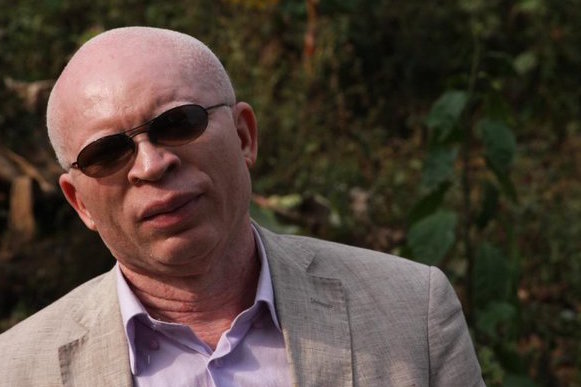
Stephane Ebongue stands nervously at the edge of a forest trail, dressed in a suit and carrying a briefcase. His dark sunglasses are a necessity because he has albinism, but they also hide his nervousness. “My heart is beating fast. I have never come to a place like this before, ” he says.
This is the day he hopes to find answers he has spent years searching for. The trail leads to a witch doctor who trades in albino potions.
“I would like to find out why albinos keep getting killed. Maybe the secret lies at the end of this path, ” he says.
Ebongue is a journalist, a rational man who deals in facts. He does not believe in magic, yet he is deeply unsettled about this meeting.
Across Africa, in countries such as Tanzania, Malawi and Ebongue’s own country, Cameroon, there is a belief that people with albinism bring luck or have magical powers. This has devastating consequences for those with the condition.
“It is believed that parts of an albino, such as their heart, hair or fingernails are important to make magical potions – for instance to fertilise the soil, to become invincible, to win political elections or a football match, ” says Ebongue.
“This is why albinos are killed and mutilated for their body parts. ”
According to a recent UN report, such body parts can fetch prices from US$2 000 for a limb to US$75 000 for a ‘complete set’ – a whole body.
Ebongue was 15 when his older brother, Maurice, who also had albinism, went missing 30 years ago.
“He went out one morning, and did not come back, ” says Ebongue.
Days later, the family found the 18 year old’s body in bushes. He had been mutilated. “His stomach was opened – I don’t know what was missing inside, ” he says.
Ebongue’s parents tried to give their two sons with albinism a normal childhood – they treated them the same way as their other children – so it wasn’t until he first went to school that he realised he was different. His classmates would ask him, “Why is it that you are white and we are black? ”
“They were coming to touch my skin, thinking that I had put talcum powder on there, ” he says.
At first, he got into fights at school but his parents, both teachers, knew what to do.
“They understood the problem, and pushed me to study harder.
“My revenge was that I was always the first in my class. ”
The trouble was that like most people with albinism, Ebongue had very poor sight, which made it difficult for him to read small print or see the blackboard, even when he sat at the front of the class.
“During official exams, there were many times I had to hand in a blank sheet of paper, ” he says. “Not because I wasn’t up to the task, but because the script was written so small that I could not read it. I had to give back a blank sheet of paper and go out crying. ”
He swore to himself that he would one day create a library where visually impaired people like himself would be able to read with ease.
Ebongue went to study journalism and English literature at university, where he was the only student with albinism out of 10 000.
His uniqueness made him a point of reference in the local community.
“People would say, ‘Where the house of the albino is, meet me there,’ ” he says.
By 2007, at the age of 37, he got married and worked as a journalist in Buea, in the shadow of Mount Cameroon, one of Africa’s most active volcanoes. It was the volcano which caused a huge crisis in Ebongue’s life.
“It is believed that when there is an eruption, it means Epasamoto, the god of the mountain, is angry, ” says Ebongue. “To calm him down, they need the blood of an albino. ”
When the volcano had erupted in 1999, lava flowed down the side of the mountain, stopping just short of Buea. There were no casualties, but the traditional doctors claimed that the town had been spared only because albinos had been sacrificed.
“When I lived in Africa, I had three enemies: the sun, the people’s disgust and the fear, ” he says.
“Here, I don’t have such problems. I feel freer here, I feel free to move, I’m not ashamed. ”
In his new home, Ebongue found he was provided with specialist sun cream as well as a magnifier to help him read. He had never seen anything like it before – and when he saw what it could do, he burst into tears. Before, it would take him two months to read a novel.
In an age of information overload, Sunrise is The Namibian’s morning briefing, delivered at 6h00 from Monday to Friday. It offers a curated rundown of the most important stories from the past 24 hours – occasionally with a light, witty touch. It’s an essential way to stay informed. Subscribe and join our newsletter community.

The Namibian uses AI tools to assist with improved quality, accuracy and efficiency, while maintaining editorial oversight and journalistic integrity.
Stay informed with The Namibian – your source for credible journalism. Get in-depth reporting and opinions for
only N$85 a month. Invest in journalism, invest in democracy –
Subscribe Now!