



THE Presidency said there is progress regarding talks between Namibia and Botswana on allegations that people are being killed at the borders for alleged wildlife poaching.
State House yesterday said the public will soon be informed on the latest about the talks.
The Namibian last year reported about an unwritten shoot-to-kill policy adopted by the Botswana government towards suspected ivory poachers crossing into that country from Namibia and Zimbabwe, which has claimed many lives.
In fact, that report said over the past two decades, 30 Namibians and at least 22 Zimbabweans have been killed in Botswana’s anti-poaching operations – although Namibian community and rights’ groups claim the figure could be much higher.
Presidential spokesperson Albertus Aochamub told The Namibian yesterday that the two governments are determined to find solutions to the issue.
“Both the ministers of home affairs and international cooperation and their Botswana counterparts are seized with the matter for a while now. Good progress is being made, and we will report as developments are concluded,” Aochamub stated.
On Monday, Geingob started his attempts to woo his political comrades across Namibia’s eastern borders.
This includes a proposed plan to co-own a desalination plant with Botswana, a project which will turn seawater into drinkable water for the two drought-hit countries.
Aochamub said it is too early to estimate the total cost of the proposed desalination plant, though.
Geingob spoke about the proposed water deal during his speech in Botswana’s parliament on Monday, saying the two countries need to agree on beneficial cross-border projects.
“One such initiative that must be investigated and brought to fruition urgently is the harvesting of seawater for our mutual benefit,” he stated.
Asked about the exact details of the proposed water agreement, Aochamub said the matter was raised during their official talks and also in the technical meeting of ministers responsible for the sector.
“It is still early to determine costs and timelines until the feasibility studies are completed. At this time, both governments are exploring how to collaborate in the area of water security, and desalination is one such possibility, amongst other solutions being considered,” he explained.
Geingob reminded his fellow leaders in Botswana that the two countries are the most drought-prone countries in sub-Saharan Africa, and the reality is that with climate change, it will only worsen.
“Through our own resources, as well as tapping into our regional development finance institutions and global initiatives such as the Green Climate Fund, we must find solutions for our common challenges,” he added.
Besides the proposed projects, the President said there are cross-border projects whose implementation needs to be fast-tracked. Examples given by Geingob include the construction of a railway line to export Botswana coal to world markets via Namibia’s sea port.
Namibia and Botstwana have jointly executed plans together over the past few years, including the Trans-Kalahari highway, and the establishment of dryport facilities for Botswana at Walvis Bay. Last year alone, Namibia exported diamonds worth more than US$1 billion to Botswana.
Geingob said he is pleased that Gaborone is now gradually becoming the diamond capital of the world, and that the two countries should cooperate more as producers in the same neighbourhood to build up a robust and diversified regional hub.
“Forever gone are the days that Gaborone was referred to as a cattle post. I commend and salute you on this excellent progress,” Geingob said.
The President also took some time to explain to Botswana’s parliament about his Harambee Prosperity Plan, a document which has ideas on how to improve the lives of Namibians by implementing state projects on time.
The President furthermore spoke about the historical ties between the two states, which includes his work as a Swapo leader during the liberation struggle.
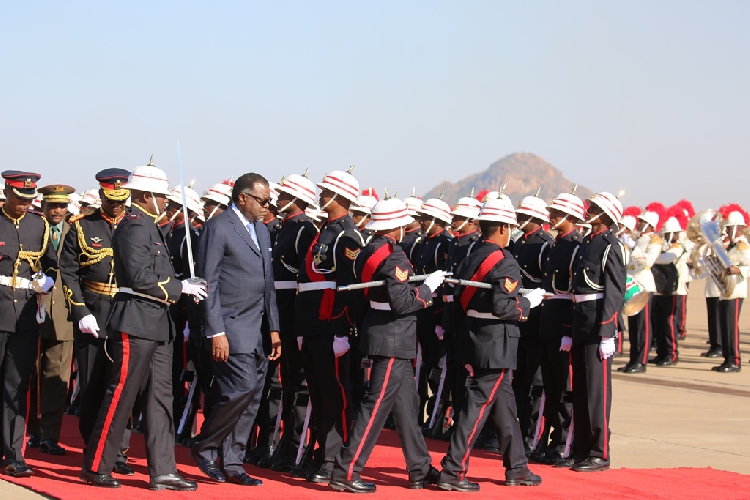
Geingob was accompanied by several Cabinet ministers and other top officials from State House, such as his economic adviser John Steytler.
In an age of information overload, Sunrise is The Namibian’s morning briefing, delivered at 6h00 from Monday to Friday. It offers a curated rundown of the most important stories from the past 24 hours – occasionally with a light, witty touch. It’s an essential way to stay informed. Subscribe and join our newsletter community.

The Namibian uses AI tools to assist with improved quality, accuracy and efficiency, while maintaining editorial oversight and journalistic integrity.
Stay informed with The Namibian – your source for credible journalism. Get in-depth reporting and opinions for
only N$85 a month. Invest in journalism, invest in democracy –
Subscribe Now!