
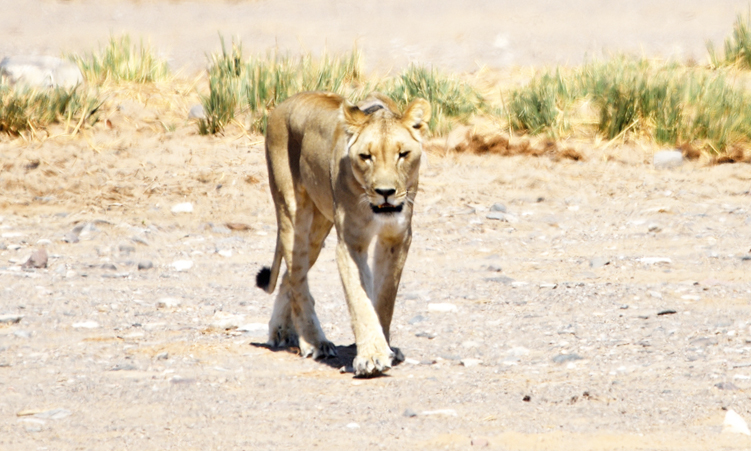
‘A lion began calling – a sawing, rasping sound that echoed off the rock’
I Had conviction. The GPS did not. Every few metres, it insisted on a U-turn.
I ploughed on, sand scraping the chassis of the four-wheel drive.
I marvelled at the ground I was covering even as the troughs deepened and the vehicle pitched and lurched. It was exhilarating, until it wasn’t.
One particularly deep pitch sent sand cascading over the bonnet.
Sense finally prevailed and I yielded to the GPS. I was trying to access the Hoanib Valley on a route I had taken back in 2017 with Namibian conservation icon Garth Owen-Smith and his partner Margaret Jacobsohn.
Garth, who died of cancer in 2020, was a man I greatly admired for his dedication to communities in conservation. The journey was part homage to him and part submission to the pull of the desert.
Seasonal floods in northern Namibia have grown increasingly destructive, a trend linked to climate change.
The water vanishes almost as quickly as it arrives, swallowed by the riverbed.
The latest surge had dumped tons of sand across the floodplain, smothering the access route. Like Garth, it was gone.
Instead, I took the long way around, climbing over a rocky plateau before plunging into a deep gorge.
The drive was bone-shaking, stones clattering against the wheel well, sunburnt rock walls closing in on either side.
At last, the gorge released me onto the Hoanib riverbed – a sandy highway lined with towering trees, their shade cooling the burning soil.
Beyond, barren hills and dunes stretched to the horizon in washes of orange, beige and blue.
The world outside felt distant and unreachable, and in that isolation I found a deep sense of ease.
I had been less at ease on my previous trip. On our way north to the Hoanib, Garth had steered his Land Rover over obscure desert shortcuts, checking in on conservancy communities.
Some reported lions attacking livestock, a trend brought on by prolonged drought.
At one small village in Torra Conservancy, chairperson Tommy Adams told us that a pride of lions had broken into a woman’s poorly made kraal.
“More than 100 goats were killed,” he said. “That woman was crying on the ground.
She said, ‘Tommy they’ve killed all my goats. Do you know how long it’s taken me to build that herd? Now I have nothing.’”
We camped that night on the edge of a dry riverbed. In the morning, I crawled out of my tent to see Garth intently studying the ground nearby.
“Big male,” he said. “Couple of females. Cubs too.”
The tracks were barely 10m away.
After another day’s drive across harsh terrain, we camped at the foot of a rocky hill cut by a stream. As we sat around the fire, a lion began calling – a sawing, rasping sound that echoed off the rocks above.
I crept into my tent with trepidation.
Next morning, Garth rose before me and noticed that I had barricaded the entrance with the camping chairs.
“It’s not the lions that you hear,” he said, smiling. “It’s the lions you didn’t hear.”
I dwelled on those moments as I weaved towards an island of ana trees where a giraffe and her calf browsed on seed pods.
A male walking towards them stopped, studying me warily. I turned off the engine and marvelled at these giants.
Dwarfed by trees whose deep roots tap into the water table below, they depend on this lifeline for food. Without trees, they would not survive here, and neither would the lions that hunt them.
With little grazing in or around the valley, plains game are virtually absent, save for a small population of superbly adapted oryx.
Yet the lions have carved out a way to survive. They travel west to the coast, some 45km from the valley’s heart, to prey on fur seals, or head far inland in search of game or livestock.
Within the valley itself, they have mastered the art of hunting giraffe, one of Africa’s most formidable prey species.
In his extensive studies on desert-adapted lions, researcher Philip Stander has documented a remarkable suite of strategies to tackle giraffes in an environment where prey is scarce and failure costly.
Hunting in coalitions, the cats work together to isolate and exhaust the giraffes. They steer their quarry into softer sand where their long-legged strides become a liability rather than an advantage.
What follows is not the explosive ambush of a savannah hunt, but a drawn-out pursuit that gradually saps the giraffes’ strength.
Closing in, the lions focus on the hindquarters, attempting to destabilise their prey, risking the fatal proximity of their brutal kicks before delivering a killer bite.
I had hoped to interview Philip but, as his former research assistant Emsie Verwey joked, he is such a desert hermit that finding him is like trying to find Bigfoot.
A PASSION FOR BROWN HYENAS
Emsie had left lion research and found her own passion in another remarkable creature.
She had been working as manager of Hoanib Skeleton Coast Camp, one of just two safari camps in the valley, when a staff member told her about a pair of brown figures he had spotted nearby.
On investigating, Emsie found what appeared to be a den. She set up a camera trap and the footage revealed a brown hyena lair.
“A female stuck her head down the hole and out came these two little cubs,” she says.
Emsie visited every morning, observing the family through binoculars while also keeping the camera rolling. “That’s when I began understanding what it took for these hyenas to survive.”
Locating a small number of clans in the area, she discovered that brown hyenas travel vast distances in extreme conditions in search of food.
“I noticed a female returning to her den with part of a zebra,” she says, “but the nearest herd was at least 50km away.”
The hyenas’ social lives in the den offer a contrast to their solitary foraging.
There is grooming, interaction, a kind of cohesion. Cubs grow up in this harsh environment with an early understanding of distance and risk.
When they leave the den after 12-15 months, the valley becomes both opportunity and threat.
Predators, competition and the sheer scale of the environment all conspire against them.
Many die before they reach adulthood (two and a half years), particularly young males whose inclination to investigate rather than avoid proves costly.
Yet they persist, moving through the landscape as both participants and beneficiaries of its harsh economy.
They are scavengers, but such a description feels inadequate.
In a place where nothing can be squandered, they are smart and proficient.
They range as far as the fur seal colony to scavenge on carcasses – some from lion kills.
– discoverwildlife.com
– Read the rest of this feature at www.namibian.com.na