


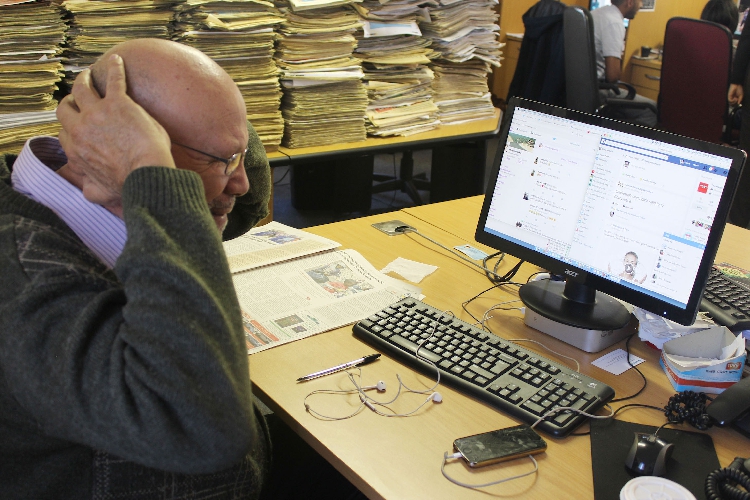
THE 2017 struggle is of such a nature that we compete with bornfrees in an era characterised by Facebook live chats, arty Instagram shots, instant and fleeting Snapchat vlogs, #etcetera, #etcetera.
As much as I own that I am not ageist, the truth is that many of us non-tweeps might feel like the digital rat race is getting the better of us and our destination-driven journeys – with each day becoming more challenging than the previous one.
Barely eight years short of the babies of the 90s in terms of my own calendar years on this planet, I recently deactivated my Facebook account and this is my second stint of this nature.
I do have a Twitter account, but literally have no idea since the day after I created it what its password is.
Yes, I just confessed all of that. And I am sure, I have brothers and sisters whose situation is equally dire if not worse.
approached René Lötter, a Namibian in the South African diaspora, to shed some light on what goes down in the digital world of business and how one could navigate one’s way through the intermittent light at the end of the seemingly one-dimensional tunnel.
She is Netwerk24’s head mistress of social media.
Lötter says: “In southern Africa, we mainly use Facebook, Twitter and Instagram.”
According to her, the relatively new kid on the block, Snapchat, is big in the USA but not so much here at our end of the food chain.
Even the lingo might be tricky for some us, she says, “Instagram and Pinterest are regarded as ‘positive’ tools. [It is] there to share interests and art. And good pictures.” Demonstrating that humour is the most powerful tool through these hurdles, Lötter says, “The ugly things are generally found on other social media.”
Raising an important point about the pros and cons of social media and how these two extremes are often inextricably intertwined in a web of madness, she says: “Facebook and Twitter are used to share ‘news’ but more often views…
“Social media helps people stay on top of news and opinion trends, but you have to make sure you follow credible sites.”
It has also given every Jacob and Johanna a license to claim we are now all journalism moguls, it appears. “These days a lot of fake news sites have sprung up even with names resembling old and trusted news outlets. Look closely at the websites and sources.”
“Dangers? I find that the pragmatic, sensible and middle opinions are drowned out. Social media is dominated by the fringe left and fringe right – those who are most vocal (fools who rush in where angels fear to tread). More analytic and academically sensible views are screamed into oblivion and insulted so much that they disappear or keep quiet.”
Her take is that one can, if that is an objective, stay up to date easily if you follow credible news sites. “In my opinion, won’t in my opinion miss much personally/emotionally if you slack down on social media, unless your job requires it and unless you have a business that you want to get out there. Social media is super important if you want to advertise your brand and get your brand image out there.”
Last, but certainly far from the least, she says this: “Do not ever text or engage on social media drunk or impulsively. Always make sure your statements are in line with the Constitution and [do] not [amount to] libel or hate speech. If somebody else writes inflammatory things, delete them.”
– An avatar is an image or username that represents a person online, often within forums and social networks.
A bio on social media refers to a short text that explains who the user is.
Blog is a word that was created from the words ‘web’ and ‘log’. Blogs are usually maintained by an individual or a business with regular entries of content on a specific topic, descriptions of events, or other resources such as graphics or video. ‘Blog’ can also be used as a verb, meaning to maintain or add content to a blog.
Bookmarking online follows the same idea of placing a bookmark in a physical publication – you’re simply marking something you found important, enjoyed, or want to continue reading later.
A chat can refer to any kind of communication over the internet but traditionally refers to one-to-one communication through a text-based chat application, commonly referred to as instant messaging (IM) applications.
– A comment is a response that is often provided as an answer or reaction to a blog post or message on a social network.
– The LinkedIn equivalent of a Facebook ‘friend’ is a ‘connection.’ Because LinkedIn is a social networking site, the people you are connecting with are not necessarily people you are friends with, but rather professional contacts that you’ve met, heard speak, done business with, or know through another connection.
Crowdsourcing, similar to outsourcing, refers to the act of soliciting ideas or content from a group of people, typically in an online setting.
Direct messages – also referred to as ‘DMs – are private conversations that occur on Twitter. Both parties must be following one another to send a message.
In a social media setting, a follower refers to a person who subscribes to your account in order to receive your updates.
Friends’ is the term used on Facebook to represent the connections you make and the people you follow. These are individuals you consider to be friendly enough to see your Facebook profile and engage with you.
GIF is an acronym for Graphics Interchange Format. In social media, GIFs serve as small-scale animations and film clips
In an age of information overload, Sunrise is The Namibian’s morning briefing, delivered at 6h00 from Monday to Friday. It offers a curated rundown of the most important stories from the past 24 hours – occasionally with a light, witty touch. It’s an essential way to stay informed. Subscribe and join our newsletter community.

The Namibian uses AI tools to assist with improved quality, accuracy and efficiency, while maintaining editorial oversight and journalistic integrity.
Stay informed with The Namibian – your source for credible journalism. Get in-depth reporting and opinions for
only N$85 a month. Invest in journalism, invest in democracy –
Subscribe Now!