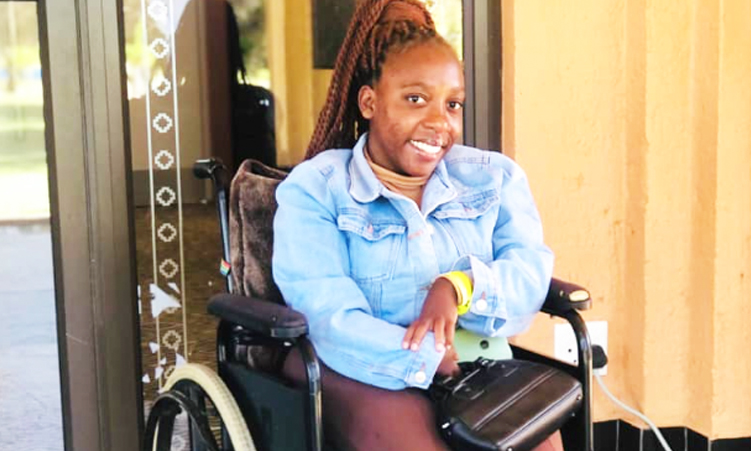
Despite quadriplegia limiting her mobility since birth, Shekupe Niilenge (22) is pursuing transport management studies and motivational speaking, fuelled by determination and her mother’s support.
Quadriplegia or tetraplegia involves paralysis of both the upper and lower limbs.
In Niilenge’s case, she was born with paralysed legs and arms.
“I always felt different from other children.While they ran and played, I watched from the sidelines, wanting to join them,” she says.
TOUGH-AS-NAILS MOTHER INSPIRES
Niilenge’s journey began at Wanaheda, where her mother, despite the odds, ensured she attended Martti Ahtisaari Primary School.
“Even on days when my mother was sick, and because we could not afford a wheelchair, she still carried me on her back to school – and that for me is the reason for my determination and consistent hard work.
“She believed in the power of education and instilled that belief in me,” she says.
Niilenge says her motto in life is: “I was born on purpose for a purpose, and I will serve my purpose on this earth – regardless of my condition.”
She says her academic journey was fraught with obstacles.
“Accessibility was a constant issue, especially wheelchairs, but eventually my pleas were heard and I had received donations along my journey from good Samaritans.”
Despite her struggles, Niilenge was determined not to let her disability define her, “because disability is not inability”, she says.
At college, she found her calling in transport management.
“I chose this field because I want to improve mobility for people with disabilities,” she says. “Transportation should be inclusive for all.”
MORE ON QUADRIPLEGIA
According to Mayo Clinic, quadriplegia is a pattern of paralysis that affects a person from the neck down.
The condition is typically caused by a spinal cord injury and can interfere with both voluntary muscle movement and automatic body functions, such as breathing or bladder control.
It can be caused by brain damage that occurs before, during, or shortly after birth – often leading to a diagnosis of spastic quadriplegia.
“The clinic notes that quadriplegia is often a symptom of other conditions, most commonly traumatic spinal cord injuries, accounting for around 60% of such cases.”
Mayo Clinic further explains that there are two main types of quadriplegia: complete and incomplete.
In incomplete quadriplegia, some signals from the brain can still get through, meaning a person might retain partial movement, sensation, or control of body functions like bladder or bowel movements.
“This occurs in about one third of spinal cord injury cases. “In contrast, complete quadriplegia blocks all brain signals from passing through the injury site, leading to a total loss of movement, sensation, and automatic function control seen in about 20% of cases.”
The clinic also distinguishes between two ways muscles are affected.
“There is flaccid quadriplegia, where muscles are limp and inactive, and spastic quadriplegia, where muscles contract uncontrollably.”
In an age of information overload, Sunrise is The Namibian’s morning briefing, delivered at 6h00 from Monday to Friday. It offers a curated rundown of the most important stories from the past 24 hours – occasionally with a light, witty touch. It’s an essential way to stay informed. Subscribe and join our newsletter community.

The Namibian uses AI tools to assist with improved quality, accuracy and efficiency, while maintaining editorial oversight and journalistic integrity.
Stay informed with The Namibian – your source for credible journalism. Get in-depth reporting and opinions for
only N$85 a month. Invest in journalism, invest in democracy –
Subscribe Now!