


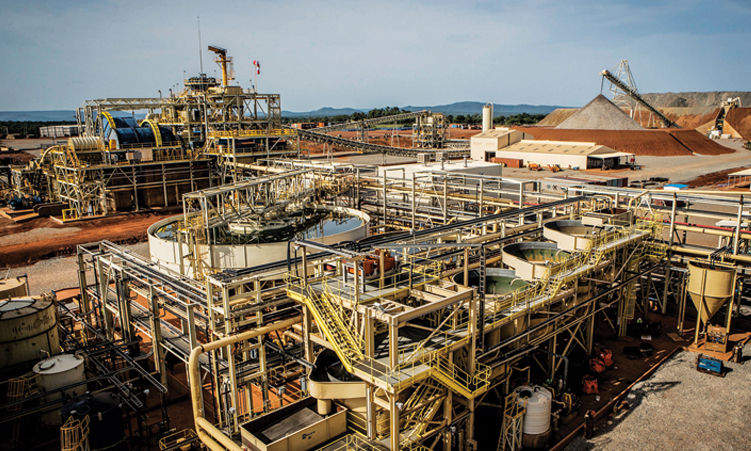
The Otjikoto Mine in central Namibia has posted a strong performance in 2024, producing 198 142 ounces of gold, realising US$486 million (about N$8.9 billion) in revenue.
A financial statement released by the company’s president and chief executive Clive Johnson, says this is close to the mid-point of its guidance range of between 185 000 and 205 000 ounces.
The Otjikoto Mine, the biggest gold producer in Namibia, delivered 52 452 ounces during the fourth quarter of 2024, as the end of its open pit mining nears this year.
This contributed to the consolidated gold production of 804 778 ounces for 2024, for total revenue of US$1.9 billion (about N$35 billion) in 2024.
On 19 February the board declared a dividend of US$0.02 per common share for the first quarter of 2025, payable on 20 March.
Johnson says the Wolfshag underground mine produced 1 650 tonnes per day in the fourth quarter of 2024 at an average gold grade of 3.61 g/t.
He reiterates that open pit mining operations at Otjikoto will end in the third quarter of 2025, while processing operations are to continue until economically viable stockpiles are exhausted in 2032.
“Underground operations are projected to continue into 2027 with potential to extend operations if the ongoing exploration programme is successful in identifying additional underground mineral deposits,” he says.
On 4 February, B2Gold announced positive preliminary economic assessment (PEA) results for Otjikoto’s Antelope deposit, comprising Springbok Zone, Oryx Zone, and a possible third structure, Impala.
B2Gold believes the Antelope deposit, approximately four kilometres south-west of the Otjikoto open pit, has the potential to become a small-scale, low-cost, underground gold mine that can supplement the low-grade stockpile production from 2028 to 2032 and result in a meaningful production profile for Otjikoto into the next decade.
The Antelope PEA indicates an initial mine life of five years and total production of 327 000 ounces of gold, averaging 65 000 ounces per year over the life of mine.
“In combination with the processing of existing low grade stockpiles, production from the Antelope deposit has the potential to increase Otjikoto Mine production to approximately 110 000 ounces per year from 2029 to 2032,” says Johnson.
The company has approved an initial budget of up to US$10 million (about N$184 million) for 2025 to de-risk the Antelope deposit development schedule by advancing early work planning, project permits and long lead orders.
The Otjikoto Mine is expected to produce between 165 000 and 185 000 ounces of gold in 2025 at cash operating costs of between US$695 (about N$12 700) and US$755 per ounce (about N$13 900) and all-in sustaining costs of between US$980 (about N$18 000) and US$1 040 (about N$19 100) per ounce.
“Gold production at Otjikoto will be weighted towards the first half of 2025 due to the conclusion of open pit mining activities in the third quarter of 2025,” says Johnson.
– email: matthew@namibian.com.na
In an age of information overload, Sunrise is The Namibian’s morning briefing, delivered at 6h00 from Monday to Friday. It offers a curated rundown of the most important stories from the past 24 hours – occasionally with a light, witty touch. It’s an essential way to stay informed. Subscribe and join our newsletter community.

The Namibian uses AI tools to assist with improved quality, accuracy and efficiency, while maintaining editorial oversight and journalistic integrity.
Stay informed with The Namibian – your source for credible journalism. Get in-depth reporting and opinions for
only N$85 a month. Invest in journalism, invest in democracy –
Subscribe Now!