



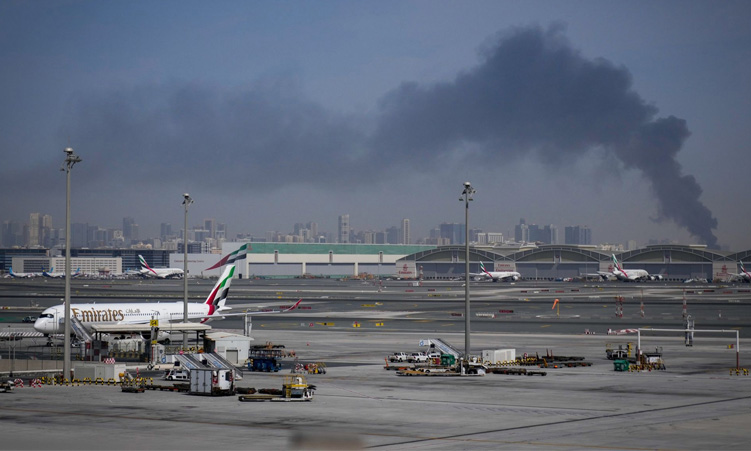
An unspecified number of Namibians are stranded at Dubai International Airport following the closure of the airspace as escalating conflict between Iran, the United States (US), and Israel raises safety and economic concerns.
A well placed senior official in the government confirmed to The Namibian yesterday that there are 80 people who are known to be working in Dubai. This number does not include those stranded in transit.
‘IT’S A HORRIBLE FEELING’
A stranded Namibian at the Dubai airport, who spoke to The Namibian on condition of anonymity, says she feels stuck and has to pay extra hotel bills for every day she stays.
“Fighter jets are flying over the entire day, even now as they are defending and protecting from missile attacks,” she says.
The source was en route to a holiday destination.
She says they are not restricted from going outside and she managed to get a few supplies yesterday.
She shared with The Namibian a public notice issued to them by the Dubai authorities;
“Due to the current situation, a potential missile threat, seek immediate shelter in the closest secure building, and to steer away from windows, doors, and open areas. Await for further instructions,” the notice reads.
The Namibian embassy in Egypt on Sunday advised Namibians living in the area to be vigilant and avoid large gatherings and locations that could be dangerous.
The notice comes as military strikes and instability escalated in the Middle East, a region critical to global oil supply.
The conflict broke out over Iran’s nuclear programme and the suppression of domestic protests.
The US and Israel launched a joint air campaign, hitting thousands of targets in Iran, including military headquarters and ballistic missile facilities, killing Iran’s supreme leader, Ayatollah Khamenei, in the attack.
Iran says its long-standing and “historical” relationship with Namibia is unlikely to be significantly affected by escalating tensions in the Middle East.
Responding to questions by The Namibian yesterday, Iran’s ambassador to Namibia, Mohammad Beigi, described bilateral ties as friendly and resilient, saying both countries have supported each other during difficult times and would continue to do so.
He acknowledged that trade between the two nations is limited, meaning any impact on cooperation in areas such as agriculture, energy and infrastructure would likely be minor and temporary.
The envoy said Tehran is interested in strengthening diplomatic ties with Namibia and has remained in close contact with senior local officials, who recently conveyed condolences following deadly attacks in Iran.
He accused the US and Israel of initiating the current conflict and claimed Iran had been engaged in mediated talks with Washington before tensions escalated. Referring to US president Donald Trump, he alleged that US actions undermined negotiations and violated Iran’s territory, prompting what he described as a defensive response from Tehran.
On Africa’s role, the ambassador said Iran values its relations with African countries and expects them to condemn what he termed aggression by the US and Israel, noting that many African nations have historically supported Iran in multilateral forums.
Meanwhile, international relations analysts yesterday warned that Namibia could begin feeling the impact of the conflict between Iran and the US as early as next week, particularly through rising fuel, food and import prices if tension escalates.
However, the Ministry of International Relations and Trade says the impact will only be felt within two to three months, noting that any escalation involving the three countries would likely push up global oil prices and shipping insurance costs.
For transport, the ministry executive director Ndiitah Nghipondoka-Robiati says it is likely to be felt within the next three months, as fuel feeds directly into taxi, bus, and logistics costs.
“Food inflation will typically be felt within one to three months later, as higher distribution and import costs pass through supply chains. Fuel shocks, therefore, translate relatively quickly into broader cost-of-living pressures,” she says.
She adds that disruptions in global shipping lanes would increase freight rates, war-risk insurance and transit times, eventually raising landed cost of fuel and other imports, feeding into inflation.
Political analyst Ricky Simasiku yesterday said with the Strait of Hormuz closed, Namibia’s oil market and stock prices will be impacted through increased fuel prices if the war continues for the next two weeks.
“As the world anticipates, Namibia will be among the countries hit by the war. We are going to be at the receiving end especially if it goes in the second week because the oil tanks cannot navigate the passage of the Strait of Hormuz as oil supply is limited,” he said.
Simasiku said he is hopeful that Namibia can withstand potential economic pressure, noting that although the country has storage facilities, they cannot sustain the country during prolonged global supply disruptions.
“We don’t know how long the war will go on and how much the facilities can sustain us. But at the same time not all oil is from that geographical area,” Simasiku said.
Former diplomat Pius Dunaiski says when oil prices spike, inflation and the economy are also affected.
With many countries involved, Dunaiski says the war could last five weeks which could cause heightened damage including losing lives, food prices going up and the economy impacted.
“I was happy when the oil price was announced to remain the same, but this war could have a big impact on the oil price,” he says.
He says the country is trying to keep its relationship with the US as a trading partner, as the US has shown interest in Namibia as a trading partner.
Political analyst Marius Kudumo says the conflict could have direct economic consequences for Namibia because the country depends on imported fuel.
He says fuel prices are influenced by availability, meaning any disruption in international supply chains can quickly lead to increased prices and even shortages.
“One of the reasons why prices increase is the availability of the commodity. Since Namibia does not produce its own fuel, any disruption in supply could have serious consequences. Households, industries and the economy will be affected,” he says.
Kudumo says the country’s response to international conflicts should be guided by constitutional principles rather than political pressure, noting that Namibia is not required to side with any country. He explains that public statements opposing war reflect constitutional values.
In an age of information overload, Sunrise is The Namibian’s morning briefing, delivered at 6h00 from Monday to Friday. It offers a curated rundown of the most important stories from the past 24 hours – occasionally with a light, witty touch. It’s an essential way to stay informed. Subscribe and join our newsletter community.

The Namibian uses AI tools to assist with improved quality, accuracy and efficiency, while maintaining editorial oversight and journalistic integrity.
Stay informed with The Namibian – your source for credible journalism. Get in-depth reporting and opinions for
only N$85 a month. Invest in journalism, invest in democracy –
Subscribe Now!