



Bernard C MooreI was sifting through files in the National Archives of Namibia last year while working on my MA thesis on economic and labour history in southern Namibia.
Throughout these long days, one inevitably finds archival files and boxes which, unopened, seem useless for the specific project one is working on. But when explored further, really interesting insights come forth. This is one of those cases.
Taxes And Labour
I was trying to understand the relationship between taxes and labour recruitment during the early years of South African colonialism in Namibia. Seemingly strange taxes and fees were implemented and enforced: the Wheel Tax, the Dog Tax, Dipping Fees, etc.
When one compares the revenue gained to the large financial costs of enforcement, it becomes evident that there were other motives to those taxes than just supplementing the state budget. Enforcing the dog tax in rural areas required huge amounts of ammunition, petrol, horses, metal for badges, not to mention the salaries of overworked police and bureaucrats.
It is difficult to do a formal cost analysis because of the often incomplete data, but it’s clear that many taxes were a net loss for the colonial state. Why implement and enforce them then? In order to explain further, let’s get some context.
Dr Wolfgang Werner, associate professor at NUST, wrote in his 1998 book ‘No One Will Become Rich: Economy and Society in the Herero Reserves in Namibia’, that the early years of South African colonialism were a time of ‘self peasantisation’. This means black Namibians were deliberately trying to remove themselves from wage labour to pursue an independent existence.
Mobility and land access were facilitated by the internment of many German farmers and the removal of German police; it took time for the South Africans to move in. One of these strategies Werner briefly explored in his dissertation was stock theft. This intrigued me, so I looked deeper.
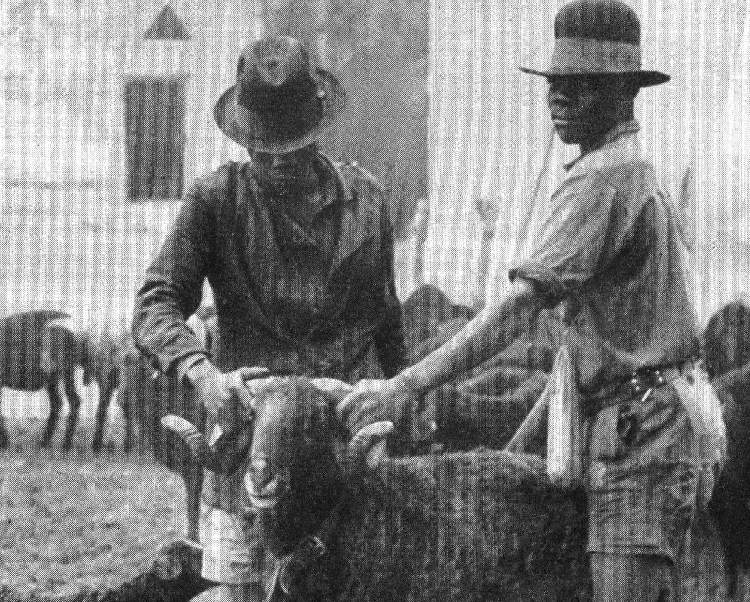
I found an interesting file describing a controversial case of stock theft near Keetmanshoop. Mr RJ van Wyk migrated to German SWA from the Orange Free State around 1907 with Sara Bloom, a South African woman, and her two children from a previous marriage: Christian and Susanna. They arrived in the Keetmanshoop district and began raising sheep.
In September 1915, Van Wyk wrote to the administration in Windhoek reporting stock theft and his subsequent inability to find any black Namibians who would work for him. When the war broke out, Van Wyk departed for Prieska in South Africa for ‘business reasons’. He left behind 3 000 to 4 000 sheep under the supervision of his stepson Christian. When he returned a year later, he found only 963 sheep remaining.
Mangled Moments
Out of confusion, he searched nearby farms and black locations, noting a significant increase in the numbers of black owned sheep. In addition, all the sheep had ‘mangled’ ears – cut off low at the base of the ear, removing any ID tags Van Wyk would have used. He had no other identification for these sheep, so the administration said that he could not prove they were stolen.
When the Magistrate interviewed Christian about the matter, he found it was far more complex than a case of spur of the moment stock theft. Christian, Susanna, the workers and servants were regularly beaten by Van Wyk with sjamboks.
Christian claims he was once hit by Van Wyk with a brick and knocked unconscious. Also, Van Wyk was never actually married to Christian’s mother.
After her death in 1911, Van Wyk began forcing himself on Susanna, Christian’s sister, aged 16, and he fathered a child with her. The actual reason for Van Wyk going to Prieska was to avoid being prosecuted for indecency: fathering a child with Susanna and falsely stating that she was his wife. He fled just before the arrest was to be made.
Political Statement
These testimonies can teach us a lot about stock theft at that time. Christian admits that a few hundred stock were sold to pay for workers’ wages, food, and clothing after Van Wyk fled to Prieska.
He also notes that there was near universal hatred for Van Wyk. It becomes clear that the sheep were taken in a planned manner with forethought, perhaps with the assistance of Van Wyk’s ‘stepson’ Christian Bloom. Regardless of the new owner of the sheep, all cut the ears to reduce identification purposes.
So what does this have to do with taxes? In these early years of South African rule, taxes became an important way to coerce black Namibians to work on white owned farms; many taxes were not about state revenue. As Werner noted, many black Namibians were distancing themselves from wage labour.
Stock theft was a way to gain self sufficiency; stealing enough sheep so you could qualify for a ‘labour exemption certificate’ was a crucial way to avoid becoming dependent on abusive white employers like Van Wyk (exemption was granted to Namibians with more than 10 cattle or 50 small stock). Taxes served as a way to make independent existence more difficult and cut into the gains black Namibians made after the Germans were defeated.
Was all stock theft like this? No. Many stock were stolen on a one off basis; someone wanted a sheep, so he took it. What the Van Wyk case shows us, though, is that stealing sheep at that time was more than just a ‘criminal’ activity; it was a political statement: a desire for economic and social autonomy from the white colonial state. And it had the support of many people; one person could not have stolen over 3 000 sheep from Van Wyk.
– NB: Names have been changed to protect anonymity. For those interested in learning more, consult National Archives of Namibia, ADM box 2, file A.13/15.
– Bernard C Moore is a doctoral student at the University of London, School of Oriental African Studies. He recently completed his MA at Michigan State University, USA, with a thesis titled ‘Canines, Carnivores, Capitalism, Colonialism: Some Transformations in Hunting, Agriculture, and Labour in Southern Namibia, 1915 1930s’. He can be reached at 081 613 3538 or bernardcmoore@gmail.com.
In an age of information overload, Sunrise is The Namibian’s morning briefing, delivered at 6h00 from Monday to Friday. It offers a curated rundown of the most important stories from the past 24 hours – occasionally with a light, witty touch. It’s an essential way to stay informed. Subscribe and join our newsletter community.

The Namibian uses AI tools to assist with improved quality, accuracy and efficiency, while maintaining editorial oversight and journalistic integrity.
Stay informed with The Namibian – your source for credible journalism. Get in-depth reporting and opinions for
only N$85 a month. Invest in journalism, invest in democracy –
Subscribe Now!