


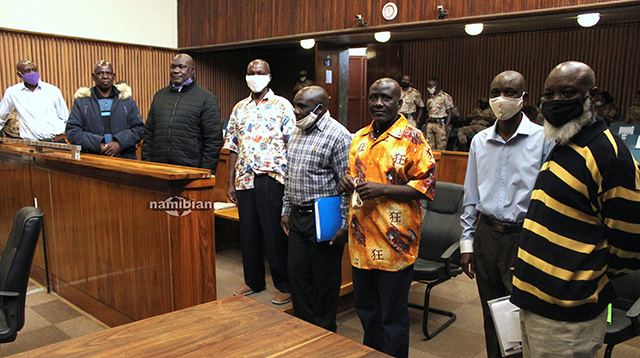
THE case for the prosecution came to an end in the second Caprivi high treason trial in the Windhoek High Court yesterday – more than 18 years after the arrest of two of the eight men charged in the matter, and 13 years after a first trial ended in convictions and lengthy prison terms.
Acting judge Petrus Unengu said the state’s case was deemed to be closed after he refused to grant the prosecution a postponement it had requested to get witnesses in Botswana to testify in the matter.
Deputy prosecutor general Lourens Campher informed the court the only witnesses whose testimony the state still wanted to present to the court were in Botswana and not able to travel to Namibia now due to that country’s coronavirus pandemic lockdown.
Unengu refused a further postponement, though, after remarking that he had told the prosecution last week he would not be postponing the case again.
With a postponement ruled out, the state had only two options left – to present more witnesses’ testimony to the court, or close its case.
Campher insisted that the state still wanted to call witnesses from Botswana to testify in the trial, but added that due to the Covid-19 pandemic closure of that country’s borders he did not know how soon the witnesses would be able to appear in the court to give evidence.
The eight men being tried before Unengu are standing trial for a second time on allegations that from September 1998 to December 2003 they had been involved in a plot to overthrow the Namibian government in the then Caprivi region and to secede the region from Namibia.
The eight men and four co-accused went through a first trial in the High Court between 2005 and 2007. That trial ended with ten of them being convicted of high treason and sentenced to prison terms of either 30 or 32 years each in August 2007.
The Supreme Court set aside their convictions and sent their case back to the High Court for a retrial in July 2013, after finding that the judge who presided over their first trial should have recused himself from the matter when he was asked to do so following his dismissal of a jurisdiction challenge raised by the accused.
The same jurisdiction challenge, based on a claim that most of the accused involved in the first trial had been abducted from Botswana and brought to Namibia illegally before they were arrested and charged by the Namibian authorities, was again raised before Unengu, who dismissed the challenge in November 2014.
A second special plea, in which the accused disputed that the Zambezi region is legally part of the territory of Namibia, was raised after the first jurisdiction challenge failed. That plea, too, was rejected by Unengu in April 2018, and the hearing of evidence on the merits of the charges against the eight accused started after that.
Namibian Police inspector general Sebastian Ndeitunga testified as the state’s last witness in the trial yesterday.
Ndeitunga gave evidence about a letter which he received from Namibia’s then high commissioner in Botswana, Theresia Samaria, in December 2003, and a follow-up letter which he then wrote to police regional commanders in Zambezi, Oshikoto and Omaheke.
In Samaria’s letter, she notified the Namibian authorities that a number of Namibian refugees in Botswana would be deported from that country after their refugee status had been revoked because they had violated the conditions of their stay in Botswana.
Ndeitunga notified the police regional commanders that suspects in the high treason case about an attempt to secede the former Caprivi region from Namibia might be among the ex-refugees who were to be deported.
Five of the accused – Progress Munuma, Shine Samulandela, Manuel Makendano, Alex Mushakwa and John Tembwe – were arrested and charged in Namibia on 12 December 2003, after they had been deported from Botswana.
By then, another of the accused, Frederick Ntambilwa, had already been in custody in Namibia for a year and five months, having been arrested in July 2002. Two of the accused – John Tembwe and Hoster Ntombo – were arrested in September 2002, after they had been deported from Botswana to Namibia.
Defence lawyers Ilse Agenbach and Jorge Neves told the judge yesterday they would be applying for an acquittal of the accused following the end of the state’s case.
The case was postponed to 2 November for that application to be heard.
In an age of information overload, Sunrise is The Namibian’s morning briefing, delivered at 6h00 from Monday to Friday. It offers a curated rundown of the most important stories from the past 24 hours – occasionally with a light, witty touch. It’s an essential way to stay informed. Subscribe and join our newsletter community.

The Namibian uses AI tools to assist with improved quality, accuracy and efficiency, while maintaining editorial oversight and journalistic integrity.
Stay informed with The Namibian – your source for credible journalism. Get in-depth reporting and opinions for
only N$85 a month. Invest in journalism, invest in democracy –
Subscribe Now!