



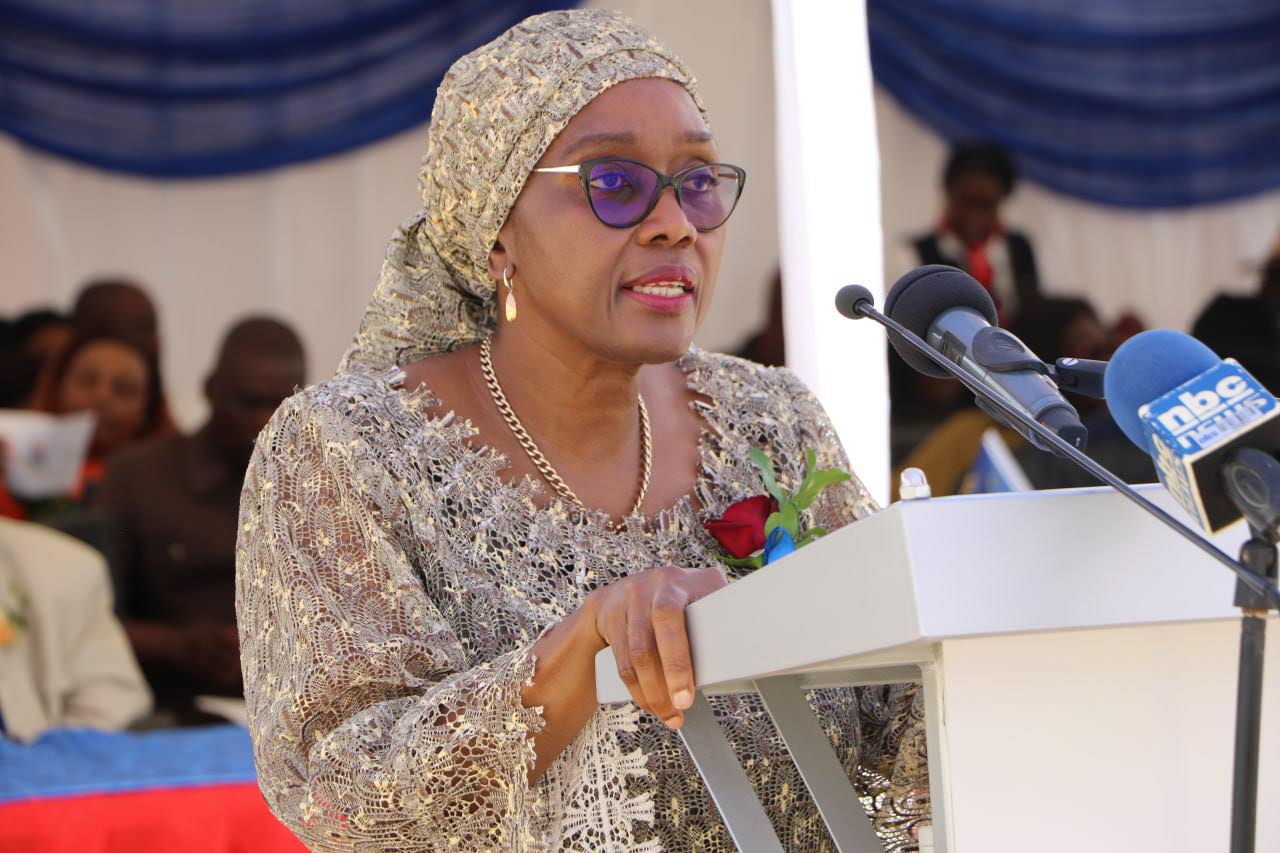
Nkurenkuru Multipurpose Youth Centre and Sport Complex, 21 March 2026.
___________________________________________________________
A very good morning to you all.
Before I commence my statement, I wish to say that Hompa Alfons Kaunda from the Bunza Traditional Authority celebrates his birthday today. We wish him a blessed birthday, and many happy returns. May we also extend birthday wishes to the governor who celebrated her birthday on 19 March. Happy birthday, governor.
Compatriots, today, I stand before you deeply honoured to join the people of Kavango West region, and indeed all Namibians, in commemorating a defining chapter in our nation’s history, the anniversary of our national independence.
Thirty-six years ago, in a dusty stadium in Windhoek, the world watched as our independent democratic republic was born. But that birth was not easy. It came after a labour that cost the lives of thousands of our sons and daughters during the colonial resistance, in exile, in the trenches at the battlefront, and in the dungeons of occupation.
Independence Day does not only mark the moment we attained freedom. It commemorates the successful conclusion of a long, painful, and heroic struggle for liberation, a struggle waged at the highest price imaginable.
As we commemorate Independence Day, therefore, we celebrate the bravery of the patriots who fought valiantly, first to defend our land against invasion, and after occupation, to rid our country of colonial subjugation and restore dignity to our people.
These brave sons and daughters of Namibia placed their very lives on the line. Because of their unwavering courage, we are today a free nation, free from oppression, free to manage our own affairs, and free to determine our own destiny.
As we commemorate this day, we honour those whose blood and toil brought forth our freedom.
We pay homage to our founding fathers whose vision laid the foundation of a robust governance framework, anchored in peace, unity, and democracy.
We honour all the liberation heroes and heroines whose sacrifices remain the bedrock upon which this republic stands.
This year, our celebration carries a heavy heart. For the first time in 36 years, we commemorate this day without the man who lit the torch of liberation. We are without our founding father and the first president of the Republic of Namibia, Sam Shafiishuna Nujoma.
I ask you to look to the sky. When you see our national flag, remember that it was Nujoma who rallied a nation behind that flag when it was just a dream. He taught us that the colour red does not just represent our people; it represents the blood of the martyrs. Today, we say to him: go well, revolutionary giant. Your long march is over. The freedom you secured for us is now in our hands.
We also remember our second president, the late Hage Geingob, whom we lost two years ago.
He was one of the architects of our constitution, the builder of the Namibian house.
He taught us that after you win the war, you must win the peace through dialogue and inclusion.
These Namibian political giants have joined the ancestors, but their spirits march with us today along the banks of the Kavango River and elsewhere in our land.
Thirty-six years after 21 March 1990, we are mindful of the fact that political freedom was only the first phase of the struggle. There remains a second, and equally important mission: to achieve self-reliance and true socio-economic liberation for every Namibian.
That is the duty we owe to the heroes of our war of resistance and the national liberation struggle. That is the debt of gratitude we must repay through committed, purposeful action.
As we reflect on the journey since independence, we must rededicate ourselves to socio-economic transformation and a better quality of life for all citizens across every region, every constituency, and every household of our country.
Fellow Namibians,
It is both symbolic and significant that we gather here in Kavango West region, a land of immense potential, rich cultural heritage, and a people of tremendous resilience.
This region presents inspiring examples of progress that give us reason to be proud and to march forward with confidence, but it also presents real development challenges that require focused and sustained intervention.
We now stand at a critical juncture. Vision 2030, the long-term blueprint to transform Namibia into a prosperous and industrialised nation, has only four years remaining. The sixth national development plan, officially launched in July 2025 by our president, is the final strategic framework designed to take us to the year 2030.
Structured around four pillars of economic growth and resilience, human development, environmental sustainability and good governance, the sixth national development plan is our nation’s collective roadmap for the remainder of this decade.
To get there, we must all pull our full weight; government, the private sector, civil society, and every individual Namibian.
This is not a journey any one sector can make alone. It demands partnership, shared purpose, and collective resolve.
This means when the government builds schools, families and communities must ensure that children attend and complete their education, that children are protected, and girls are encouraged to stay in school and not become victims of teenage pregnancies and early marriages.
It requires that we embrace gender equality and fight gender-based violence, and we uphold the rights of all Namibians to live a life of dignity, free from poverty, violence, and socio-economic exclusion, with their full human potential developed.
I must say that the current levels of gender-based violence and violence against children in our country are unacceptable. They amount to a violation of fundamental human rights.
As a nation, we cannot progress while women and children live in fear.
This scourge must be confronted with the full force of the law and with the full moral weight of our communities.
The progress made in the agricultural sector here in Kavango West is encouraging. Interventions such as dryland crop production, seed systems development, horticulture support, and poultry production are improving food security and rural livelihoods.
These efforts form part of a broader national strategy to transition agriculture from subsistence to commercially viable systems.
The Musese Green Scheme has delivered remarkable results, generating N$28.5 million from 4,200 tonnes of maize, a testament to what coordinated investment and effective management can achieve.
In 2024, the government invested approximately N$7 million into the Sikondo Green Scheme for new tractors and implements, and all state-managed schemes are now operational across the country, with both winter and summer crops flourishing.
We call on Musese and Sikondo to continue diversifying into other crops and vegetable production, to grow the region’s agricultural footprint further.
Eyes are now turning to the Zone Green Scheme, which has secured 2 000 hectares and represents an enormous opportunity for this region.
Our farmers must not only grow crops; they must own the markets.
Infrastructure development remains a key enabler of economic growth and service delivery. We have made progress in the completion of schools, health centres, police infrastructure, electrification projects, and water supply systems across Kavango West.
Constituency offices have been established at Mankumbi, Tondoro, Ncamagoro, and Mpungu, bringing government closer to the people.
A government office park has been constructed in the region, and a rural development centre at Rupara village in Musese constituency.
On water access, progress has been made, with 77% of the population in Kavango West now having access to safe drinking water.
We must redouble our efforts to extend access to all residents through expanded water infrastructure.
Telecommunications towers have been commissioned in the region in recent years, expanding digital connectivity and opening new avenues for education, commerce, and communication.
Digital inclusion is not a luxury; it is a necessity that even our most remote communities must have access to.
The construction of the Nkurenkuru regional hospital remains an urgent priority.
Furthermore, road infrastructure continues to be a critical priority.
The development of feeder roads connecting deep rural areas to national roads is not merely a convenience; it is the artery through which development flows.
The education sector continues to play a central role in national development. The performance of Kavango West’s schools at national level is commendable and reflects the dedication of our educators, learners, parents, and school boards.
The expansion of vocational education and training through the Nkurenkuru vocational training centre, which welcomed its first intake of 170 trainees this month, is worth applauding.
Equipping young people with practical, market-relevant skills is not optional. It is imperative. Government builds the training facilities; our youth must fill them with ambition, diligence, and purpose.
Fellow Namibians,
Youth development remains a top priority in our national agenda. Young people are our greatest resource. With a large and youthful population, this region has a demographic advantage that, properly harnessed through education, skills development, entrepreneurship, and innovation, can become an engine of transformation.
The development of micro, small, and medium enterprises is equally critical for inclusive economic growth and job creation. Efforts to support local businesses, improve access to finance, and facilitate the formalisation of informal economic activities will build a more resilient and inclusive economy.
We call on the formal private sector to complement government by embracing and mentoring emerging indigenous enterprises, and to invest meaningfully in corporate social responsibility, not as charity, but as a strategic investment in shared prosperity.
The cultural and creative industries hold tremendous untapped potential. Investing in artisan cooperatives, creative entrepreneurship, and cultural preservation will both honour our heritage and create new economic opportunities.
I would be remiss not to acknowledge an exciting development on the horizon for Kavango West. The recent hydrocarbon discovery in the region represents a potentially transformative opportunity for this region and for our entire country.
Production testing is expected to commence in 2026. If realised at scale, this discovery could unlock new rounds of investment, infrastructure development, and local employment, particularly for our youth.
Government will ensure that our natural resources benefit Namibians.
Sport continues to serve as a powerful platform for youth engagement, social cohesion, and the building of national identity.
The investment in sports infrastructure, including this very facility at which we gather today, reflects our commitment to promoting healthy lifestyles, nurturing talent, and keeping our youth positively engaged.
We are proud to hold these national celebrations in a space that represents investment in the future.
The decentralisation of services to the regions remains a cornerstone strategy for responsive and efficient service delivery.
Strengthening the capacity of regional institutions ensures that government is not a distant entity, but a present and accountable partner in the daily lives of our communities.
Fellow Namibians,
As we reflect on all that has been achieved and all that remains to be done, let us be united in our determination.
Many challenges still remain, but with common purpose, focus, and resilience, they can and will be overcome. We have overcome greater odds before.
Let us march together in unity to transform our country into what we want it to be: a united, peaceful, and prosperous Namibia where no one feels left behind.
Government will continue to honour its commitment to a sound governance framework and inclusive sustainable development.
The freedom we celebrate today is not the end of the journey; it is the platform from which we must leap to greater heights. We owe that leap to the heroes whose sacrifices brought us this independence. And we owe it to our children and grandchildren, to whom we must bequeath a bright and dignified future.
It is within our means. It is within our reach.
May the revolutionary spirit of our heroic forebears, the departed and the living, continue to inspire us to persist in marching towards progress.
May the memory of those who gave their lives for this freedom be eternally honoured.
May their souls continue to rest in peace.
To the people gathered here today, let me speak directly to your identity.
Kavango West was established as a region in 2013 to bring services closer to the people. From Mpungu to Ncamagoro, from Tondoro to Nkurenkuru, this region is a breadbasket of our northern frontier.
For centuries, this region has been a crossroads of culture and trade. Our woodcarvers are famous the world over, our traditional music fills the air, and our resilience fills our hearts.
I come here with a message: your challenges are the business of our parliament.
When we achieved independence in 1990, we did not just change the flag; we replaced a system of oppression with a system of rights. Our constitution is the supreme law. It says that all the people of Namibia have the right to be heard.
As your speaker, I ensure that your elected representatives to parliament have the space to speak on your behalf when the budget is discussed and the needs for rural electrification, water provision, and road infrastructure are debated.
Our judiciary, independent of parliament and the executive, ensures that if your rights are violated, you have a place to seek justice. This separation of powers, the law-making by parliament, the enforcement by the cabinet and the interpretation by the courts, is the tripod upon which our peace stands. It is the reason we have had 36 years of uninterrupted stability while many others have faltered.
For 36 years, we have managed our politics well. Now, we must manage our economy better.
Our government has set a clear path. We are moving from a consuming nation to a producing nation.
Here in Kavango West, what does that mean?
Agriculture and food security: we must move beyond subsistence farming. We have the water. We have the land. We must scale up irrigation. Government programmes are in place to support horticulture so that Kavango West does not only feed itself, but also supplies fresh produce to the rest of the country. Let us turn our fields into factories of food.
Green energy and industry: you have heard about green hydrogen. The energy generated therefrom will power the entire country. It will attract industries.
We must prepare our youth with skills in engineering, logistics, and agri-processing so that when the investors come, they hire Namibians, including from Kavango West, not foreigners.
Local beneficiation: we must stop exporting raw materials and importing finished goods at high prices. Our timber should become furniture here. Our cattle should be processed into high-grade beef here. Our crops should be packaged here. This is how we create jobs. This is the economic freedom we seek.
Independence is a collective project. Let us all optimise job creation. To the corporate sector and individuals, complement government to achieve inclusive growth and sustainable development.
To the youth: learn a trade, whether it is welding, carpentry, or information technology. Those with interest to do business must make use of the opportunities made available. Stay away from crime and learn your history; know how your freedom came about.
Read about the Cassinga massacre. Read about the battle of Cuito Cuanavale. A person who does not know where they come from cannot know where they are going.
To the women: you are the backbone. You raise the children, you till the land, you keep the home. We see you.
We will continue to pass and implement laws that protect you from gender-based violence and give you access to land and credit and all other opportunities available to other citizens.
To the traditional leaders: you are the custodians of our customs and traditions. Work with the government to ensure land is allocated fairly, that our communities and investors respect our customs, and that our communities remain cohesive.
To our veterans: we owe you a debt we can never fully repay. We must ensure that those who fought for this freedom live out their days in dignity.
As we develop, we must safeguard our safety and security. There is no investment without security. There is no tourism without safety.
I call on the community to work with the Namibian Police. Report crime. Let us look out for each other in our neighbourhoods.
Let us solve disputes through our traditional courts where possible, and through the formal justice system where necessary. A peaceful country is a prosperous country.
As I look out at this gathering, I see the faces of a nation. I see the young and the old, the farmer and the teacher.
Let me leave you with this thought. Thirty-six years ago, Namibia was the world’s youngest democracy. Today, we are a respected middle-income country.
But the journey is not over. The next 36 years must be about inclusive prosperity.
It must be about ensuring that the child born today in a village in Kavango West has the same chance in life as the child born in Windhoek West.
It must be about finishing the work our founding fathers started.
Let us honour Sam Nujoma and Hage Geingob by being the best Namibians we can be.
Let us work hard. Let us stay united.
Let us reject division and tribalism.
Let us build one Namibia, one nation.
Let the spirit of 1990 remain alive, burning bright in the hearts of the people of Kavango West and the entire nation.
God bless our president.
God bless the veterans of the liberation struggle.
God bless the people of Kavango West.
And God bless the Republic of Namibia and all its people.
Happy 36th independence anniversary.
I thank you.
In an age of information overload, Sunrise is The Namibian’s morning briefing, delivered at 6h00 from Monday to Friday. It offers a curated rundown of the most important stories from the past 24 hours – occasionally with a light, witty touch. It’s an essential way to stay informed. Subscribe and join our newsletter community.

The Namibian uses AI tools to assist with improved quality, accuracy and efficiency, while maintaining editorial oversight and journalistic integrity.
Stay informed with The Namibian – your source for credible journalism. Get in-depth reporting and opinions for
only N$85 a month. Invest in journalism, invest in democracy –
Subscribe Now!