




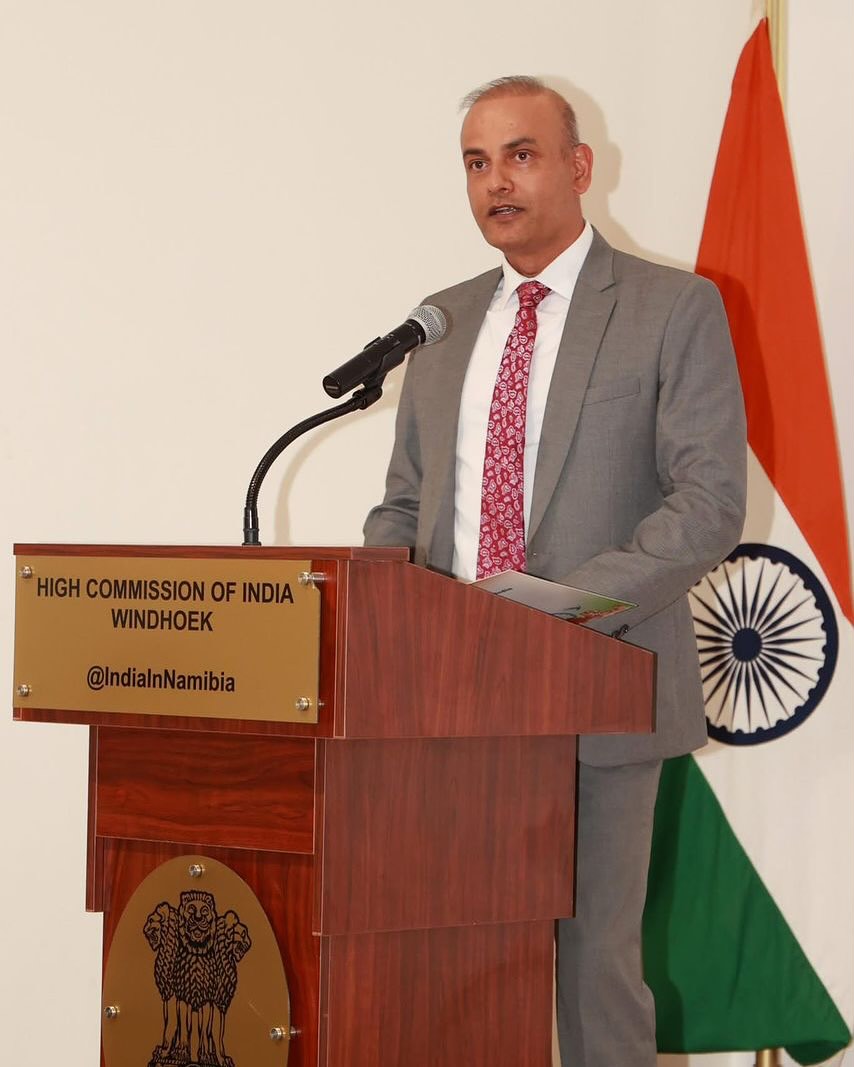
Windhoek, February 2026
___________________________________________________________
The conclusion of the India–European Union Free Trade Agreement marks a historic milestone in India’s global economic engagement and signals the emergence of a new era of trusted, forward-looking trade partnerships. It is not only a milestone in relations between two major economic powers but also a signal of India’s growing role as a trusted, forward-looking trade partner — a development that carries important implications for Namibia and the wider southern African region.
Announced at the 16th India–European Union Summit by Narendra Modi, prime minister of India, and Ursula von der Leyen, president of the European Commission, the agreement brings together two of the world’s largest economic powers – India, now the fourth-largest economy, and the European Union, the second-largest. Together, these partners account for roughly a quarter of global gross domestic product and a significant share of world trade. Their closer integration is poised to create unprecedented opportunities for growth, innovation and investment.
At the heart of the agreement lies unprecedented market access. More than 99 percent of Indian exports by value will enjoy preferential entry into the European Union market. This opens the door for a major expansion of Indian exports, including an estimated US$75 billion worth of goods already traded. Nearly US$33 billion in labour-intensive exports such as textiles, leather, footwear, marine products, gems and jewellery and handicrafts are set to gain significantly from the elimination of tariffs that currently reach up to 10%.
The benefits of the free trade agreement go well beyond trade figures. It is designed to create jobs and new opportunities for micro, small and medium enterprises, as well as for women, artisans, youth and professionals. By strengthening India’s integration into global value chains, the agreement supports inclusive growth and broad-based economic participation.
The agreement also includes a carefully calibrated approach to automobile trade, providing reciprocal market access while supporting India’s Make in India initiative. European manufacturers will gain structured access to India’s market in higher price segments, while Indian-made vehicles will have improved opportunities to enter the European Union. This balanced approach is expected to promote investment, technology transfer and future export potential.
India’s agricultural and processed food sectors are also poised for gains. Products such as tea, coffee, spices, fruits, vegetables and processed foods will become more competitive in the European Union, benefiting farmers and rural enterprises. At the same time, India has prudently safeguarded sensitive sectors, including dairy and certain agricultural products, ensuring that domestic priorities remain protected.
A particularly important feature of the free trade agreement is its strong focus on services a fast-growing component of both economies. The agreement secures commercially meaningful market access for Indian service providers across 144 subsectors in the European Union, including information technology and information technology-enabled services, professional services, education, financial services, tourism and construction. In return, the European Union will gain access to 102 subsectors in India, fostering two-way flows of expertise, technology and investment.
Complementing these provisions is a future-ready mobility framework that facilitates the movement of skilled and semi-skilled professionals. The agreement provides predictable pathways for business visitors, intra-corporate transferees, contractual service suppliers and independent professionals. It also includes frameworks for student mobility, post-study opportunities and future dialogue on social security arrangements. These measures are expected to expand global opportunities for Indian talent while contributing to knowledge exchange and innovation.
The free trade agreement also addresses modern trade challenges. It strengthens cooperation to reduce non-tariff barriers, improve customs procedures and enhance transparency in regulatory systems. Forward-looking provisions related to the European Union’s Carbon Border Adjustment Mechanism ensure constructive engagement, technical cooperation and support for greener production processes. The agreement further promotes collaboration in emerging areas such as digital trade, artificial intelligence, clean technologies and semiconductors.
Strong intellectual property protections, in line with global rules, are included, alongside recognition of India’s Traditional Knowledge Digital Library. Together, these elements create a modern, balanced and rules-based trade framework capable of adapting to future technological and regulatory changes.
This landmark agreement demonstrates India’s ability to negotiate balanced, modern and development-oriented trade partnerships. Importantly, it shows India’s readiness to engage constructively with partners across the world – including in Africa. It is in this broader context that discussions between India and the Southern African Customs Union on a preferential trade agreement assume special significance. The Southern African Customs Union, comprising Botswana, Eswatini, Lesotho, Namibia and South Africa, represents one of Africa’s most established regional economic groupings. Namibia’s role as coordinator for the Southern African Customs Union side in these discussions places it at the centre of shaping a future trade framework with India.
Over the course of this year, several meetings have been held between India and Southern African Customs Union member states to finalise the terms of reference for the proposed preferential trade agreement. These preparatory steps are laying a solid foundation for formal negotiations aimed at expanding trade, improving market access and strengthening economic cooperation. Studies indicate that once the preferential trade agreement is concluded, bilateral trade between India and the Southern African Customs Union could increase by 40 to 60%. Such growth would represent a substantial expansion of commercial ties and open new opportunities for businesses on both sides.
For Namibia, the potential benefits are significant. India is a major and growing market for minerals, energy resources and agricultural products – sectors where Namibia has strong export capacity. A preferential trade agreement could improve the competitiveness of Namibian exports in the Indian market, while also supporting value addition and industrial development.
At the same time, Namibian businesses and consumers would gain better access to affordable and high-quality Indian products, including pharmaceuticals, machinery, vehicles, textiles and technology. India’s strengths in information technology, digital services, education and healthcare also create opportunities for deeper cooperation in skills development and services trade – areas that align closely with Namibia’s development priorities, particularly youth employment and small and medium enterprise growth.
Much like the India–European Union free trade agreement, India’s approach to trade partnerships with the Southern African Customs Union is not limited to tariffs alone. The focus is also on building long-term, development-oriented relationships that promote industrialisation, strengthen supply chains, encourage innovation and create jobs.
Trade between India and Africa has grown steadily over the past two decades, yet it remains well below its full potential. The proposed India–Southern African Customs Union preferential trade agreement is an important step towards unlocking that potential through a partnership rooted in mutual benefit and South–South cooperation.
As negotiations progress, India looks forward to working closely with Namibia and other Southern African Customs Union partners to translate this shared vision into tangible outcomes – expanding trade, supporting development and building a resilient economic bridge between Southern Africa and one of the world’s fastest-growing major economies.
In an age of information overload, Sunrise is The Namibian’s morning briefing, delivered at 6h00 from Monday to Friday. It offers a curated rundown of the most important stories from the past 24 hours – occasionally with a light, witty touch. It’s an essential way to stay informed. Subscribe and join our newsletter community.

The Namibian uses AI tools to assist with improved quality, accuracy and efficiency, while maintaining editorial oversight and journalistic integrity.
Stay informed with The Namibian – your source for credible journalism. Get in-depth reporting and opinions for
only N$85 a month. Invest in journalism, invest in democracy –
Subscribe Now!