


Nothing says you’re open for business like selling an art piece the day you launch your new website.
Ironically, titled ‘The Tragedy of Africa’, StArt Art Gallery’s very first triumph through StArt Online – their updated portal – was the sale of a large wood rendering of the continent by local artist Fillipus Sheehama on 5 July.
“I felt really good because that piece was very big and people here didn’t want to buy it as they didn’t have enough space,” says Sheehama whose work sold to a buyer in the United Kingdom. “StArt Art Gallery have a contemporary market strategy and I think they have started something very impressive. It’s good that more Namibian art is going out in the world to represent us.”
And that’s the plan.
Having recently closed their physical gallery at the Gruner Kranz complex on Macadam Street to focus their efforts on the online aspect of their business while freeing up time for pop-up events and individual consultations, StArt Art Gallery founders and curators Gina Figueira and Helen Harris believe their move online was a natural progression.
“From the beginning we made a point of being accessible online, our website has always been up to date and as informative as possible,” says Harris. “The website has served us well, bringing us customers who would otherwise have not known that we exist. Now we’ve gone one step further and are meeting our customers online, in their homes or wherever it is they choose to browse. Accessibility is our primary aim, not only to increase sales but also to increase the visibility of Namibian art online.”
Still advocates of physical arts spaces in which curators, for example, encourage viewers to explore particular relationships, StArt Online believes that, due to the global nature of communities and how easily one can be linked to an international audience, it is important that artists interact in the digital space as well.
“The online space is an archive. Even if an artwork sells, it can still be viewed in the public online arena,” says Harris who explains that when art is collected by private individuals, it is seldom seen by a wider audience.
“Artists’ websites and online galleries create a long-term platform for researchers and artists to view works that are no longer publicly visible. Selling work online also opens up the market. People from all over the world can now take an interest in the work we show online.”
Not only a space in which to archive one’s work, an online space is also a place to maintain an artist’s work in a portfolio.
“Even better if they archive it with as much information as possible, ie where it sold, from which gallery or privately, how much it sold for, what the artist’s price was for it, how it was transported/shipped, etc,” says Figueira.
“Buyers are looking for the easiest way to access artworks, and more and more people are embracing the internet as a way to gain this access. Additionally, by putting samples of their work online, artists are able to place their work in dialogue with other artworks by other artists without taking on the expenses of, for example, going to art fairs in other countries. Again, it may not be as quick and impactful as networking face-to-face at an art fair, but art fairs are an opportunity that people often can’t experience due to lack of funds.”
Connecting artists to buyers, facilitating commissions, speaking to researchers about Namibian art and artists and constantly on the look-out for opportunities to show their artists’ work, StArt sees the website as a contribution to building the archive of information about art in Namibia.
“This growing body of knowledge is one of the things that we are most passionate about which is why we also take as many opportunities as possible to write about and encourage writing about Namibian art,” says Harris.
“The less commercial aspect of our work involves conversations with our artists that take many forms. Our relationships with the artists we work with are the most important part of what we do. This is also why we work with relatively few artists. The more artists we take on, the less time we have to exhibit, market and curate the work of each individual.”
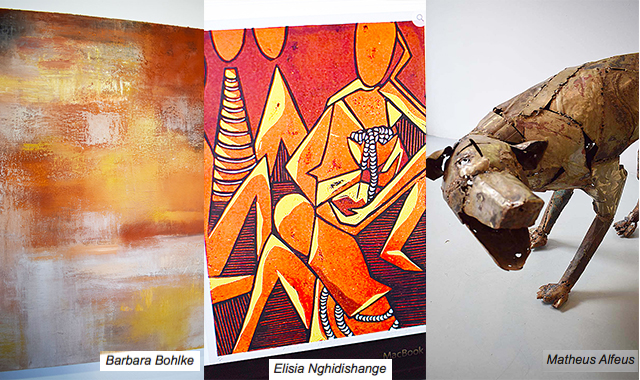
Currently working with artists Ismael Shivute, Nicky Marais, Laimi Mbangula, Fillipus Sheehama, Tony Figueira, Lok Kandjengo, Petrus Amuthenu, Elisia Nghidishange, Barbara Böhlke, Elisia Nghidishange, Mateus Alfeus and Lynette Diergaardt, Figueira describes the featured creatives as all “engaged in conscious and critical thinking about their work, their contexts and contemporary discourse in the visual arts”.
“I love working with StArt Art Gallery,” says artist Elisa Nghidishange who recently sold an artwork titled ‘After the Argument’ through StArt Online after a buyer following her work and seeking more of it found some of her pieces on the website.
“They are very good at promoting artists and they’ve got a strong curatorial system so I believe only my good creative, artistic artwork will be displayed online.”
Designed by Harris, browsable by medium or artist and showcasing the featured artists work replete with an artist page, product pages and the ability to click on an artwork and zoom in close enough to see texture, the website aims to make buying art without seeing it in person as easy as possible.
“The website isn’t just for buyers,” says Harris. “It exists as a platform for anyone who wants to become better acquainted with art. Anyone who is interested in art and society should take a look at what our artists have to say about the world we live in.”
Aimed towards their vision of seeing “contemporary Namibian art holding great value in Namibia and abroad… being both more visible and accessible to everyone” while artists “thrive in an environment that values their work both intellectually and financially”, StART feels, as various Namibian artists continue to produce amazing work, now is the time for the rest of the industry to grow and expand around this incredible resource.
“Art from Africa is gaining more and more attention globally,” says Harris, with Figueira adding that being online makes it easier to join the conversations other galleries and arts communities are having around the world.
“It is up to us to make sure that we are included in the narrative.”
In an age of information overload, Sunrise is The Namibian’s morning briefing, delivered at 6h00 from Monday to Friday. It offers a curated rundown of the most important stories from the past 24 hours – occasionally with a light, witty touch. It’s an essential way to stay informed. Subscribe and join our newsletter community.

The Namibian uses AI tools to assist with improved quality, accuracy and efficiency, while maintaining editorial oversight and journalistic integrity.
Stay informed with The Namibian – your source for credible journalism. Get in-depth reporting and opinions for
only N$85 a month. Invest in journalism, invest in democracy –
Subscribe Now!