



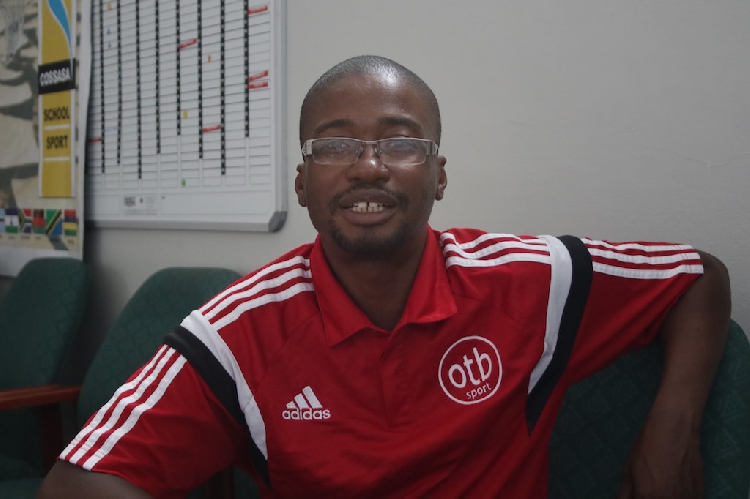
NAMIBIA ‘s national Paralympic coach Michael Hamukwaya has come a long way since growing up in Angolan refugee camps and going to school in Cuba.
He was born in Zambia and grew up in Angolan refugee camps after his parents joined the liberation struggle. By the age of eight he was taken to Cuba where he completed Grade 12 and arrived in Namibia for the first time in 1994.
He never got to know his father, who died in the battle for Namibia ‘s independence, and although he does not dwell on it much, dismissing it as ‘another era, ‘ he was clearly inspired by the revolutionary Cuban leader Fidel Castro.
As a youngster at Hendrik Witbooi Primary School on the Island of Youth in Cuba, Castro once came for a visit and his presence and message made a big impression on the young Michael.
“I ‘d say the one who inspired me the most was Fidel Castro. He loves sport, he ‘s crazy about sport. I remember once he came to our school in Cuba, just to visit us refugee kids. We were busy playing on the basketball court and this gentleman, with everyone following him around in uniforms, he just picked up the ball and came to play with us.
“He said, ‘you people who will go back to Africa, please take back what we are teaching here – everything goes through sport – you need to go back and install that into your people. We don ‘t want to hear Africa being called a Third Nation, we want you guys to move ‘… that has really inspired me till today and I was very fortunate to be there and hear those words.”
On his arrival in Namibia, Michael re-did his final school years at Deutsche Oberschule Swakopmund, where he excelled in sport and won the school ‘s sportsman of the year award in 1995.
After school he studied instrumentation mechanics at the Namibia Institute of Mining and Technology in Arandis and later got a job in Oshakati as an orthopaedic technician. Here, Michael got to know the physically disabled people at the hospital and found out about their passion for sport.
“Maybe it was a calling or just meant to be, but the department where I worked was right next to the wards of the people who were disabled, so I started speaking to them. They loved sport and even had a sports club, but it was not very active so I decided to get involved and help to revive the club.
Michael started organising wheelchair basketball matches and wheelchair races, and gradually raised the profile of disabled sport in the north.
He meanwhile also became Oshana ‘s Paralympic coach and when he took them to the National Championships for the first time in 2005, they excelled winning most of the medals on offer, and Michael was later appointed as Namibia ‘s national coach.
He had no knowledge of disabled sport and had to learn as he went along, googling information, and later learning from Cuban experts and doing international courses.
But he was passionate and driven and by 2008 he went to his first Paralympic Games in Beijing where Reginald Benade made history be winning Namibia ‘s first medal.
Despite their success, Michael was disillusioned by the ignorance and lack of support when they returned to Namibia with Benade ‘s bronze medal.
“People didn ‘t think much of Paralympics and they were not grateful for Reginald ‘s bronze medal, they didn ‘t know how big it was. So the fight for recognition continued after Beijing, but the other athletes, who did not make it were hungrier now and more motivated to work hard.”
Michael started coaching and producing new stars who went on to shine at the South African and African Disabled Games, like Johanna Benson, Ananias Shikongo and Martin Aloysius, and in 2011, Benson, Shikongo and Benade won Namibia ‘s first medals at the World IPC Championships in New Zealand.
That, however, was just a prelude to what was to come the following year when Johanna Benson took London by storm to win Namibia ‘s first ever gold medal at the Paralympic Games.
It was a great achievement, for Michael as well, but he was once again disillusioned on his return.
“The athlete was rewarded and everything, getting a house and N$180 000, but I was disappointed not to be rewarded. Some people said the coach should also be rewarded, but then I heard the Directorate of Sport said how can you reward a coach who is not even accredited. It hit me so hard, I was thinking how can they say that, you can see the results I am bringing in. So I became disillusioned and quit the national team for a year.”
“But I think it was also a blessing from God because the next year I enrolled at Unam doing physical education and biology. I ‘m now in my final year so hopefully I ‘ll get my degree next year and then at least I ‘ll be a qualified coach,” he added.
After a year Michael returned as Paralympics Namibia ‘s national coach, also after being encouraged to do so by his athletes, and he is now once again hard at work and preparing for the Rio Paralympics in September. Eleven Namibian athletes have already qualified for the Paralympic Games and Michael is excited about their chances in Rio.
“Our athletes have gained a lot of experience, they are much more knowledgeable now and they are on top of their training programme. We believe they can do much better than London and even win three or four gold medals in Rio.”
Michael, and the National Paralympic Committee, with the assistance of Coca-Cola have now started a ‘Road to Rio ‘ campaign with the aim of raising funds for the athletes – both as preparation funds before the Games and as remuneration funds for the achievers.
The campaign consists of three phases – an SMS line, a gala dinner and a nation wide tour to introduce the Paralympians to the nation.
“People only tend to know about our athletes when they come back with medals, but this time we want to make them aware of our athletes and how massive the Paralympic Games are. We hope to meet a lot of people along the way and they can pledge whatever they want and become involved,” he said.
One on One with Michael Hamukwaya
23 December 1977 in Onyango, Zambia.
Schooling:
Angolan refugee camps; Hendrik Witbooi Primary and Hosea Kutako Secondary schools in Cuba; and Oberschule Swakopmund.
In an age of information overload, Sunrise is The Namibian’s morning briefing, delivered at 6h00 from Monday to Friday. It offers a curated rundown of the most important stories from the past 24 hours – occasionally with a light, witty touch. It’s an essential way to stay informed. Subscribe and join our newsletter community.

The Namibian uses AI tools to assist with improved quality, accuracy and efficiency, while maintaining editorial oversight and journalistic integrity.
Stay informed with The Namibian – your source for credible journalism. Get in-depth reporting and opinions for
only N$85 a month. Invest in journalism, invest in democracy –
Subscribe Now!