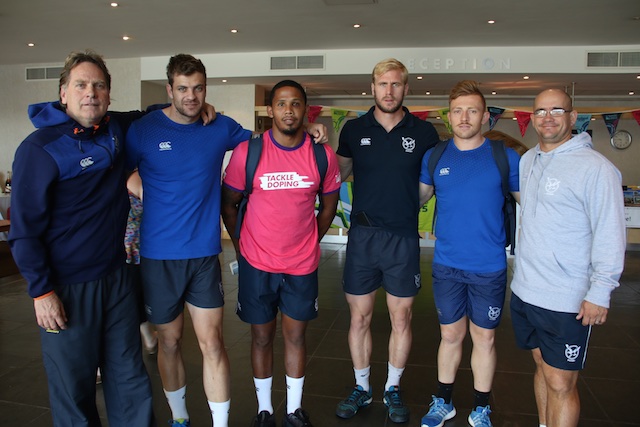
When Namibia qualified for the Rugby World Cup, Namibia Rugby Union president Bradley Basson left no stone unturned in organising them the best preparation possible for the global event.
A growing part of the success of a team is the role that a sport psychologist plays and in this regard, Basson organised the services of South African sport psychologist Dr Henning Gericke.
Gericke has played a major role as a sport psychologist in South Africa, and was part of the Springbok team that won the 2007 Rugby World Cup. He also worked with the South African swimming team at the 2012 Olympic Games where Cameron van den Burgh set a new world record, as well as with the Bulls, the Sharks and now the Stormers, while he is also a top motivational speaker and the author of a best-selling book, ‘Champions in Sport, Business and Life’.
Gericke was also a top athlete in his day, breaking a junior world record as a 16-year-old, while he qualified for the Olympic Games, only to be denied an opportunity due to South Africa’s ban from international competition at the time. Helge Schutz of The Namibian’s Sport Desk spoke to Dr Gericke about his past and his role with the Namibian rugby team.
Tell us about your athletics career.
When I was 16 I set a world age group record for the 1 500m with a time of 3:46,9 and later I went on to run 10 sub-four minute miles and in those years it was quite an achievement. I qualified by two seconds for the 1984 Olympic Games, but because of apartheid in our country I wasn’t allowed to compete.
It was always my dream to compete internationally against the best but I couldn’t do it because of the situation. So when I couldn’t compete internationally I decided to pursue a professional career. I studied and did my Doctors degree in clinical psychology and then it just happened that I started working with Springbok team and other rugby teams.
So in my own life I couldn’t compete internationally but now I can make a difference in people’s lives and motivate them to be at their best to compete internationally.
Tell us a bit about your work and how you motivate the Namibian team.
I work a lot on dynamics and getting the team spirit right and playing for one another. I’ll show them visuals about it and we’ll have sessions where we talk about the value that each person brings to this team.
What I did last night (Monday night, before the Tonga match), I stuck a piece of paper on the back of each player, and each one of the 31 players had to write for that one person why they believed in him. After the session they took it off and could see what 31 people wrote for them and why they believe in him. So it’s getting guys to believe in each other.
Another thing I did last night – I showed them the best visuals of what we did against New Zealand, we took the best clips out and made a movie and called it ‘the stuff of champions’, because Namibia, with all respect are good people, they are humble which is a good quality, but I want us to believe more in what we can do, to be more confident and to have that belief that we don’t need to stand back.
I know there is still a long way to go but at this World Cup we are going to give it all we’ve got. Last night we showed them the best visuals against New Zealand – in sport psychology we call it visualisation – because I want them to visualise how good they can actually be, because if you see it in your mind you start believing it.
But the important thing of mental toughness is not just to be motivated, but to be calm and composed, which is even more important. When you play the All Blacks, the last thing you have to do is to motivate them, so it was more important to keep them calm.
Even though they didn’t start off too well, they got their composure back at halftime and defended well. Behind the posts they weren’t blaming each other, they listened to their captain, they were composed and they went out and fought. And that’s mental toughness for me to have that composure and calmness to have a clear mind in a pressure situation.
You have also played an important role in terms of transformation in South Africa, tell us about that.
I was part of the Springbok team from 2004 to 2007 and it was also a sensitive issue back then and all I can say is that it is so important to develop people and that everyone gets a fair chance.
I’m not a politician but for me the human being comes first, I respect people for who they are and what they are so for me this Namibian team is great. I can tell you in all honesty there are no issues with this team – they care for each other, this is one team.
I don’t focus on the issue of colour, it’s not an issue for me because I see everyone as the same, I see it as one team, one nation.
For the record, I’m proud to be part of the Namibian team. I actually broke a record here as an athlete – in 1981 when I was in the army I ran in a race in Tsumeb at a local meeting and I broke the national South West Africa record. So for me it’s great to be back and part of the Namibian team and in all honesty I’m not even shouting for South Africa in this World Cup, for me its Namibia first.
So that’s the way I am – I try to let people feel part of a team and that is one of our main challenges. Of course we want to win a game, but we want to create memories for life and I want to be part of creating that environment and culture. And I think Namibia needs that actually more than a win – actually creating a culture where people believe in one another, and not blaming one another – it’s about creating a culture of excellence and showing respect for one another and that’s what I’m trying to create here.
In an age of information overload, Sunrise is The Namibian’s morning briefing, delivered at 6h00 from Monday to Friday. It offers a curated rundown of the most important stories from the past 24 hours – occasionally with a light, witty touch. It’s an essential way to stay informed. Subscribe and join our newsletter community.

The Namibian uses AI tools to assist with improved quality, accuracy and efficiency, while maintaining editorial oversight and journalistic integrity.
Stay informed with The Namibian – your source for credible journalism. Get in-depth reporting and opinions for
only N$85 a month. Invest in journalism, invest in democracy –
Subscribe Now!