


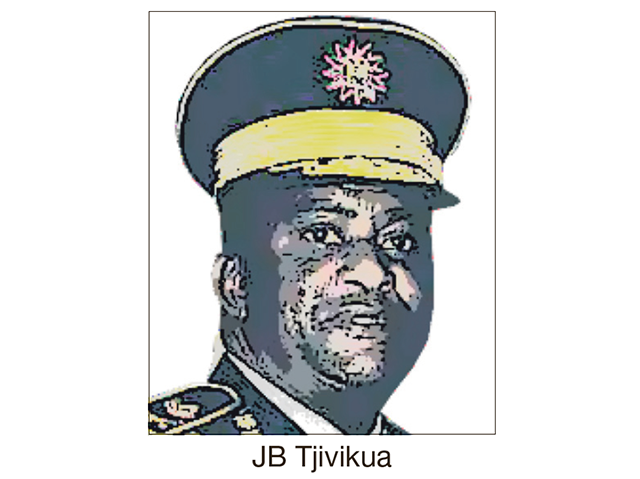
JB TJIVIKUATHIS IS AN encomium for a dear cousin, comrade and friend. As the saying goes, “Otjinguma tjo pomuvero tjazupo ombepera jahiti”. This loosely translates to “the shield has moved and the cold weather has no defence”.
Kazenambo Kazenambo (KK) was born on 6 July 1963 in Maun, Bechuanaland (now Botswana), to Veketa Kazenambo and Uazuva Karamata. He was born in the lineage of Tjout_uku Ua Kasupi, whose eight siblings gave birth to the Tjamuaha and the Maharero royal clan. KK attended primary and secondary school at Tsau, Maun and Pikwe in Botswana. He was a gallant freedom fighter with a pedigree equal to many of his class, such as the legendary commander Hanganee ‘Katjipuka’ Kavezeri, Caleb Tjipuahura, Pavanga Kahaka, and many others born of exiled Ovaherero and Ovambanderu, and who proved themselves adept combatants of Plan, Swapo’s former military wing.
A fitting tribute to the late KK would be incomplete without recalling the anti-colonial war of resistance waged by our forebears and the miseries endured during the ‘Great Trek’ while fleeing to Bechuanaland, where many descendants of the 1904 Herero genocide find themselves today.
Around 1896, hundreds of Ovaherero and Ovambanderu crossed into Bechuanaland with their livestock as a result of early skirmishes with the German colonial Schutztruppe in then German South West Africa (now Namibia). After the bloody battle of Ohamakari at Waterberg on 11 August 1904, and the incessant genocidal war until 1908, many Ovaherero and Ovambanderu people crossed into Bechuanaland under the leadership of Chief Samuel Maharero of the Ovaherero people. They were the forebears of the closely knit Otjiherero-speaking communities in Botswana.
One of the tragic events during the flight to Bechuanaland was an ambush by German troops at a waterhole. When the fleeing Ovaherero and Ovambanderu ran forward to drink at the waterhole, they were instantly shot dead. Fierce battles over the waterhole ensued where our people heroically fought for their survival. They knew it was a matter of life and death and many were martyred there. An eyewitness account of the tragedy is reflected in an extract from a song ‘Our Hill’, which symbolically describes the horrors of the ambush: “Like a brook, do not go to drink the water which gives you sores, in that water you will be shot.”
Sub-Inspector Hodson of the British Bechuanaland Protectorate wrote about meeting the refugees in Kalahari: “The poor natives presented a terrible appearance; men, women and children were in an absolute state of starvation, and, to add to their miseries, were suffering from smallpox…”
KK was acutely aware of his Namibian identity and cultural roots. He joined Swapo in 1979 at the tender age of 16 and in 1984 joined Swapo’s liberation forces in exile, undergoing basic military training at the Thobias Hainyeko Training Centre near Lubango, Angola, during 1985/1986. After completing his training, he heard about my presence at a not-too-distant base and came to meet me at my dugout. It was a heartfelt, tearful encounter. We spent a few days together, with me teaching him Commander Katjipuka’s liberation song ‘Ondero ndjirimuete ojo kukuturehi’ (‘Our wish is to free Namibia’). On the day he returned to base, I presented him with a GDR (‘okakongola’) uniform – gifted to me earlier in Luanda by the legendary chairman of Swapo, Tate David Hosea Meroro – as well as some bare essentials for the battlefront. I told him “matuka hakaenena konganda” (we will meet at home, Namibia) and we saluted.
KK was subsequently deployed to the Moscow Battalion, where he was appointed company political commissar, and later redeployed at Capeu Peu, northwestern front, Angola. He was immediately engaged in two fierce battles with Unita forces. Thereafter, KK was sent to attend a course in journalism in the former Democratic Republic of Germany (GDR) before returning to the battlefront.
After the UN Repatriation programme for exiled Namibian refugees in 1989, KK returned to Namibia. He later worked as a news reporter for Namibia Today (the Swapo newspaper), until 1991, when he went to study in the United Kingdom.
He was a longtime member of the Swapo Party Youth League, and a member of its Central Committee from 1991 until 2002. After the 2004 elections, KK was appointed deputy minister of regional, local government and housing and rural development. In 2010, he was appointed minister of youth, national service, sport and culture, and served in that position until 4 December 2012. In 2014, he became a member of Swapo’s Politburo.
KK was sociable and frank, a critical thinker, shrewd politician, astute entrepreneur and businessman, and farmer, with an MBA from Oxford Brookes University, United Kingdom.
Until the end, KK fearlessly and unreservedly fought for justice, freedom and fairness. Sadly, he’s gone too soon.
Ozond_u mbari za Tjindumbu tja Kandomaze. Onduezu no nd_end_u
nd_a kuruka pozondomba. Ozombo imbari ooKakuze no Kazorohaka.
Omaue ijevari ekuee ne kueeua.
Ovakuatjivi, Ovakuatjivi arikanee! Kazenambo uakaenda nguharu nombunda jomuti.
Mutoore naua ouetu!
In an age of information overload, Sunrise is The Namibian’s morning briefing, delivered at 6h00 from Monday to Friday. It offers a curated rundown of the most important stories from the past 24 hours – occasionally with a light, witty touch. It’s an essential way to stay informed. Subscribe and join our newsletter community.

The Namibian uses AI tools to assist with improved quality, accuracy and efficiency, while maintaining editorial oversight and journalistic integrity.
Stay informed with The Namibian – your source for credible journalism. Get in-depth reporting and opinions for
only N$85 a month. Invest in journalism, invest in democracy –
Subscribe Now!