




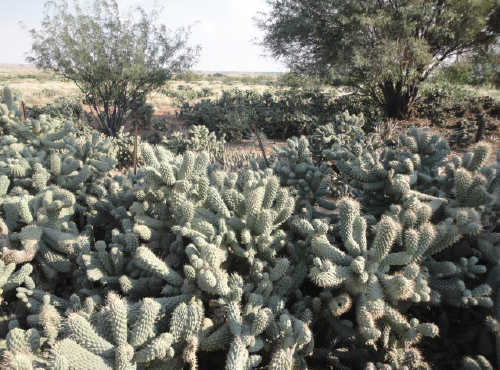
LUISE HOFFMANNDURING his brief visit to Namibia in 2010 world expert on the control of invasive cacti Helmuth Zimmermann from Pretoria noted 23 invasive cactus species, the most dangerous of which are listed below.
Due to the short duration of his stay it was impossible for him to travel extensively and he is convinced that there are many more invasive species than mentioned in his “Notes”, which are available in full on the internet.
He rated their potential impact according to the following criteria:
• Is the species a problem elsewhere?
• Does it belong to a taxon that is known to contain several invasive species?
• Correct identification;
• Does the originating environment match the introduced environment and climate?
• Reproduction potential (seeds, vegetative, or both, seed persistence and undesirable trends);
• Modes of dispersal (water, wind, birds, mammals, humans);
• History of domestic cultivation;
• Are effective control methods available and their costs?
• The vulnerability of the habitats and biodiversit threatened;
• Poisonous, allelopathic, unpalatable and thorny;
• Growth requirements and tolerance to various soil types
Daunting as botanical names may seem, they are indispensable for finding more information, which for most of these cacti is available on the internet. Add “South Africa” to your search to avoid pages meant for cacti collectors who wish to cultivate these species.
Rosea cactus, Afr roseakaktus (Cylindropuntia rosea = Cylindropuntia pallida) – widely used as ornamental and living fences; extremely spiny and injurious to livestock [Klein Windhoek, Avis Dam]. Difficult to control, no biocontrol available.
Australian pest pear, Afr suurturksvy (Opuntia stricta var. stricta) – widespread, used for making jams and syrups. Some dense infestations covering many hectares found north of Windhoek.
Also a serious invader in many other countries in Africa and elsewhere. [Klein Windhoek]. Good biocontrol available.
Imbricate prickly pear, Afr kabeltyurksvy (Cylindropuntia imbricate) Common garden Ornamental; very widespread and problematic in some southern regions, [Klein Windhoek].
Biocontrol effective in the drier parts of South Africa. Boxing glove cactus (Cylindropuntia fulgida var mamillata) Very common garden ornamental; common around towns where plants have been dumped, invasive around Aroab and Windhoek (see photo). Very invasive, var. mamillata can convert back to fulgida, which is very invasive. Good biocontrol agent available from South Africa
Brown-spined prickly pear (Opuntia phaeacantha) Invasive around Windhoek; has all the properties to become a serious invader; No control methods.
Engelmann’s prickly pear, Calico cactus (Opuntia engelmannii (=Opuntia lindheimeri) – As above; serious invader in South Africa and Texas, biocontrol ineffective, difficult to control
Large flowered prickly-pear, creeping pricklypear (Opuntia humifusa) – Serious invader in South Africa, probably less aggressive in Namibia, chemical control.
Moon cactus, Afr toukaktus (Harrisia adscendence and Harrisia martinii) – Effectively dispersed by birds; serious invaders in South Africa and Australia [Windhoek along Sam Nujoma Drive above crossing with Robert Mugabe Ave]. Reasonably good biocontrol of all species available.
Long-spine cactus, Afr langdoringkaktus (Austrocylindropuntia subulata = Cylindro-puntia exaltata, Opuntia subulata). Very spiny; declared weed in South Africa. [Klein Windhoek along Dr Kenneth Kaunda Str]. No biocontrol; control difficult.
During the coming months I will attempt to provide descriptions and photos of these cacti.