



Social media has been one of the most impactful turning points in history since the Industrial Revolution.
It has literally brought the once unknown wonders of the world to our fingertips. Friends and family from across the world seem as if they’ve never left thanks to platforms which allow communication within seconds.
There’s no doubt that the internet has its dark side with online bullying, black market trading (*coughs in the Dark Web*) and illegal pornography, however, there is also light. Most importantly, social media can be used to bring about social change.
#MeToo is one such example. Women across the world experience sexual harassment, rape, blackmail, molestation, mental, physical and emotional abuse and murder at the hands of men – basically because #MenAreTrash.
Although #MenAreTrash has trended on social media for a while, especially after incidences of violence towards women, #MeToo gained popularity after sexual allegations emerged against Hollywood film producer Harvey Weinstein.
The hashtag #MeToo was first coined by American civil rights activist Tarana Burke in 2006 but was popularised by actress Alyssa Milano when she encouraged women to tweet it to show the magnitude of sexual harassment or assault. It has since been tweeted by Gwyneth Paltrow, Ashley Judd, Jennifer Lawrence and Uma Thurman, among other influential celebrities.
Another social media movement is the international #BlackLivesMatter which originated in the African-American community and campaigns against violence, systematic racism, racial profiling, police brutality and racial inequality in the United States criminal justice system.
Although many use online platforms to make a change, for some it’s just a way to get some attention, seen especially during the #IceBucketChallenge in 2014.
A campaign to raise donations towards research for amyotrophic lateral sclerosis (ALS), also known as motor neurone disease, participants had buckets of ice and water dumped over their head either by themselves or friends.
The challenge encouraged nominated participants to be filmed getting drenched and then nominating others to do the same. A common stipulation is that nominated participants have 24 hours to comply or forfeit by way of a charitable financial donation, although many just jumped on the bandwagon, doing it for laughs.
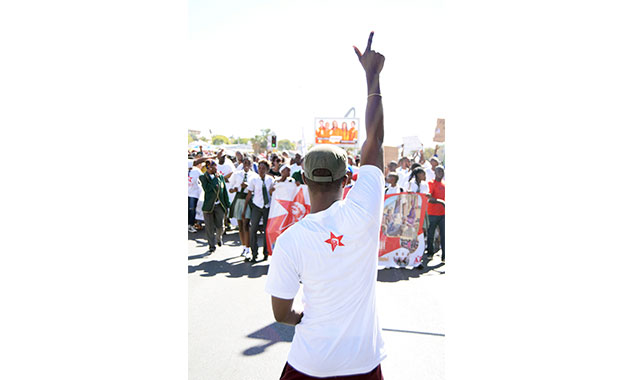
Much closer to home, Windhoek has also seen social media used to sway societal inequalities and fights against injustice. The land issue sparked former Swapo youth leader Job Amupanda to initiate the Affirmative Repositioning movement which organised a march on 16 June 2016 to deliver a petition to the speaker of the National Assembly, Peter Katjavivi.
During these protests, The Namibian reported Amupanda saying: “Our fight is not for farms. We want houses, not farms. The story of farms has nothing to do with us and our struggle. What we want is land for houses”.
#June16 saw hundreds of landless Namibians march through Katutura all the way to Ausspannplatz to deliver a petition in hopes that the government will solve the country’s land issue. The same year, following South Africa’s mass protests against hiked tuition fees, Namibian students followed suit with #FeesMustFall.
Both University of Namibia (Unam) and Namibia University of Science and Technology (NUST) students demonstrated and shut down their respective institutions. For the most part, the students were successful and registration fees were scrapped – at least for the time being.
At the time of these sometimes violent protests, class hours were disrupted and shone a negative light on the movement. Ernest Mweneni Hamukwaya, who was doing his postgraduate diploma in accounting at the University of Cape Town (UCT) at the time, had several of his final exams cancelled while the situation was being resolved, The Namibian reported.
“I don’t think it should be an issue for as long as one doesn’t get in between protesters and their objectives,” he said, adding that he understands the cause and commends the protestors for their commitment.
These movements prove that social media has the power to reach, empower and cause social change while giving a voice to many who are afraid to speak up alone.
The key? Putting your money, time and energy where your Twitter fingers are.
In an age of information overload, Sunrise is The Namibian’s morning briefing, delivered at 6h00 from Monday to Friday. It offers a curated rundown of the most important stories from the past 24 hours – occasionally with a light, witty touch. It’s an essential way to stay informed. Subscribe and join our newsletter community.

The Namibian uses AI tools to assist with improved quality, accuracy and efficiency, while maintaining editorial oversight and journalistic integrity.
Stay informed with The Namibian – your source for credible journalism. Get in-depth reporting and opinions for
only N$85 a month. Invest in journalism, invest in democracy –
Subscribe Now!