




Survival is as old as creation, with four basic components which are the main actors in this play. The one is water, another is body temperature, and then there is also food and reproduction.
The currency of life is water – everyone needs water. The Namib Desert is a hyper-arid desert which means that its annual evaporation is four times more than its rainfall. Amazingly, with just three to 15 mm of rainfall a year, some creatures still manage to survive! The question is: “how do they do it?”
1. The first animal on the list is the a web-footed Namib dune gecko (Pachydactylus rangei otherwise known as the palmato gecko). Its main food supply consists of fish moths, spiders and dune crickets, which are all active at night. The gecko gets protein as well as moisture from its food source. The palmato gecko is also able to lick the water that has condensed on its body due the thick fog that settles on the Namib. Before sunrise, the gecko will dig into the dune sand or gravel to ride out the heat of the day with sand temperatures sometimes exceeding 70˚ C!
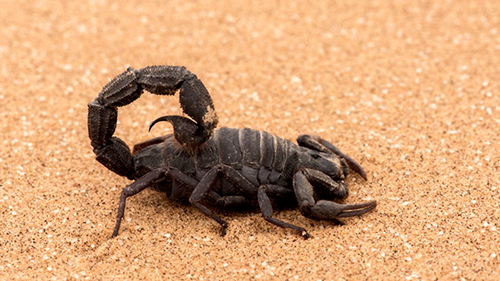
2. The Namib is also home to many scorpions. Most scorpions are active at night, but the hairy thick-tailed scorpion (Parabuthus villosus) moves only in the day. These scorpions can reach lengths of 18 cm and can survive without food for 12 months. Their hard body armour consists of manganese, iron and tin. To regulate their body temperature they readily seek cover in plants, bushes, rocks, cardboard boxes as well as your shoes. They get most of their moisture from eating lizards, other scorpions, baby chameleons, spiders and insects.
3. The Namaqua chameleon (Chamaeleo namaquensis) is another one of the Namib’s inhabitants. It is classified as the fastest chameleon on earth and can clock speeds of 3 km/h. This chameleon will flatten its black body towards the sun to absorb as much heat as possible, kick-starting its metabolism. If the day temperatures rise to above 30˚ C, the chameleons will climb onto a rock or a small bush to get as far away from the hot sand (remember sometimes more than 70˚ C). They will also try ensure that as little of their body is exposed while turning white to reflect the heat.
4. Most snakes have their eyes on the side of their heads. In the Namib, we have another exception to the rule, the side winder or Peringuey’s adder (Bitis peringueyi). This snake’s eyes are situated on top of its head, which means it can bury totally into the sand but still be able to see you. The sidewinder’s diet consists of lizards and Namib dune geckos. They like sandy dunes and have adapted a very unique way of climbing them – sideways! The side winding motion enables them to easily climb the steep sides of dunes. When moving sideways they can have as much as 50% of their body not touching the sand, allowing them to move over very hot sand.
5. The Namib sand snake (Psammophis namibensis) is a very slender and fast moving snake. They get most of their moisture from their food, but they will also suck water drops off the leaves of plants or from their own bodies when there’s thick fog, or occasional rain. To regulate their body temperature they take refuse in bushes and mouse holes.
6. The shovel-snouted lizard (Meroles anchietae) is another of many desert-adapted creatures of the Namib. To prevent their feet from burning they have adapted a thermal dance to lift their feet off the hot sand – a front leg and opposite hind leg lifts on a rotational basis. Should it get too hot, the shovel-snouted lizard will dig into the dune sand or run up the dune to the shaded side where temperatures are cooler. Most of their moisture is accumulated by drinking fog off their bodies or stones. Then they have a special card up their sleeve – they have two bladders! One for urine, and one for water. The shovel-snouted lizard can carry up to 12% of its body weight in water in the second bladder. If that is full to capacity, they can survive on it for weeks. Peringuey’s adders like to eat shovel-snouted lizards, because that second bladder of water is like a built-in water bottle – an added bonus.
In an age of information overload, Sunrise is The Namibian’s morning briefing, delivered at 6h00 from Monday to Friday. It offers a curated rundown of the most important stories from the past 24 hours – occasionally with a light, witty touch. It’s an essential way to stay informed. Subscribe and join our newsletter community.

The Namibian uses AI tools to assist with improved quality, accuracy and efficiency, while maintaining editorial oversight and journalistic integrity.
Stay informed with The Namibian – your source for credible journalism. Get in-depth reporting and opinions for
only N$85 a month. Invest in journalism, invest in democracy –
Subscribe Now!



