


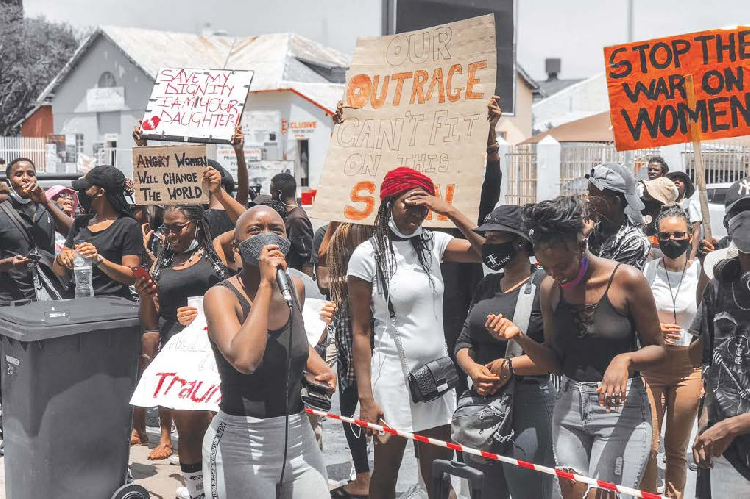
AMID a global pandemic that forced Namibians into a lockdown, a youth-led initiative decided to follow suit and shut down Namibia for a completely different reason.
This came after the remains of the 22-year-old Shannon Wasserfall were found near Walvis Bay in October last year, six months after she had gone missing.
The discovery sparked a wave of anger, disappointment and emotional trauma for many young Namibians and galvanised an initiative that took its form in a hashtag as a means to mobilise young people on social media to demand decisive action to curb sexual and gender-based violence (SGBV).
The Namibian Youth Paper caught up with activist and one of the mobilisers of #ShutItDown Ndilokelwa Nthengwe, to reflect on what transpired almost a year ago.
“The protests should never have stopped until all our demands were met. This was not a Shannon Wasserfall problem, it was a SGBV and femicide problem that still persists,” she said.
Nthengwe added that as long as there is no political will, especially from institutions such as the ministry of gender that, according to her, remains an inactive institution, there is no need to stop protesting.
The series of protests characterised Namibia’s youth as unwavering, even in the face of the law as the Namibian Police arrested 25 young protesters, including three journalists who covered the event.
The aim of the protests was to disrupt everyday activity, especially in Windhoek’s Central Business District. The group of protesters, who demanded a state of emergency to address the state of SGBV and femicide in the country, marched to parliament, the Namibian Police station in town as well as to the gender ministry.
“Our generation demands immediate action, but not necessarily for ourselves. It’s for the generation after us; this is what sustainable development means. I am sure the older generation had similar aspirations (during the struggle for freedom in the 90s). It seems those aspirations for equality, freedom and sustainability no longer serve a purpose to them,” she added.
Nthengwe further noted that the state of dignity and safety of women, girls and gender-diverse communities ultimately determine the priorities of the government, and she does not believe that they are being prioritised.
Ndapandula Louw, a 23-year-old student who participated in the protests last year, said that the initiative was very important, considering how SGBV is treated in the country.
“We [women] are tired of being unseen and unheard. People [need] to unlearn rape culture and recondition themselves into treating women and children like human beings. With the state of things in the country, the role of #ShutItDown is very crucial,” she added.
Louw also stressed the importance of the movement for the next generation, saying it will help them to understand that women deserve to be treated like human beings.
Candidate legal practitioner Undjimuna Katjerungu said #ShutItDown effected a change that was felt by the world over and disapproved of the notion of millennials being lazy and entitled.
“The movement set a tone of solidarity and vigour that I believe will persist moving forward. That same energy and determination will be used in another cause that affects us, the youth,” she explained.
Katjerungu (23), who only participated in the protest virtually, said it was heart-warming to see that so many people came out and spent hours standing up for the cause, showing how much need there is for actual change.
In an age of information overload, Sunrise is The Namibian’s morning briefing, delivered at 6h00 from Monday to Friday. It offers a curated rundown of the most important stories from the past 24 hours – occasionally with a light, witty touch. It’s an essential way to stay informed. Subscribe and join our newsletter community.

The Namibian uses AI tools to assist with improved quality, accuracy and efficiency, while maintaining editorial oversight and journalistic integrity.
Stay informed with The Namibian – your source for credible journalism. Get in-depth reporting and opinions for
only N$85 a month. Invest in journalism, invest in democracy –
Subscribe Now!