National u20 men football head coach, Lucky Shipanga, has called for no changes to the current squad.
The young lads came fourth overall at the just concluded Cosafa Cup where Namibia was awarded the ‘Fair Play’ award recognition.
Shipanga tells The Namibian Sport that the Namibia Football Association (NFA) youth technical department is currently working on a plan of action.
“From our side, we have already started collecting information and data on the players. That is important because this should not be the end of the journey for these boys.”
“We need to continue monitoring them, identifying their strengths and weaknesses, and creating opportunities for them to keep developing and competing at a high level,” says Shipanga.
“The first thing is continuity. We have started collecting and keeping proper data on the players, and the next step is to build a structured programme around them. These players should not disappear after the tournament,” warns the head coach.
He adds: “We need organised friendly matches, regional competitions and international exposure against neighbouring countries.”
Shipanga says organising opportunities to play against teams from South Africa, Botswana and other SADC countries would expose the players to different levels of intensity and tactical demands.
“We also need to strengthen our domestic youth structures so that players are playing regularly at a competitive level.
“The objective is not only to prepare one u20 team for one tournament. The objective is to build a pathway that continuously produces future Brave Warriors.”
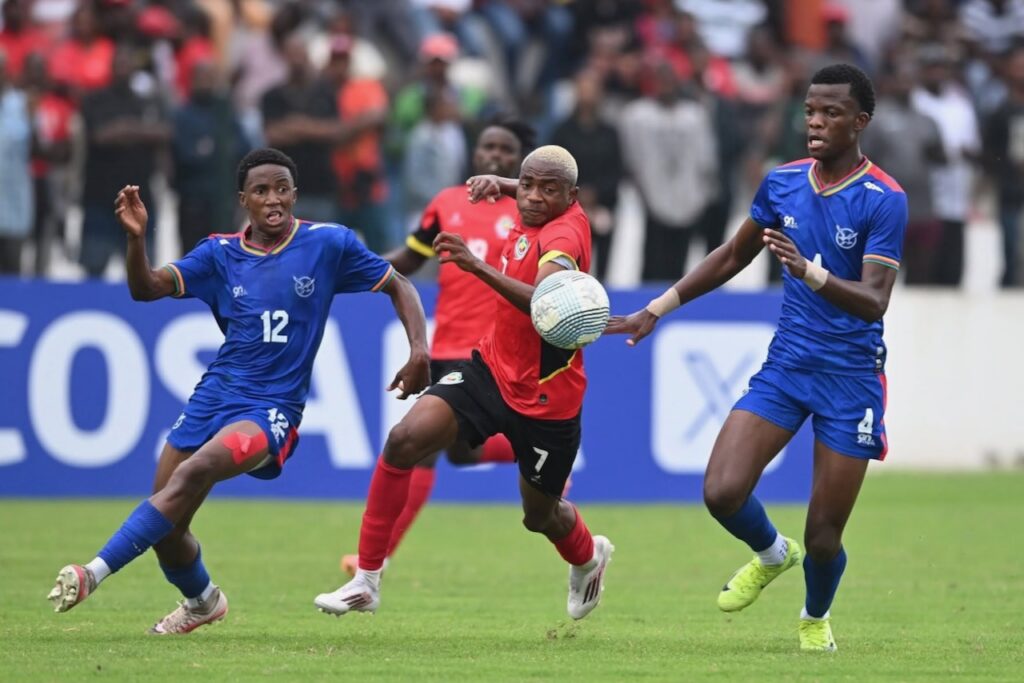
Reflecting on the Cosafa Cup knockout stage, Shipanga says: “Nothing fundamentally shifted in our approach. We knew the semi-final against Mozambique would be different because they had the home-ground advantage, the pressure of their supporters and, importantly, the motivation to respond after the group-stage defeat.”
“Our defensive organisation was good in principle, but we were a fraction slower in reacting to the decisive moments.
“For their first goal, our goalkeeper made the initial save, but we were slow to react to the follow-up. The second goal came from our left side after Mozambique overloaded that area with their pace, and again our defensive cover was slightly late.
“We also created almost five good opportunities in the second half but failed to capitalise. At the same time, you could see that the players, particularly some of our defenders who had played almost every minute of the tournament were becoming physically drained.”
Shipanga says by the Zambia match, the fatigue was more visible. “We saw signs of dehydration and players running out of energy. With only one day between high-intensity matches, recovery was extremely difficult.
“For me, this tournament was a very important lesson about managing four or five high-intensity matches within a short period with limited recovery time,” says the coach.
“I would not say the concerns we identified against Seychelles were the primary reason for the defeats. Rather, the tournament showed us the importance of squad depth, game management and making the right changes at the right time.”
Shipanga says: “Against Seychelles, when I introduced fresh legs, we became more creative and improved our ability to manage the transition from defence to attack and back again.
“Some experienced players who had consistently given their best during the process started showing signs of under performance, and we had to make changes.”
He says the intensity of the tournament was extremely high, and as a coach his expectations were also very high.
“We wanted to compete for the best possible outcome, but the experience also taught us where we need to improve.”
RASHID NAOBEB ABSENCE IN SEMI FINAL
“His absence had some impact because Rashid had been important to us and had scored in almost every match. However, I was very pleased with the player who came in to replace him.”
“He is a u17 player, and he produced one of the best performances I have seen from him. He surprised even us with his maturity and discipline.
In the game against Mozambique the game plan, he says was well prepared, as Mozambique would try to stop Namibia’s combination play and instead use longer balls towards the wings, where they could utilize the speed of their forwards.
“We had discussed that threat beforehand. The problem was that, as the tournament progressed, the workload on our regular defenders began to catch up with them. Their reactions to certain defensive situations became slower.”
The coach also admitted to the poor finishing. “We created opportunities in the second half but did not convert them, and at this level those moments are decisive.”
SCOUTING
“We need consistent scouting across all regions and a system that identifies and develops players from u15, u16, u17, u18 and u19 level. We cannot wait until players are 19 or 20 before we start preparing them for international football,” says Shipanga.
A regular high-level friendly matches and tournaments against neighboring countries are needed so that young players become accustomed to intensity, pace and different styles of football.
“But the foundation is qualified, high-quality coaching. If we want to produce powerful, fast and technically strong players, we have to invest in the coaching and development structures from a young age,” he says.
Shipanga admitted that the boys ran out of steam against Zambia.
“Yes, particularly in the final two matches. Our medical team worked extremely hard, but there is only so much recovery you can achieve in a few days. It is not realistic to expect a player to become fully conditioned or completely recover within one week when he is being asked to train, recover and compete at high intensity almost immediately.”
Also, a proper pre-season training is required that will take around six weeks to build the body, conditioning, fitness and recovery capacity. However, the squad only had a fraction of this time,” the coach lamented.
Shipanga says the medical team worked under tremendous pressure and never stopped trying. “They were not only treating bodies, they were helping us rebuild confidence, mentality and recovery. Today, I can honestly say that I understand the work behind the work.”
MCHENI KAVENDJII AND ONESMUS TIMOTEUS
“The fact that two of our defenders were selected in the Team of the Group Stage is encouraging, but development cannot stop there.
“The NFA is planning to invest more in youth football, and the youth programme that is being developed will be important for creating a proper pathway from youth national teams into the senior Brave Warriors.”
He further welcomes NFA’s commitment towards supporting different national teams, particularly during this September period, “and that gives us confidence that youth development is being taken seriously”.
Of the team, he says these players need continuity, regular high-level matches, proper conditioning and structured development.
“You cannot make a young player physically ready for this level in just two weeks,” warns Shipanga.