



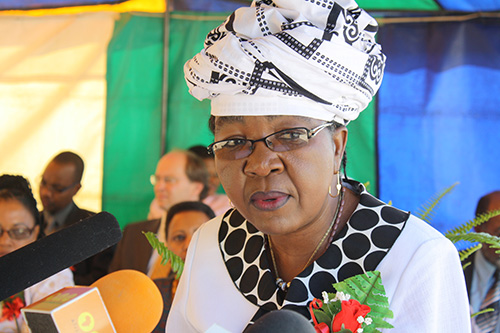
URBAN development minister Sophia Shaningwa was breathing fire when she reprimanded her staff yesterday for slow service delivery and alleged favouritism in the allocation of land.
She was addressing the opening session of a workshop hosted by her ministry on the strategic plan for the 2017-2022 period.
Shaningwa said her office had received a large number of complaints from members of the public about irregularities and cases of favouritism at local authorities, and warned: “I want to see an end to this unbecoming conduct.”
She also railed against the irregular use of funds for projects not budgeted for, and expressed concern that when confronted, some officials would question why they were being questioned.
Shaningwa furthermore reprimanded subordinates for spending time doing what they are not supposed to do, while the public waits for service delivery.
“If we are doing what we are not supposed to do, we are committing an injustice. We need a mind shift, we need to act proactively, and do away with unnecessary power struggles. We must deliver because people are suffering on the ground,” she stressed.
The minister also instructed her staff to listen to the pleas of the people they serve, and to prioritise their needs.
“I am urging all of you to start prioritising services that are mostly being demanded by your communities. Let us listen to what they tell us; let us not dictate priorities for them without consulting them,” Shaningwa said.
On the issue of traditional leaders, she said she will not tolerate the insults she is getting from some of them.
“I do not deserve to be insulted by traditional authorities. Why do some of them keep on insulting me, their boss?” she asked, adding that her office had received letters with insulting undertones addressed to her.
Shaningwa noted that there was also an increase in the number of traditional authorities in the country, and expressed concern at the infighting, divisions and disputes over succession within these traditional authorities.
On the issue of land delivery and housing, the minister said bureaucracy was slowing down the process, and must be done away with.
“In order for us to get this right, all unnecessary bureaucratic processes and procedures must be done away with. Times have changed; we must move forward with what is right, and avoid unnecessary hiccups found in our systems,” she said.
Shaningwa said the process of land delivery needs to be re-examined, streamlined as well as reformed to allow the timely finalisation of applications for the sale of urban land.
“Developers who acquire land mostly for housing development cannot sit on such land for ages, preventing development from taking place. If it continues like that, then the decision to allocate them land must be revoked, and the land given to those who can develop it,” she added.
The ministry last year delivered 7 754 serviced plots, while 5 058 housing units were constructed, both exceeding the Harambee Prosperity Plan’s annual targets.
The minister noted that her ministry had roped in the Namibia University of Science and Technology to review the 2013 mass housing development programme blueprint, and to develop a strategy that would guide and ensure effective implementation.
In an age of information overload, Sunrise is The Namibian’s morning briefing, delivered at 6h00 from Monday to Friday. It offers a curated rundown of the most important stories from the past 24 hours – occasionally with a light, witty touch. It’s an essential way to stay informed. Subscribe and join our newsletter community.

The Namibian uses AI tools to assist with improved quality, accuracy and efficiency, while maintaining editorial oversight and journalistic integrity.
Stay informed with The Namibian – your source for credible journalism. Get in-depth reporting and opinions for
only N$85 a month. Invest in journalism, invest in democracy –
Subscribe Now!