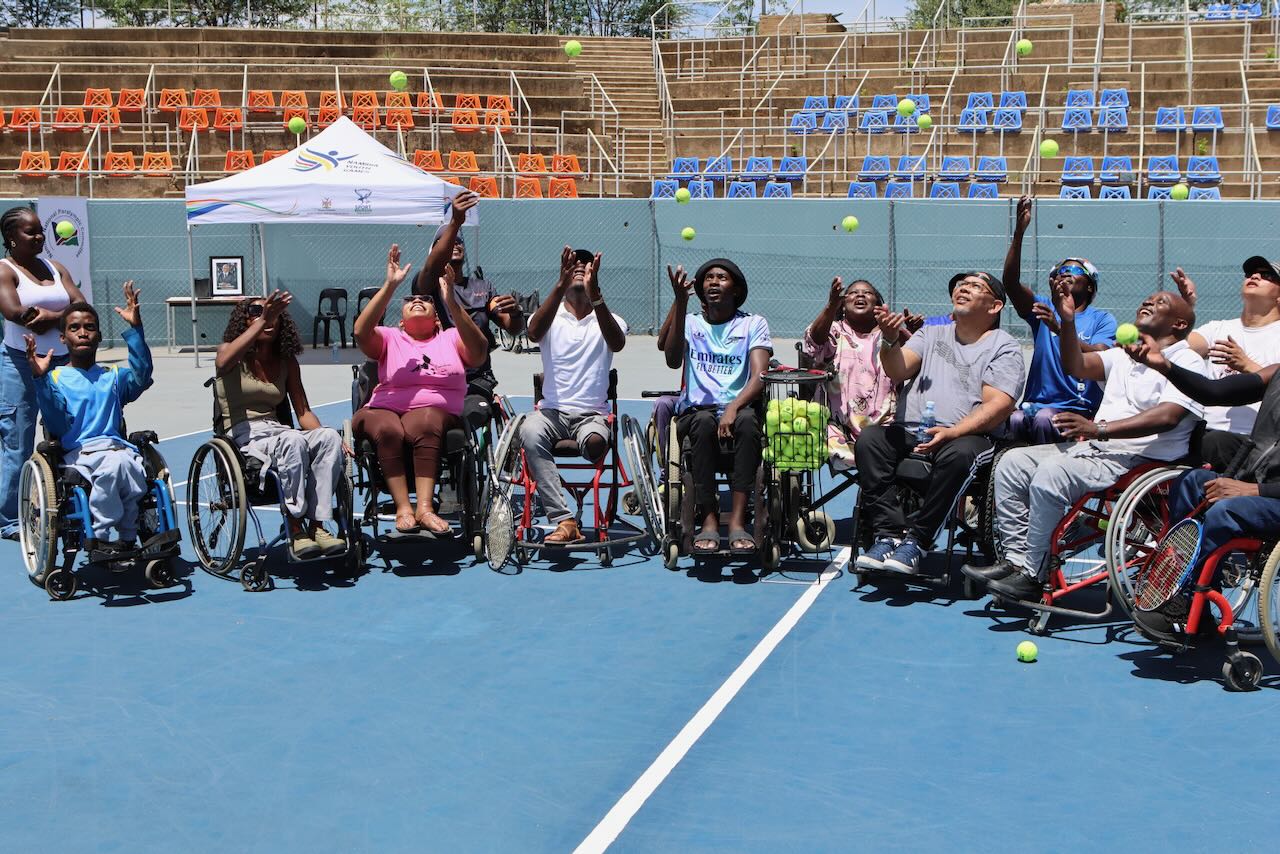
Wheelchair tennis in Namibia received a boost over the weekend when about 15 aspiring players attended an ITF clinic conducted by South African coach and referee Patrick Selepe.
Selepe is one of Africa’s leading figures in wheelchair tennis, having come through the ranks as a player, official, coach and referee. He also completed an ITF Level 2 coaching course and last year was coach of a South African player who won a bronze medal at the Paris Paralympics.
Selepe said his visit to Namibia came through his friendship with Mike Hamukwaya, the secretary general of the Namibia Paralympic Committee.
“This developed from a partnership that I have with brother Michael – we met in America, doing our mentorship programme and exchanging ideas. We recently met again at the Paralympics in Paris and continued talking about how we can do this clinic, and this is the reason that I’m here,” he said.
“This is a continuing thing, and Ill come back in June because the main reason is to identify two juniors to come to South Africa to attend an African camp, where we will have other nations as well. It’s for them to have fun just like these guys are having fun, just for them to be motivated, to say, ‘Oh wheelchair tennis is alive, I can come back and do it,” he added.
“So we are introducing it and we need representation in September, the guys must come to South Africa and learn more, and make new friends,” he said.
Hamukwaya said their relationship grew over many years.
“I’ve known Patrick for many years and saw he was an expert in his work so we remained in contact and kept on talking. But now through the ITF this opportunity has come for Patrick to do a clinic in Namibia and he was also in Eswatini and Lesotho, and the programme will continue in future,” he said.
“We want to concentrate on developing our youth, South Africa now showed the way with a bronze medal at the Paris Paralympics, so why can’t Namibia also do that,” he said.
Selepe, meanwhile, related his career and how his involvement with wheelchair tennis came about.
“I lost my leg due to bone cancer many years ago in 1996. I had two legs andnever thought about people on wheelchairsor with disabilities andthen boom, it happened. Then I had to transform my life from being able-bodied to being a person with disabilities,” he said.
Selepe became quite active in various disciplines like high jump, shot put, and javelin throwing, but then got involved with wheelchair tennis in about 2004.
“It was brilliant for me, because I really love wheelchair tennis and then I ended up being a development officer for wheelchair tennis,” he said.
“My role was to visit the provinces in South Africa and introduce wheelchair tennis to them, not just playing, but also thinking of the governance and taking care of people with disabilities – how do we transport them, how do we take care of them, and how can we take them to the next level to be high-performance players,” he added.
Selepe became a development manager of wheelchair tennis in South Africa and later started officiating, first becoming an ITF tennis referee and later a coach.
“I officiated at Wimbledon qualifiers, I officiated at the Tokyo Paralympics and I also did my level two of coaching with the ITF. Now I’m a national coach and that’s why I travel a lot with our national teams, to the world cup or the Paralympics, which is where we got a bronze medal last year,” he said.
One of the participants at the clinic, Pandulo Sheehama said she was inspired by the clinic.
“I just came to explore different wheelchair sports and also to support our wheelchair community – a lot of the guys who came here are my friends.
It was great fun and I also learnt that sport is about dedication and finding a passion, and that with hard work you can achieve the goals that you set for yourself,” she said.
In an age of information overload, Sunrise is The Namibian’s morning briefing, delivered at 6h00 from Monday to Friday. It offers a curated rundown of the most important stories from the past 24 hours – occasionally with a light, witty touch. It’s an essential way to stay informed. Subscribe and join our newsletter community.

The Namibian uses AI tools to assist with improved quality, accuracy and efficiency, while maintaining editorial oversight and journalistic integrity.
Stay informed with The Namibian – your source for credible journalism. Get in-depth reporting and opinions for
only N$85 a month. Invest in journalism, invest in democracy –
Subscribe Now!