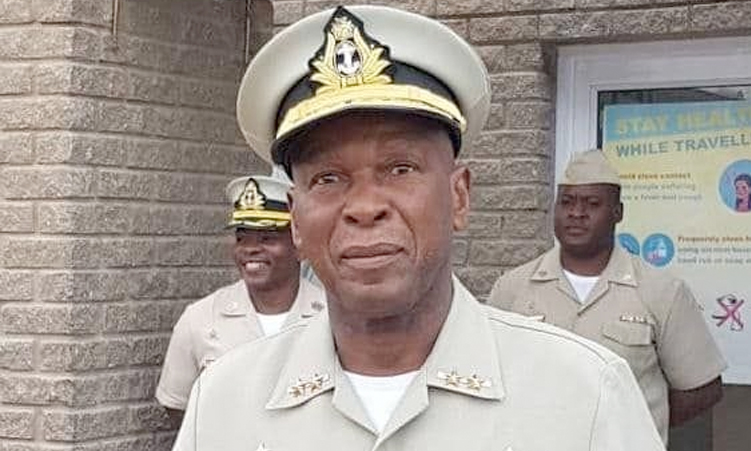




MATHIAS HAUFIKU and TILENI MONGUDHIPOLICE, military, and intelligence bosses were divided over a decision by acting chief of defence Martin Pinehas to deploy soldiers on Namibian streets in the name of national security.
understands that Pinehas’ attempt to impress president Hage Geingob for his possible promotion also played a key role in his declaring that the country’s security alertness was at its highest level after the elections last month.
Pinehas announced on 2 December that the defence force elevated the country’s security alertness to its highest level, and necessary measures are in place to protect national key points and citizens. This followed threats of unspecified action on social media platforms before the national elections.
Sources said Pinehas broke protocol, and involved the army in internal security affairs while there was no threat to the country’s national security.
It is alleged that he acted unilaterally, and his actions caused chaos and confusion within the country’s security cluster.
The security cluster consists of officials from the ministries of home affairs; justice; international relations; the Namibian Police; the Namibian Defence Force (NDF); the Namibian Central Intelligence Service (NCIS); and correctional services.
has learned that apart from the fact that Pinehas does not have powers to deploy soldiers into the streets, he also failed to follow the right procedures before making his decision.
Security sources insisted that the security threat, which prompted Pinehas to act, was allegedly either imaginary at worst, or exaggerated at best.
“It was based on a frivolous assessment,” said a source familiar with the matter.
also understands that police inspector general Sebastian Ndeitunga was invited to attend and co-address Pinehas’ media briefing, but declined the invitation.
Ndeitunga allegedly snubbed the invitation on grounds that he was not kept in the loop, as well as the fact that his principal, safety and security minister Charles Namoloh, was not briefed at Cabinet level about the said security threat.
Ndeitunga declined to comment when approached for comment last week, saying he was busy with electoral matters at the time of Pinehas’ statement.
He referred to the defence ministry.
A retired military officer told that when a security threat to the country is detected, it is dealt with at three different levels before it is made public or forces the security cluster to act on it.
The first level is the intelligence coordination committee, which is occupied by mid-level and senior officers from the police intelligence apparatus, military intelligence, and the Namibian Central Intelligence Service.
These officers share information on what they discover in their operations. Once this committee is satisfied that the potential threat requires attention or action, it is then forwarded to the national joint intelligence committee.
This is a committee comprising service chiefs, mainly the police, defence, correctional services and intelligence chiefs.
The services chiefs then refer their assessment to the Cabinet select committee on defence, security and international relations, which has the final decision on a said security threat.
This Cabinet committee also has the responsibility to decide on the action to be taken about a particular threat.
In this case, if the threat was credible, the committee would have instructed the police, which are responsible for internal and public safety in the country, to issue a statement, or take steps to contain the threat.
Law-enforcement and security sources told that these three committees were sidestepped when the military unilaterally decided to occupy civilian space.
“If they had their own investigations and threat assessments, they never shared it with the other agencies,” stated another security cluster source, who is well-vested with the work of the said committees.
Another structure is the president’s defence council, which is chaired by the president. In this structure, the president is allowed to appoint members who are not part of the country’s security structures to provide him with independent advice.
A senior government securocrat, however, defended Pinehas, saying the existence of all those structures are merely for administrative purposes.
He said Pinehas is empowered by defence legislation to act on security threats, provided the commander-in-chief has been briefed by the defence minister.
The Namibian was unable to get comment from any members of the Cabinet committee on defence and security. Home affairs minister Frans Kapofi refused to comment on security matters.
Safety and security minister Namoloh referred questions to prime minister Saara Kuugongelwa-Amadhila, who is the chairperson of the Cabinet committee. She did not respond to calls and SMSes sent to her.
Defence minister Penda ya Ndakolo did not answer his phone, while international relations minister Netumbo Nandi-Ndaitwah could also not be reached since last week.
In an age of information overload, Sunrise is The Namibian’s morning briefing, delivered at 6h00 from Monday to Friday. It offers a curated rundown of the most important stories from the past 24 hours – occasionally with a light, witty touch. It’s an essential way to stay informed. Subscribe and join our newsletter community.

The Namibian uses AI tools to assist with improved quality, accuracy and efficiency, while maintaining editorial oversight and journalistic integrity.
Stay informed with The Namibian – your source for credible journalism. Get in-depth reporting and opinions for
only N$85 a month. Invest in journalism, invest in democracy –
Subscribe Now!