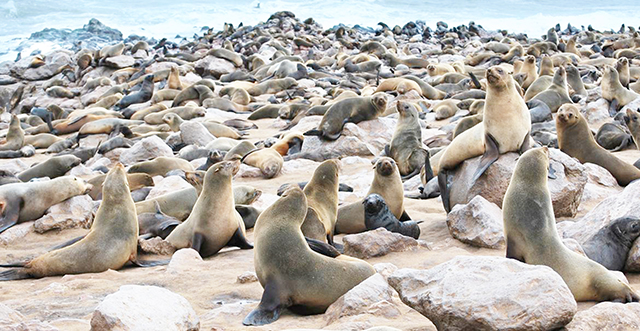
ON 1 July, the Ministry of Fisheries and Marine Resources started its annual seal harvesting season which runs for a total of five months, concluding on 15 November.
Over the years, activist groups, organisations and individuals have condemned the annual seal ‘culling’, citing brutality and animal cruelty as the reason for their staunch rejection of it.
By definition, culling is the process of reducing the population of (a wild animal) by selective slaughter.
Answering some questions posed by , the ministry said it prefers to place the emphasis on harvesting rather than culling because “our policy is to harvest, and not to cull.”
Furthermore, the ministry said the practice contributes to state revenue for national development programmes and is critical to the livelihood of the people and families directly involved in the harvesting.
“Namibia has a constitutional responsibility to use resources at its disposal for development and advancement of its people,” the ministry said.
The ministry claims that it is continuously monitoring the seal harvesting practice to ensure that it adheres to all relevant legislations, citing the Government Gazette ‘Regulations related to the exploration of marine resources of 2001’ of the Marine Resources Act.
“The process entails herding the pups from the large population and, upon settling, the pups are harvested as humanely as possible,” they said.
This debatably ‘humane’ process includes immobilizing and stabbing the seal pups swiftly to ensure that the animal is unconscious in no time, the ministry detailed.
“Mature animals are harvested with a rifle rendering them unconscious instantly, just like cattle in an abattoir,” they said.
Pups, on the other hand, are clubbed in the centre of the head and stabbed immediately thereafter.
It is this method that has put animal rights activists and the ministry at loggerheads over the years.
In 2012, the Office of the Ombudsman issued a report on these complaints, in which the positions of the various groups and organisations involved were presented. The ombudsman made a number of recommendations, some of which included amendments to the Marine Resources Act and revisions to the killing process.
He recommended an effective hitting/shooting, monitoring, bleeding out and implementation process, in which sealers would be trained and become competent in the procedures they use.
The ministry of fisheries said that keeping in line with these recommendations, they conduct an annual review of the harvesting practice and provide refresher courses for workers.
“The latest refresher course was conducted on 26 June at the ministry’s offices at Swakopmund and Lüderitz, with good attendance from operators,” they noted.
The ministry also assured that because of the fur seals standing on appendix II of the Convention on International Trade in Endangered Species (Cites), their sustainable and humane utilisation is ensured.
According to Cites, appendix II includes species not necessarily threatened with extinction, but in which trade must be controlled in order to avoid utilisation incompatible with their survival.
The ministry maintains that Namibia’s seal numbers do not demonstrate any threat of extinction.
“Our research indicates that the seal population in the Namibian waters is in a very healthy and growing state and thus their sustainability is not threatened under the current harvesting rates,” they wrote.
Furthermore, Namibia maintains a seal sanctuary at Cape Cross which, according to the Ministry of Environment and Tourism, is the world’s largest breeding colony of cape fur seals, with up to 210 000 seals present during the breeding season in November and December.
The environment and tourism ministry touts it as one of the country’s most visited parks.
The fisheries ministry also says the harvesting contributes to the growth of the tourism industry.
“The practice of harvesting is also harmonised with other national interests and sectors, such as tourism, that depends on the seals resource,’ they stated.
Furthermore, the harvesting process itself is an employment creator, the ministry details. The ombudsman’s analysis of the matter also came to the same conclusion.
“The short culling season provides part-time employment, however unpleasant it may be, to the poorest people in the community. Each employed person supports about seven members of their extended family,” the 2012 report noted.
Since about mid-June this year, when searching for ‘Namibia’ or ‘seals’ on social media, gruesome images of seals in pools of blood, hanging off meat hooks or foaming with milk out of their mouths pop up with pleas to ‘sign the petition or boycott the country altogether’.
has been able to determine that although real, the images circulating are from as early as 2013 and are not necessarily a depiction of the current situation on the ground.
As stated in the ombudsman’s report, the Namibian government has on several occasions invited anti-sealing proponents to meet and bring new ideas and proposals to the table to resolve the controversial issue; however, that call is yet to be heeded.
In an age of information overload, Sunrise is The Namibian’s morning briefing, delivered at 6h00 from Monday to Friday. It offers a curated rundown of the most important stories from the past 24 hours – occasionally with a light, witty touch. It’s an essential way to stay informed. Subscribe and join our newsletter community.

The Namibian uses AI tools to assist with improved quality, accuracy and efficiency, while maintaining editorial oversight and journalistic integrity.
Stay informed with The Namibian – your source for credible journalism. Get in-depth reporting and opinions for
only N$85 a month. Invest in journalism, invest in democracy –
Subscribe Now!