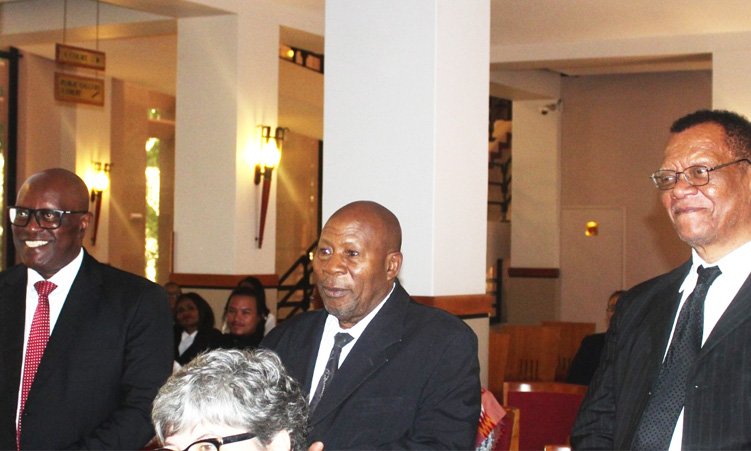





Minister of urban and rural development James Sankwasa has directed local authorities to stop allocating government-serviced land to private developers to ensure affordable housing for low-income citizens.
He says the decisions of government parastatals, including the National Housing Enterprise (NHE), should be guided by the land’s intended use.
“The NHE has a clear act which states that it builds houses for both low- and high-income groups, and therefore they can apply. However, no serviced land allocated to the NHE should be used for commercial purposes,” he says.
Sankwasa said this at the induction of regional and local authority councillors at Otjiwarongo yesterday.
“There is a difference between someone buying land to build their own house and someone buying a large serviced plot to build houses for commercial purposes,” he said.
Private investors cannot keep benefiting from land serviced by the government, he said.
Sankwasa said the formalisation of informal settlements in both urban and communal areas must be treated as a gateway to affordable housing and security of tenure.
He said private developers are targeting those who can afford houses of N$1.5 million or N$2 million, which is why no local authority should give serviced land to private developers.
Sankwasa said land serviced with public funds should not be used for developments that exclude the majority of citizens.
He said private developers who wish to operate commercially should service their own land and charge market related prices.
“Local authorities are currently losing revenue because people in informal settlements are not paying,” he said.
The minister believes issuing certificates of ownership would enable residents to use their land as collateral to access bank loans to build proper houses.
“They can take this certificate of ownership to the bank to borrow money to build a house,” he said.
The workshop, focusing on governance, land management and service delivery, will end on Friday.
Affirmative Repositioning Oshana region chairperson Angelina Immanuel says policy decisions of this magnitude must take into account the financial realities faced by local authorities.
“Private investors are not the enemy, they are partners in development. Councils depend on land sales and development partnerships to fund bulk infrastructure such as water, sewerage and roads. Transformation must be balanced with sustainability,” she says.
Immanuel says if the door is shut for investors without providing alternative funding, this effectively cuts budgets that allow councils to service land for low-income residents.
Independent Patriots for Change shadow minister of urban and rural development Armas Amukoto is in favour of the directive, saying private investors should develop their own land.
“Private investors have money, and in this case can develop their own land for commercial use,” he says.
In an age of information overload, Sunrise is The Namibian’s morning briefing, delivered at 6h00 from Monday to Friday. It offers a curated rundown of the most important stories from the past 24 hours – occasionally with a light, witty touch. It’s an essential way to stay informed. Subscribe and join our newsletter community.

The Namibian uses AI tools to assist with improved quality, accuracy and efficiency, while maintaining editorial oversight and journalistic integrity.
Stay informed with The Namibian – your source for credible journalism. Get in-depth reporting and opinions for
only N$85 a month. Invest in journalism, invest in democracy –
Subscribe Now!