



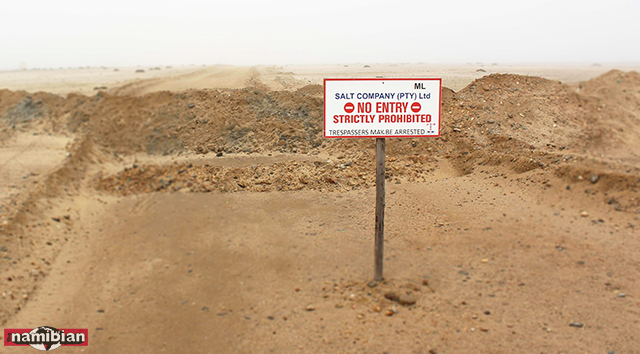
THE owners of the salt pans at Swakopmund recently fenced off their licence area to protect it from vandalism and littering, blocking all vehicle access.
This has resulted in restricted access to a stretch of beach that has been one of the most popular fishing spots for local recreational and subsistence anglers.
The fence has been erected on the southern border (at Mile 4) of the salt pans, only allowing space for pedestrians or those on bicycles to have access to the beach. Before that, anyone could drive through with any vehicle. To block access from the northern border (the old pump station), a trench was dug, heaps of earth placed, as well as large rocks put down on the beach to keep vehicles out.
Members of the community are not happy with this development, lamenting the impact it could have on the bread and butter of subsistence anglers.
Concerned community members indicated that they had brought this to the attention of the Swakopmund municipal council, but their plight was “just ignored”.
“We are disappointed that our councillors have sold the ocean – the same councillors we elected,” one person charged.
“We cannot fish anywhere anymore; all the beaches have ‘no fishing’ signs, or access is blocked. This is inhuman, because there are people who need to live from the fish and care for their families.”
Detlef Klein of the Salt Company at Swakopmund said any mining company has to limit access to its mine site. Salt production is considered an activity that falls under mining.
“We have been delaying the decision to block off the area for a long time now, but it has become necessary due to vandalism and littering. It is also dangerous, as there are 11 000 volt cables not deep underground, and any irresponsible behaviour can result in a dangerous situation,” he explained.
Klein added that more vehicles drove through the area, mostly to the beach, where people would angle and have picnics, or even drive around the pans and have ‘braais’ on the mine site too, damaging pump station infrastructure and making fires on top of live cables.
Besides this, the pans, which are also home to thousands of bird species as well as aquaculture activities, are being strewn more and more with litter.
“There is a lot of damage, and people just dump their rubbish there. When we confront and warn people that there are cables half-a-metre below, they just chase us away, and ask who we are to confront them,” said Klein.
He said he understood that the area was frequented by anglers.
“They can still come. There is access for people to enter by foot or bicycle. They can still go fishing; it’s just vehicles that cannot enter. People can also still go for walks, and walk their dogs. We don’t have a problem with people coming in, and we are aware of the complaints, but it is part of the deal”, he continued.
Klein stated that the Salt Company owns the pans, and that the property goes to the water’s edge – from the main road (Swakopmund to Henties Bay), to the beach “right to the low-water mark”.
A well-placed source at the municipality said while the owners of the land have a right to protect their property, consideration has to be made for access to the beaches and sea, which cannot be closed – or formal arrangements would have to be made with the necessary clearances from authorities, which may include the Ministry of Fisheries and Marine Resources, as well as the environment ministry.
Swakopmund municipality’s CEO, Alfeus Benjamin, told this newspaper that the measures of the salt company are being looked into, as there may be questions as to the legality of the fencing off – especially if it blocks access to the beach and sea.
In an age of information overload, Sunrise is The Namibian’s morning briefing, delivered at 6h00 from Monday to Friday. It offers a curated rundown of the most important stories from the past 24 hours – occasionally with a light, witty touch. It’s an essential way to stay informed. Subscribe and join our newsletter community.

The Namibian uses AI tools to assist with improved quality, accuracy and efficiency, while maintaining editorial oversight and journalistic integrity.
Stay informed with The Namibian – your source for credible journalism. Get in-depth reporting and opinions for
only N$85 a month. Invest in journalism, invest in democracy –
Subscribe Now!